
You crack the window. Maybe even open it all the way. And yet — the room still feels like a sealed box. The air sits heavy. You breathe in and it doesn’t feel like you’re getting anything. Maybe there’s a faint smell you can’t quite place, or the walls seem to close in a little. You’re not imagining it.
A stuffy room with an open window is one of those deeply annoying problems because it seems like it should be simple to fix. Fresh air equals better air, right? Not exactly. The reality of how air moves — or doesn’t — inside a bedroom is more complicated, and understanding what’s actually happening is the first step to fixing it for real.

Why Does My Room Feel Stuffy Even With the Window Open?
The short answer: opening a window only works if air can actually move. And in most rooms, it can’t.
Ventilation isn’t about having access to fresh air — it’s about airflow. That means air needs a way in and a way out. If your room only has one window and no other opening (a door crack, an air vent, a second window), you haven’t created airflow. You’ve created a window. The air outside hovers at the opening and doesn’t push through.
There are several specific reasons why this happens:
Pressure imbalances. Buildings and rooms develop slight pressure differentials based on temperature, wind direction, and HVAC activity. If the air pressure inside your room is equal to or higher than outside, fresh air won’t naturally flow in — it has nowhere to displace to.
Room orientation and wind direction. If your window faces a direction with little to no wind — like a shielded inner courtyard, a narrow alley, or a direction that’s calm during the hours you sleep — there’s no mechanical force pushing air inside. Wind is what drives passive cross-ventilation.
Outdoor humidity. On humid summer days, opening a window can actively make a room feel worse. You’re importing hot, moisture-saturated air that your room has no way to process. The result: the room feels heavier, stickier, and harder to breathe in, even with fresh air technically present.
Urban heat islands and outdoor pollution. If you live in a city with high ambient temperatures, poor outdoor air quality, or significant pollen, opening the window during peak hours can backfire. The «fresh air» coming in carries particulates, pollutants, or allergens that irritate the respiratory system and add to the sense of stuffiness.
Heat trapped in walls and furniture. Dense materials — concrete walls, heavy wooden furniture, thick rugs — absorb heat during the day and release it slowly overnight. Even with an open window, the radiated heat from these surfaces can make a room feel much warmer and heavier than the air temperature alone would suggest.
Insulation doing its job too well. Modern airtight homes are built for energy efficiency, which means they’re also built to trap everything inside — air, heat, moisture, and CO2. Without a mechanical ventilation system, even a well-insulated home can become suffocating.
Signs Your Bedroom Air Quality Is Worse Than You Think
Air quality problems rarely announce themselves clearly. Instead, they show up as patterns you brush off — fatigue you blame on stress, a headache you attribute to screen time, sleep that never feels restorative.
Here are the signals worth paying attention to:
- You wake up tired even after a full night’s sleep. Not just groggy — genuinely unrefreshed, like the sleep didn’t do much.
- Headaches in the morning that fade once you’re outside. This is a classic sign of CO2 accumulation or VOC buildup overnight.
- Dry, itchy eyes or a scratchy throat when you wake up. Can indicate low humidity, dust mites, or mold spores in the air.
- Congestion or a runny nose that clears up during the day. Your bedroom may be harboring allergens your immune system spends all night reacting to.
- Difficulty concentrating in the first hour or two after waking. Cognitive fog in the morning is often linked to CO2 exposure during sleep.
- A smell in the room you can only detect when you first enter. You stop noticing it after a few minutes, but guests always do — that’s a sign of stale, trapped air with VOCs or mold.
- The room feels «heavy» or harder to breathe in than the rest of the house. This isn’t metaphorical — thicker, warmer, more humid air literally has more resistance per breath.
- You sleep hotter in this room than anywhere else. Even with similar temperatures, rooms with poor airflow trap body heat and humidity from breathing and sweating.
If you recognize more than two or three of these, your room’s air quality deserves a closer look. These aren’t dramatic symptoms, but they compound over time — and most people have no idea their bedroom is the source.
Related: Signs Your Bedroom Air Quality Is Making You Tired
The Hidden Reasons Fresh Air Never Reaches Your Room
Even when a window is open, air can fail to circulate because of things inside the room. Most people don’t think about internal obstacles to airflow, but they matter enormously.
Furniture Blocking Airflow Pathways
Large wardrobes, bookshelves, or bed frames positioned near a window don’t just take up space — they create dead zones where air stagnates. The window might technically be open, but the furniture acts as a baffle, deflecting the little incoming air before it reaches the rest of the room. Air hugs the path of least resistance, and if that path is blocked, it simply doesn’t move.
Closed Interior Doors
This is one of the most underrated causes of stuffiness. Closing your bedroom door when you sleep essentially seals the room. Without an exit path, any air that comes through the window has nowhere to go, so pressure equalizes almost instantly and flow stops. Even leaving the door open two or three inches makes a meaningful difference in how air circulates through the house.
Curtains and Heavy Drapes
Thick curtains, particularly those that cover the full window frame and rest on the floor, can almost entirely cancel out an open window. They block the opening at floor level where heavier, cooler air enters, and at the top where warmer air exits. Sheer or split curtains are a simple upgrade that preserves privacy while allowing real airflow.
Fans Used in the Wrong Direction
A fan blowing into the room seems logical, but it can create turbulence rather than real airflow — especially if there’s no exit point for the air it’s pushing in. Fans are most effective when positioned to exhaust air out (pushing stale air outward), which creates a slight negative pressure that draws fresh air in from other openings. Alternatively, positioning a fan diagonally across the room — not directly in front of the window — moves air across the space more efficiently.
Dirty or Blocked Vents
If your home has any kind of HVAC, air return vents, or even simple exhaust fans, a clogged or dusty vent silently kills airflow. These are often behind furniture, forgotten, and packed with years of lint and dust. A vent that’s 60% blocked barely functions, yet nobody thinks to check.
Negative Pressure from Kitchen or Bathroom Fans
Running exhaust fans in other parts of the house can pull air away from your bedroom, creating a suction effect that fights against your open window. It’s a strange dynamic, but the air physics of a home are interconnected. If the kitchen fan or bathroom exhaust is running while your window is open, you might actually be making airflow worse in your room.
CO2 Buildup Indoors Can Make You Feel Exhausted
This one doesn’t get nearly enough attention, and it should.
When you breathe, you exhale CO2. In a sealed or poorly ventilated room, CO2 concentrations build up over hours — and they build up faster than most people realize. Outdoor CO2 levels hover around 400–420 ppm (parts per million). A bedroom with two sleeping people and minimal ventilation can reach 1,500–2,500 ppm by morning.
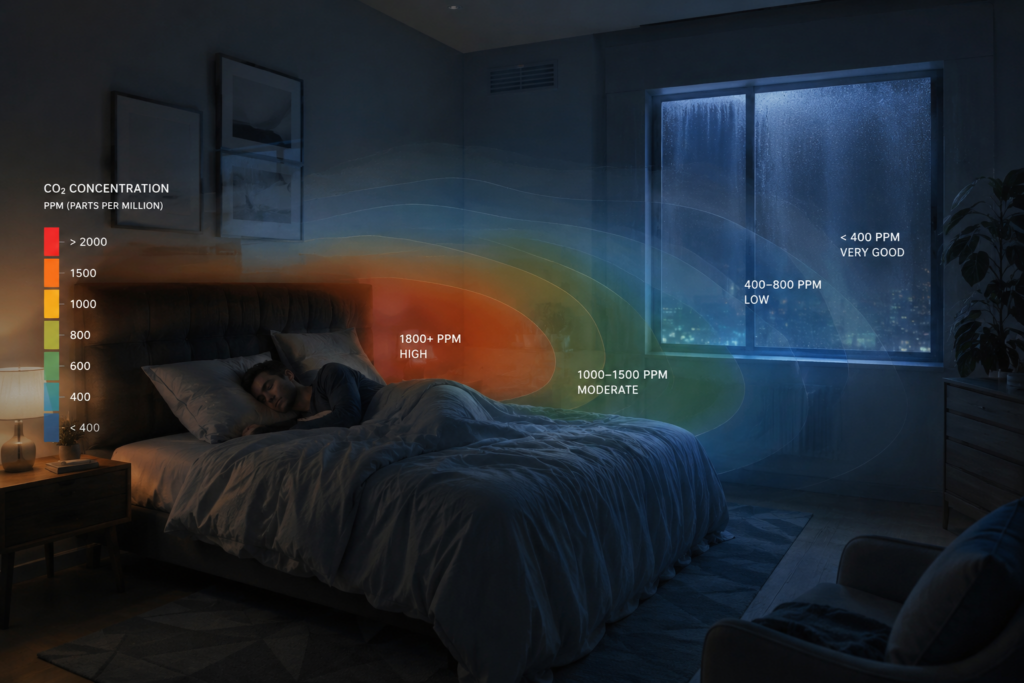
Research published in environmental health journals consistently shows that at levels above 1,000 ppm, people begin experiencing measurable drops in cognitive function — slower thinking, reduced decision-making capacity, and increased fatigue. Above 1,500 ppm, these effects are significant. The EPA and ASHRAE recommend maintaining indoor CO2 below 1,100 ppm for occupied spaces.
The bedroom is the worst-case scenario for CO2 accumulation:
- You spend 7–9 hours in a relatively small, enclosed space
- Your body produces CO2 continuously throughout the night
- The door is often closed
- Ventilation is minimal (especially in winter)
- CO2 is heavier than air and settles near floor level — right where you’re sleeping
The result: you sleep «fine» by your clock, but the quality of that sleep degrades as CO2 rises through the night. You enter lighter sleep stages more frequently. You toss and turn. You wake up feeling like you barely slept — which, in terms of cognitive restoration, is closer to the truth than you’d think.
The fix isn’t complicated: keep the bedroom door cracked or fully open, run a small fan to create circulation, and crack a window even slightly before sleep. A CO2 monitor (affordable ones exist for around €30–60) will genuinely shock you the first time you check it in the morning.
Related: Why Do I Wake Up With a Dry Mouth Even After Drinking Water
Humidity Can Make Air Feel Heavy Even If The Temperature Is Fine
You might be checking the thermometer and thinking — it’s not that hot in here. But heat and humidity are two different things, and the body responds to both simultaneously.
The human body cools itself by sweating. Sweat works when it evaporates — and evaporation requires the surrounding air to have capacity to absorb moisture. When humidity climbs above 60%, that capacity shrinks. Your sweat doesn’t evaporate efficiently. You feel hot and sticky even in moderate temperatures. The air itself feels thicker. This is exactly what «stuffy» often means physiologically — it’s not just temperature, it’s the air’s inability to absorb what your body is trying to release.
The comfortable indoor humidity range is 40–60%. Below 40%: dry eyes, irritated airways, cracked skin. Above 60%: sticky air, mold risk, worsened asthma and allergy symptoms. Most people have no idea what their bedroom’s humidity is, and many bedrooms run consistently above 65% in summer.
Common summer ventilation mistakes that worsen humidity:
- Opening windows during the hottest, most humid part of the day (typically midday to mid-afternoon)
- Not using a dehumidifier in basements or ground-floor rooms
- Drying laundry inside the bedroom
- Not ventilating after showers — bathroom humidity migrates through the house
- Having too many houseplants concentrated in a small room (plants transpire moisture)
A basic hygrometer tells you exactly what you’re dealing with. If your room consistently reads above 60%, addressing humidity is more impactful than any window-opening strategy.
Simple Ways to Improve Airflow in a Bedroom Naturally
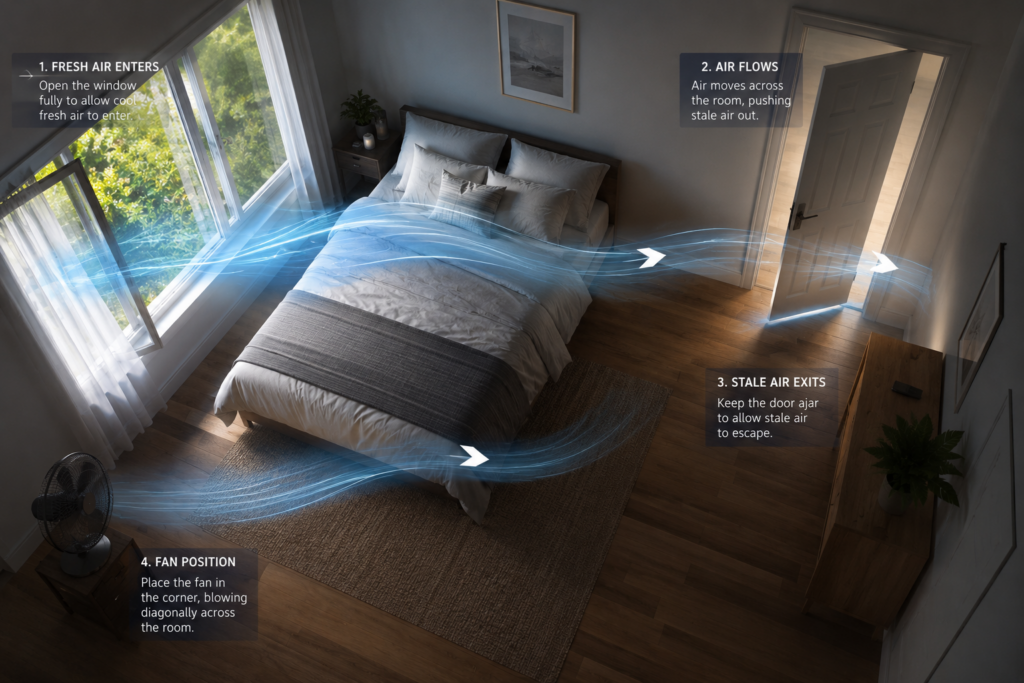
The goal is to stop thinking about ventilation as «open a window» and start thinking about it as creating a circuit for air to travel.
Set Up Cross Ventilation
Cross ventilation requires two openings on opposite sides of a space — one for air to enter, one for it to exit. The most effective setup: bedroom window partially open, bedroom door open or ajar, and a window or vent in another room providing the exit point. Air follows this path passively if there’s any outdoor breeze at all.
If your layout doesn’t allow for true cross ventilation, create a one-way circuit: open window, door cracked, ceiling fan or stand fan positioned across the room to push air toward the door opening.
Position Your Fan Correctly
Put the fan facing outward through the window during the hottest parts of the day — this exhausts hot indoor air and creates a draft that pulls cooler outdoor air through other openings. At night, rotate it inward to draw cooler outdoor air into the room, positioning it diagonally so it circulates across the entire space rather than just blowing straight at the bed.
Leave Interior Doors Open When You Sleep
If safety allows, leave bedroom and hallway doors open. The improvement in air circulation is immediate and significant. If privacy is a concern, door stops that keep doors cracked 2–4 inches achieve most of the benefit.
Reduce Fabric Mass in the Room
Heavy curtains, multiple thick rugs, and an excess of upholstered furniture all absorb humidity and trap particulates. Switching to lighter curtains, washable cotton rugs, or bare flooring improves airflow and air quality more than most people expect.
Time Your Window Use Strategically
In summer: open windows early morning (5–8 AM) when outdoor air is coolest and least humid. Close them during midday heat. Reopen in late evening once outdoor temperature drops. This single habit can reduce indoor temperature by several degrees and significantly cut humidity.
Check and Clean Air Vents and Filters
If your room has any mechanical ventilation — even a bathroom-adjacent vent — clean it. Dust-clogged vents can reduce airflow by 50% or more. HVAC filters should be changed every 1–3 months depending on usage.
Consider a Small Dehumidifier
For rooms that consistently read above 60% humidity, a compact dehumidifier (400–700ml water capacity, designed for bedrooms) makes a noticeable difference within hours. Running it for 2–3 hours before sleep creates a measurably different sleeping environment.
When a Stuffy Room Might Be a Bigger Problem
Occasionally, persistent stuffiness is a symptom of something that needs more than ventilation tweaks.
⚠️ Warning Signs That Go Beyond Poor Ventilation
- A persistent musty, earthy, or sour smell even after airing the room out
- Visible condensation on windows or walls regularly (not just winter)
- Dark spots appearing on walls, ceiling, or around window frames
- Allergy or asthma symptoms that reliably worsen at home but improve elsewhere
- Peeling wallpaper, bubbling paint, or warped wood — signs of moisture intrusion
- A smell that returns within days of cleaning or airing out
- Chronic respiratory symptoms in everyone who regularly sleeps in the room
Any of these could point toward mold growth, water damage, or a failing HVAC system. Mold doesn’t need visible damp patches to cause air quality problems — it can grow inside walls, under flooring, or behind furniture with only moderate moisture over time. The CDC notes that mold exposure is linked to respiratory symptoms, headaches, and chronic fatigue in otherwise healthy people.
If you’ve tried everything in this article and your room still feels stuffy — especially if it smells — it’s worth consulting a building professional or having the air tested. Persistent condensation in winter often indicates inadequate insulation or thermal bridging that creates cold spots where moisture accumulates.
| Ventilation Method | Cost | Effectiveness | Best For | Limitations |
|---|---|---|---|---|
| Opening one window | Free | Low | Mild weather | No airflow without exit point |
| Cross ventilation (2 openings) | Free | High | Most situations | Needs proper layout |
| Window + door cracked | Free | Medium-High | Night ventilation | Noise/privacy trade-off |
| Box fan (exhaust position) | €20–50 | High | Hot weather | Noise |
| Ceiling fan | €60–200 | Medium | Year-round | Moves air, doesn’t exchange it |
| Portable dehumidifier | €60–150 | High (humidity) | Humid climates | Doesn’t exchange air |
| Air purifier with HEPA | €80–300 | Medium | Allergens / VOCs | No CO₂ reduction |
| HRV / ERV system | €800–2000 | Very High | Airtight homes | Installation required |
If you look at the table above, one pattern becomes pretty obvious: the most effective solutions usually aren’t the most complicated — they’re the ones that actually improve air movement inside the room.
For most people, the biggest difference comes from combining proper cross ventilation with one extra tool that targets the real problem. A box fan can help push trapped warm air out much faster, while a dehumidifier is often the best option if the room feels sticky or heavy even when the temperature looks normal. If the issue is dust, allergies, or pollution from outside, a HEPA air purifier usually makes the room feel noticeably fresher within a few nights.
The good news is that you don’t necessarily need an expensive setup. Even small changes in airflow can completely change how a bedroom feels, especially during sleep.

Quick Bedroom Air Quality Checklist
✅ Bedroom Air Quality Action Checklist
Quick Fixes That Actually Work
💡 Fast Improvements You Can Make Today
- Open the bedroom door at night — even 3 inches changes everything
- Point a fan diagonally across the room, not straight at the window
- Move any furniture that’s within 30cm of a window or vent
- Switch heavy curtains to lightweight ones or tie them back fully
- Buy a hygrometer (€8–15) — knowing your humidity is step one
- Open windows between 5–8 AM before humidity peaks, close by 10 AM
- Check behind the bed and wardrobe for dark spots or musty smell
FAQ
Q: Why does my room feel stuffy even with the window open at night?
Because one open window creates access, not airflow. At night, outdoor wind is often lighter, meaning there’s no force to push air through. CO2 from breathing also accumulates. Leave the door cracked and use a fan to create active circulation rather than relying on passive breeze.
Q: Can a stuffy room cause headaches?
Yes, and this is well-documented. Elevated CO2 levels, VOC buildup, and reduced oxygen-to-CO2 ratio in poorly ventilated spaces all contribute to headaches. If your headaches consistently appear in the morning and fade once you’re outside or in a different room, ventilation is almost certainly a factor.
Q: What humidity level should a bedroom be?
40–60% is the recommended range for both comfort and health. Above 60%, mold risk increases and air feels sticky and heavy. Below 40%, mucous membranes dry out and irritation increases. A basic hygrometer tells you exactly where you stand.
Q: Is it bad to sleep with the window open all night?
For most people in most climates, no — it’s generally beneficial. The exceptions are: high outdoor pollen seasons (if you have allergies), high urban air pollution, or nights where outdoor humidity significantly exceeds indoor levels. A small fan near the window helps maintain airflow without relying on wind alone.
Q: How do I know if my room has mold affecting air quality?
Mold often presents as a musty or earthy smell that returns quickly after airing out the room, visible dark spots on walls or ceilings (especially near windows and in corners), and respiratory or allergy symptoms that improve when you’re away from home. A professional air quality test can confirm mold presence without visible growth.
Q: Does air purifier help with stuffiness?
An air purifier with a HEPA filter reduces particulates, allergens, and some VOCs — useful for air quality, but it doesn’t address CO2 buildup or lack of airflow. For stuffiness, ventilation comes first. An air purifier is a complement, not a substitute.
Q: Why does my room feel stuffy in winter even with a heater on?
Heating dry air raises its capacity to hold moisture while simultaneously reducing actual humidity (a classic dry winter effect). The stuffiness in winter is often a combination of low humidity (under 35%), elevated CO2 from keeping windows closed, and VOC off-gassing from textiles and furniture warmed by the heater. Crack a window slightly and consider a humidifier.
Final Thoughts
A stuffy room is rarely one thing. It’s usually a combination — an unhelpful layout, an open window with no exit, CO2 building up overnight, humidity sitting too high, or furniture quietly blocking the air you’re trying to bring in. The good news is that most of these are solvable without spending much money or effort.
The starting point is always the same: measure before you guess. A €10 hygrometer and an affordable CO2 monitor tell you more in 24 hours than any process of trial and error. Once you know what you’re actually dealing with — humidity, airflow, CO2, or something structural — the fixes become obvious.
Your bedroom is where your body does most of its recovery. The air in it deserves more attention than it usually gets.
*Disclosure: Some of the links on this site are affiliate links. This means that if you choose to make a purchase through them, we may earn a small commission at no additional cost to you. We only recommend products or tools that are relevant to the content and that we believe can provide value. This helps support the site and allows us to continue creating useful, free content.