
You go to bed feeling okay. You wake up feeling like someone spent the night tightening a vice around your lower back.
Sound familiar?
For millions of people, sleep is supposed to be recovery time — but it quietly makes back pain worse instead. Not because of what you’re doing during the day. Because of how you’re spending those 7–8 hours flat on a mattress.
The good news: changing how you sleep can genuinely reduce lower back pain. Not as a miracle fix — but as one of the most underrated, zero-cost tools you already have access to.
This guide explains exactly why certain positions hurt you, how spinal alignment and pelvic tilt affect your discs and muscles overnight, and what you can actually do starting tonight.
Quick Answer
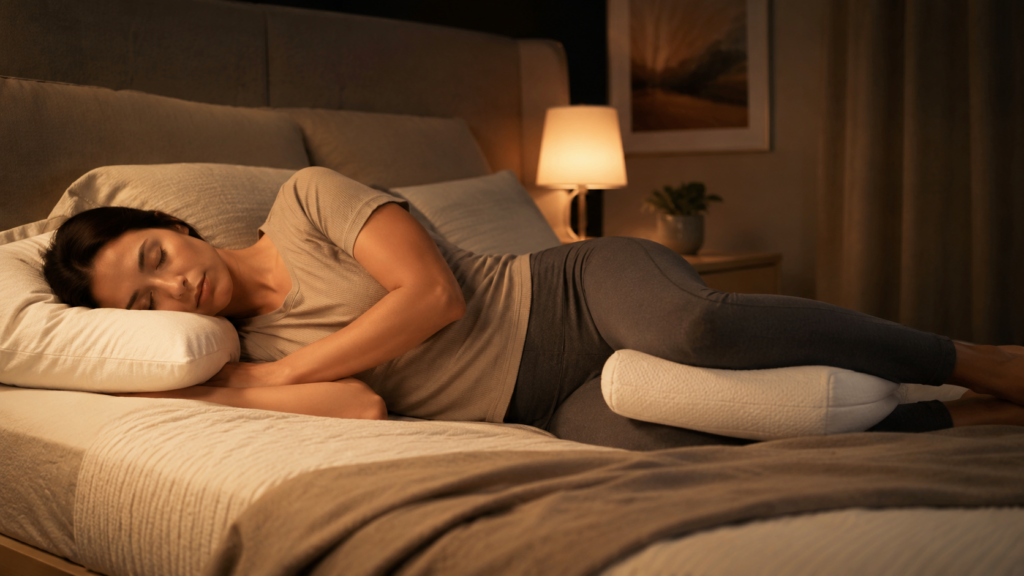
The best sleeping position for lower back pain is
side sleeping with a pillow between your knees
— because it prevents your pelvis from rotating, keeps your spine in neutral alignment, and takes pressure off your lumbar discs while your muscles fully relax.
But the «best» position ultimately depends on your specific type of pain, and we’ll break that down below.
Why Your Sleeping Position Can Make Lower Back Pain Worse
Most people don’t think twice about how they sleep. You collapse into bed, fall asleep, and trust that your body knows what to do.
But here’s the thing: your spine doesn’t get a break at night. It still has to deal with gravity, muscle tension, and poor positioning — just for 7+ hours straight instead of 30 seconds.
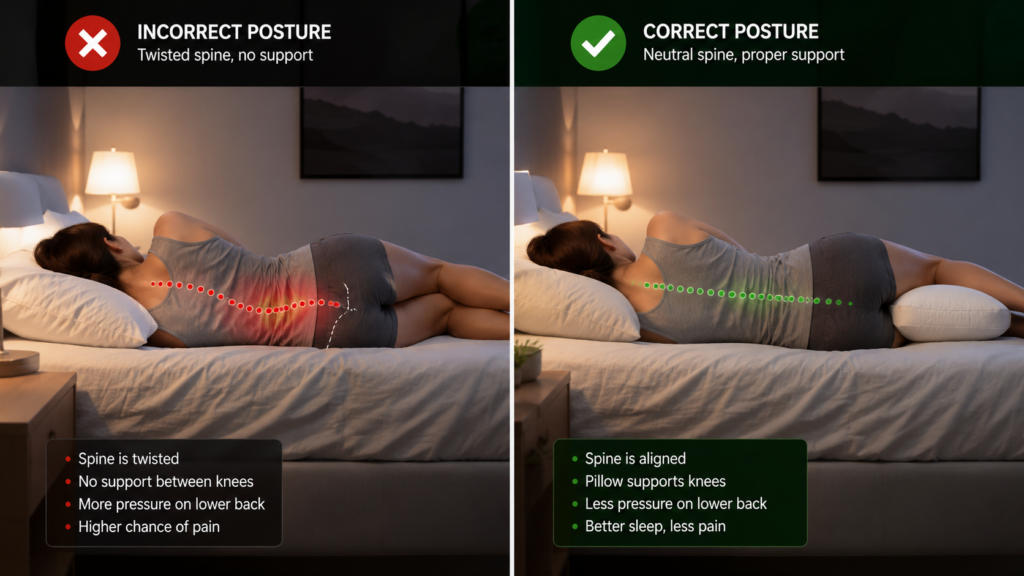
When your sleep posture misaligns your spine, a few things happen:
- Lumbar discs absorb uneven pressure. Discs are mostly water. When they’re compressed incorrectly for hours, they don’t rehydrate properly — contributing to that crushing stiffness in the morning.
- Muscles stay in a low-grade contraction. If your pelvis tilts forward or to one side, nearby muscles (hip flexors, erector spinae, piriformis) stay partially engaged instead of fully releasing.
- Joints get loaded in non-neutral positions. Facet joints in the lumbar spine are highly sensitive to rotation and extension. Certain positions put constant stress on these joints all night.
The result? You wake up not just tired — but in pain that wasn’t there when you went to bed.
The Lumbar Pressure Problem Nobody Talks About
Standing up, your lumbar spine carries significant load — roughly half your body weight plus any movement you add to it.
Lying down should reduce that. And it does — but only if your alignment is decent.
A 1999 study published in The Lancet and frequently referenced in ergonomics research found that the medium-firm mattress group reported significantly less pain than those on firm mattresses — pointing to the fact that pressure distribution during sleep is a real, measurable variable.
The key isn’t just softness or firmness. It’s whether your spine stays in its natural curve while the rest of your body is supported.
Best Sleeping Positions for Lower Back Pain Relief
Let’s go position by position — with the real reason each one helps or hurts.
Side Sleeping: Why It Helps Most People
Side sleeping is the most common position worldwide. And for lower back pain, it’s generally the most forgiving — when done right.
Here’s why it works:
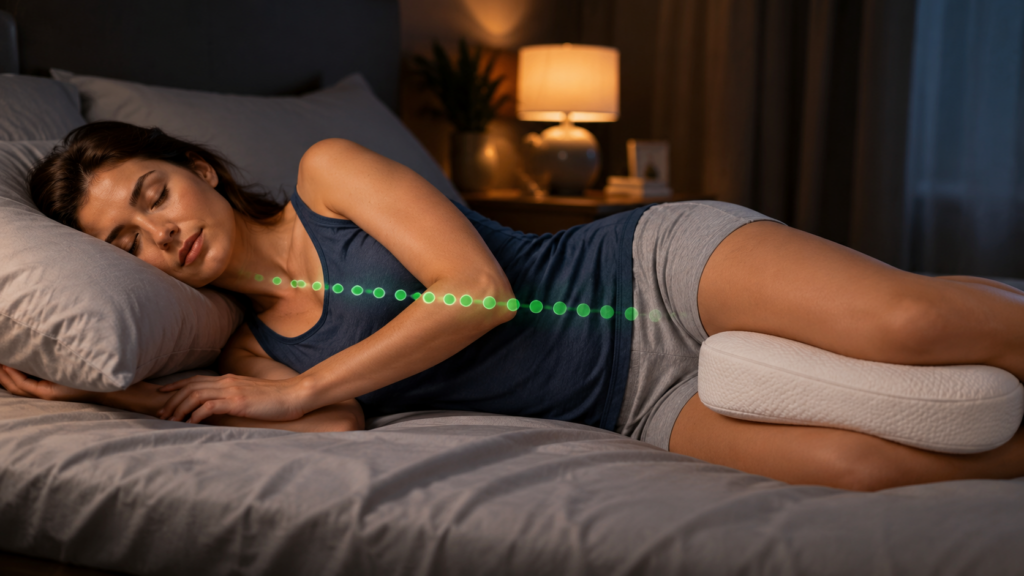
When you lie on your side with your knees slightly bent (fetal-ish but not fully curled), your lumbar spine can maintain something close to neutral curvature. The key word is close — because without support, your top knee tends to drop forward, dragging the pelvis with it and creating a rotational torque in the lumbar region.
That’s where the pillow between the knees changes everything.
Placing a firm pillow (or a wedge pillow) between your knees keeps your hips stacked, prevents pelvic rotation, and takes the tension out of your piriformis and iliotibial band — two structures that are deeply connected to lower back pain.
Which Side Should You Sleep On?
For general lower back pain: either side works, as long as you use pillow support.
For sciatica or nerve pain radiating down one leg: many people find relief sleeping on the opposite side from the pain — it takes pressure off the affected nerve root. Though individual results vary, and you should experiment.
For pregnancy: left side is typically recommended for circulation reasons — but that’s a separate conversation.
Side Sleeping Checklist
Sleeping on Your Back: Good or Bad?
Sleeping on your back gets a lot of praise in ergonomics circles — and it deserves it, under the right conditions.
When you lie flat on your back, your weight is distributed across the largest surface area of your body. There’s no rotational stress on the spine. The lumbar curve can be maintained if the mattress is supportive.
The catch: most people who sleep on their back let their legs lie flat — and this subtly flattens the lumbar curve, tightening the hip flexors and increasing pressure on the lumbar facet joints.
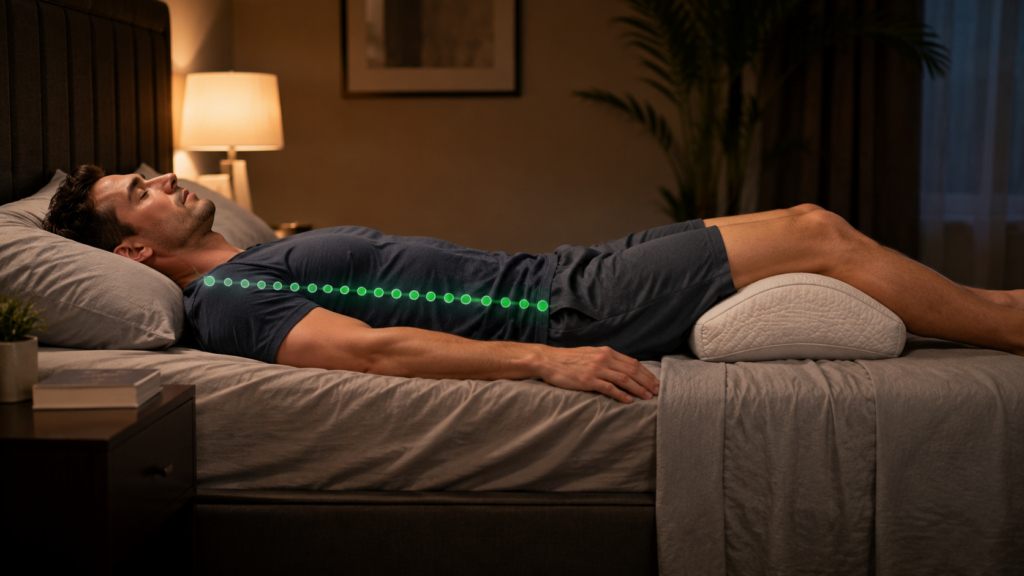
The fix is simple: a pillow under the knees.
Bending the knees just slightly (15–30 degrees) releases tension in the hip flexors and allows the lumbar spine to rest in its natural curve instead of being pulled flat.
When Back Sleeping Doesn’t Help
Back sleeping can actually increase pain if:
- You have spinal stenosis (narrowing of the spinal canal) — the slight extension of lying flat can compress the canal further. These patients often feel better curled forward.
- You have sleep apnea — lying on the back worsens airway collapse, which has indirect effects on pain and inflammation.
- Your mattress is too soft — it lets your hips sink, arching your lower back upward.
Why Sleeping on Your Stomach Often Causes Problems
This one is hard to hear for stomach sleepers. But sleeping face-down is consistently the worst position for lower back pain — for a specific mechanical reason.
When you lie on your stomach:
- Your head must rotate to one side to breathe — creating sustained cervical rotation.
- Your lumbar spine is pushed into hyperextension (excessive inward curve) by the weight of your abdomen.
- Your hip flexors — already tight in most adults from sitting — get shortened further.
- Your gluteal muscles can’t engage to stabilize the pelvis.
The result is increased compression on the posterior elements of the lumbar spine — the facet joints, the spinous processes, and the nerve roots exiting between vertebrae.
If You Can’t Stop Stomach Sleeping
Some people have slept this way their whole lives and genuinely struggle to change. In that case:
- Put a flat pillow under your pelvis/abdomen (not your head). This reduces the degree of lumbar hyperextension significantly.
- Use a very flat pillow for your head — or none at all.
- Work on side sleeping gradually: start with a body pillow in front of you to give your arms and top leg something to rest against.
The Best Pillow Placement for Lower Back Pain
Pillows are an underrated tool. The right placement can transform a mediocre sleeping position into a supportive one.
| Sleeping Position | Where to Place Pillow | Why It Helps |
|---|---|---|
| Side sleeper | Between knees | Prevents pelvic drop and spinal rotation |
| Back sleeper | Under knees | Releases hip flexors, maintains lumbar curve |
| Back sleeper (arch pain) | Small pillow under lumbar area | Fills the gap between lower back and mattress |
| Stomach sleeper | Under pelvis/abdomen | Reduces lumbar hyperextension |
| Side sleeper (shoulder pain) | Body pillow in front | Supports top arm, reduces shoulder drop |
One underrated tip: If you’re a back sleeper and your lower back still aches, try a small rolled towel tucked under the lumbar curve. It’s cheap, adjustable, and surprisingly effective.
Mattress Firmness and Lower Back Pain
«Get a firm mattress for back pain» is advice that’s been passed around for decades. It’s not entirely wrong — but it’s not entirely right either.
Here’s the nuance:
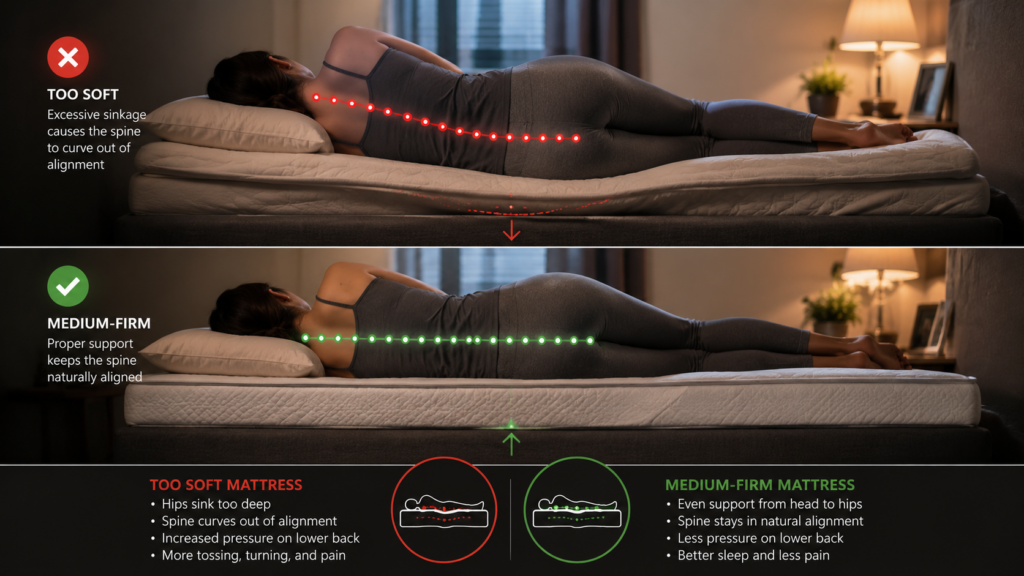
Too soft: Your hips sink deeper than your shoulders, creating a U-shaped curve that stresses the lumbar joints.
Too firm: Your spine has no give at all — your hips and shoulders don’t compress into the mattress, forcing your lumbar region to bridge over a hard surface.
Medium-firm: Generally the sweet spot for most people with lower back pain, according to research cited by the American Academy of Sleep Medicine.
The Body Weight Factor
Your ideal firmness also depends on your size:
- Lighter body weight (under 130 lbs): A slightly softer surface works better — you need it to contour without sinking.
- Average weight (130–230 lbs): Medium to medium-firm is the consensus.
- Heavier (230+ lbs): Firmer support is usually needed to prevent the hips from sinking too deep.
Sciatica vs General Lower Back Pain: Different Sleeping Needs
Not all lower back pain is the same — and this distinction matters for sleep position.
General Lumbar Muscle Pain
Usually feels like diffuse aching, stiffness, or tightness across the lower back. Often worse in the morning, eases after moving around.
Best positions: Side sleeping with knee pillow, or back sleeping with pillow under knees.
Sciatica
Sciatic pain travels — down the buttock, into the thigh, sometimes all the way to the foot. It’s nerve pain caused by compression or irritation of the sciatic nerve, often at the L4–L5 or L5–S1 level.
For sciatica, position matters more precisely:
- Side sleeping on the unaffected side usually reduces nerve tension.
- Fetal position (on the non-painful side) opens the intervertebral foramen slightly, giving the nerve root more space.
- Back sleeping with knees elevated can also reduce pressure on the nerve root.
If you’re dealing with sharp, shooting, or burning leg pain, this may be related to nerve compression rather than just muscle tension. The Mayo Clinic has a solid overview of sciatica symptoms and causes.
You might also want to read our guide on Lower Back Pain: 7 Simple Fixes That Actually Work for complementary daytime strategies.
Morning Back Stiffness: Why It Happens
You slept 8 hours. You wake up and it takes 20 minutes before you can stand fully upright. Why?
Several things happen during sleep that explain this:
1. Disc rehydration Intervertebral discs absorb fluid while you’re lying down (less gravity = more rehydration). In the morning, your discs are slightly more engorged than during the day — which can temporarily increase stiffness.
2. Inactivity stiffens joints and muscles Synovial fluid in joints needs movement to stay circulating. Sleeping still for hours reduces joint lubrication. Muscles also cool and tighten without movement.
3. Inflammatory cycles For people with inflammatory lower back conditions (like ankylosing spondylitis), morning stiffness lasting over 30 minutes is a hallmark symptom. If this is you, the problem isn’t just your sleeping position — it may need medical evaluation.
4. Prolonged positions create adaptive tension If you slept in a slightly twisted or extended position for 7 hours, your soft tissues adapted to that shape. Moving away from it suddenly produces that familiar morning pain.
The Fix: Don’t Jump Out of Bed
Before getting up:
- Bring both knees to your chest for 20–30 seconds (gentle lumbar flexion)
- Roll slowly onto your side
- Use your arms to push up, letting your legs swing down
This matters more than it sounds. Jerking upright from a lying position is one of the most common ways people aggravate a lower back injury.
Common Sleeping Mistakes That Quietly Make Back Pain Worse
| ❌ The Mistake | ⚠️ Why It Hurts | ✅ The Fix |
|---|---|---|
| Sleeping with phone propped up in bed | Neck flexion + trunk twist increases lumbar tension | Phone away 30 min before sleep |
| Pillow too high or too flat for side sleeper | Head angle causes cervical-thoracic compensation that ripples down | Pillow height = gap between ear and mattress |
| Sleeping fully curled (tight fetal) | Sustained lumbar flexion compresses anterior disc | Loosen the curl — partial fetal only |
| Old mattress with sag in the middle | Creates lateral pelvic tilt all night | Replace or add a mattress topper |
| Watching TV on couch before bed (slouched) | Pre-loads lumbar flexion before sleep position | Use a floor cushion or armchair with support |
| Sleeping after intense evening workout | Muscles inflamed, sleep interruptions increase cortisol | Gentle stretching before bed instead |
Simple Night Routine to Reduce Lower Back Tension Before Sleep
This takes 10 minutes. It works. No equipment needed.
Step 1: Hip Flexor Release (2 minutes)
Kneel with one knee on the floor (on a mat or folded blanket). Shift your weight forward gently until you feel a stretch in the front of the trailing hip. Hold 60 seconds per side. This counters the hip flexor shortening from sitting.
Step 2: Knee-to-Chest Stretch (2 minutes)
Lie on your back. Bring both knees to your chest and hold them gently for 30–45 seconds. This creates gentle lumbar flexion and can decompress tight facet joints.
Step 3: Supine Twist (2 minutes)
Still on your back, drop both knees to one side while keeping shoulders flat. Hold 30–45 seconds per side. Reduces rotational tension in the lumbar and thoracic region.
Step 4: Set Up Your Sleep Position (1 minute)
Don’t just collapse. Actually place your pillow(s) before you close your eyes:
- Pillow between knees (side sleeper)
- Pillow under knees (back sleeper)
- Flat pillow under pelvis (stomach sleeper, if you must)
This 10-minute habit can meaningfully reduce the morning stiffness you’ve normalized.
If neck tension is part of your picture, you might also find value in our guide: Neck Pain After Sleeping? 6 Causes (And How to Fix It Tonight).
Sleeping Position Comparison at a Glance
| 🛌 Position | ⭐ Overall Rating | ✅ Best For | ⚠️ Avoid If |
|---|---|---|---|
| Side (pillow between knees) | ⭐⭐⭐⭐⭐ | General LBP, sciatica, pregnancy | Shoulder impingement (modify) |
| Back (pillow under knees) | ⭐⭐⭐⭐ | Disc issues, general LBP | Spinal stenosis, sleep apnea |
| Fetal (modified) | ⭐⭐⭐ | Sciatica, disc herniation | Tight curl worsens disc pressure |
| Stomach (no support) | ⭐ | — | Almost everyone with LBP |
| Stomach (pelvis pillow) | ⭐⭐ | Habitual stomach sleepers (transition) | Herniated disc, sciatica |
When Back Pain During Sleep May Need Medical Attention
Most sleep-related lower back pain is mechanical — meaning it’s about posture, tension, and alignment. But some signs warrant a conversation with a doctor:
- Pain that wakes you up at night (not just stiffness in the morning)
- Pain that doesn’t improve at all with position change
- Back pain with fever, unexplained weight loss, or bladder/bowel changes
- Severe sciatica with weakness in the leg or foot drop
- Morning stiffness lasting more than 45–60 minutes consistently (possible inflammatory arthritis)
None of this is meant to alarm you. The vast majority of lower back pain cases are benign. But if any of the above sound familiar, the Cleveland Clinic’s overview of back pain warning signs is a good place to start.
For shoulder-related sleep pain, our article Why Do My Shoulders Hurt After Sleeping? covers complementary territory.
Full Night Checklist — Better Sleep for Lower Back Pain
🌙 Before bed
🛌 Your position
☀️ Getting up
📆 Longer term
FAQ — Frequently Asked Questions
What is the best sleeping position for lower back pain?
Side sleeping with a firm pillow between the knees is widely considered the best position for lower back pain. It reduces pelvic rotation, keeps the spine in neutral alignment, and takes pressure off lumbar discs. For some people, back sleeping with a pillow under the knees is equally effective — it depends on your specific pain pattern and anatomy.
Why does my lower back hurt more after sleeping?
Morning lower back pain usually comes from one of three things: prolonged muscle tension during sleep (often from poor positioning), disc rehydration overnight causing temporary stiffness, or an inflammatory condition. If you consistently wake up with sharp or severe pain — rather than dull stiffness — it’s worth checking with a healthcare provider.
Is sleeping on a firm mattress better for back pain?
Not necessarily. Research, including a study referenced by the Sleep Foundation, suggests medium-firm mattresses outperform both very firm and very soft options for most back pain sufferers. The key is that your spine stays in a neutral position — neither sagging into a U nor bridging over a hard surface.
Can sleeping on your stomach cause lower back pain?
Yes. Stomach sleeping pushes the lumbar spine into hyperextension (excessive inward curve), compresses facet joints, and shortens already-tight hip flexors. If you can’t break the habit, place a flat pillow under your pelvis to reduce the lumbar arch, and use little or no head pillow.
What’s the best sleeping position for sciatica?
Most people with sciatica find relief sleeping on their side — specifically the side that is NOT in pain. This reduces tension on the irritated nerve root. A modified fetal position (knees gently pulled up, not tightly curled) on the non-painful side can also open the foraminal space where the nerve exits, reducing compression.
How long should I try a new sleeping position before giving up?
Give it at least 2–3 weeks. Changing a sleep habit is uncomfortable at first — your body has adapted to its usual position, and switching feels unnatural. Use pillows to support the new position, and accept that the first few nights might not feel great. Most people notice a meaningful difference within 2–3 weeks if the position change was the right call.
Could my pillow be causing lower back pain?
Indirectly, yes. A pillow that’s too high or too low causes your head and neck to angle awkwardly — and your thoracic and lumbar spine compensate. For side sleepers, the pillow should fill the gap between your ear and shoulder completely. If you’re using a pillow that was never right for your sleeping position, switching can reduce overall spinal tension — including in your lower back.