
Processed meat health risks are often ignored because these foods are part of everyday life. Most people eat them without thinking, in sandwiches, breakfasts or quick meals.
But what feels normal could be quietly draining your energy and affecting your long-term health.
And that’s where the problem starts.
What are you actually eating?
We’re talking about processed meat.
Foods like bacon, sausages, deli ham, salami or packaged cold cuts. Products that have been preserved, cured, smoked or modified to last longer and taste stronger.
They are everywhere. In quick breakfasts, sandwiches, pizzas or ready-made meals. And because they are so common, most people never stop to question them.
The problem is not just that they are “not healthy”.
It’s how they are made.
To extend shelf life and improve flavor, these foods go through industrial processes that change their structure. Additives like preservatives, high levels of salt, and chemical compounds are introduced to keep them stable and visually appealing.
That convenience comes at a cost.
And while you might not feel it immediately, your body does.

Why it’s draining your energy?
One of the most noticeable processed meat health risks is how it affects your energy levels.
You might not link it directly, but if you often feel tired, heavy or mentally slow after eating, this could be part of the reason.
First, these foods are extremely high in sodium. Processed meats are designed to last longer, and salt is one of the main tools used to preserve them.
When you consume high amounts of sodium, your body has to work harder to maintain fluid balance. This can lead to mild dehydration, which directly affects how energized you feel throughout the day.
Second, processed meats are harder to digest than they seem.
They are dense, high in fats, and chemically altered. Your digestive system needs more time and effort to break them down properly.
That means your body redirects energy toward digestion.
And when that happens, you feel it:
- slower
- heavier
- less focused
There’s also an impact on blood flow.
After eating heavy, processed foods, more blood is sent to your digestive system. As a result, less oxygen reaches your brain and muscles temporarily.
This is why you can feel:
- brain fog
- low motivation
- physical fatigue
And while this might seem like a small effect, it becomes more noticeable when it happens several times per week.
That’s when low energy stops being occasional… and becomes your baseline.
Processed meat health risks explained
When we talk about processed meat health risks, we’re not just talking about feeling tired after eating.
We’re talking about long-term effects that build up over time.
Foods like bacon, sausages, deli ham, salami or packaged cold cuts might seem harmless because they are part of everyday meals. You see them in sandwiches, pizzas, breakfasts or quick snacks.
But the issue is how often they appear in your routine.
One of the main problems is the combination of high salt, unhealthy fats and chemical additives used during processing. These don’t just affect your energy in the moment, they slowly impact how your body functions.
Regular consumption of foods like bacon or processed sausages has been linked to an increased risk of cardiovascular problems. High sodium levels can contribute to elevated blood pressure, while certain fats can negatively affect cholesterol levels.
Over time, this creates more strain on your heart and blood vessels.
There is also a strong connection between processed meat and metabolic health.
Eating processed products like deli meats or packaged ham frequently can make it harder for your body to regulate energy properly. This can lead to fluctuations in energy levels, increased fatigue and, in some cases, weight gain that is difficult to manage.
Another important factor is inflammation.
Processed foods such as salami, chorizo or industrial cold cuts can promote low-grade, chronic inflammation in the body. This isn’t something you feel immediately, but over time it affects recovery, energy levels and overall health.
The key problem is not a single meal.
It’s the pattern.
When foods like these become part of your weekly routine, the effects start to accumulate.
And that’s when something that feels completely normal begins to have a real impact.
What science acctually says
The concerns around processed meat are not based on opinions or trends. They come from consistent scientific evidence collected over years of research.
The World Health Organization, through the International Agency for Research on Cancer, has classified processed meat as a Group 1 carcinogen. This means there is strong evidence that regular consumption can contribute to cancer development in humans.
One of the clearest associations is with colorectal cancer. Studies have shown that people who frequently consume foods such as bacon, sausages, deli ham or salami have a higher risk compared to those who consume them rarely.
This is not just about the meat itself, but about how it is processed.
Many processed meats contain nitrites and nitrates, which are used to preserve color and extend shelf life. Inside the body, these compounds can form substances called nitrosamines, which have been linked to DNA damage.
In addition, processing methods such as smoking or curing can produce harmful compounds like heterocyclic amines and polycyclic aromatic hydrocarbons. These have been studied for their role in cellular damage and long-term disease development.
Beyond cancer, research has also linked frequent consumption of processed meat with a higher risk of cardiovascular disease and overall mortality. High sodium levels, unhealthy fats, and repeated exposure to these compounds contribute to long-term stress on the body.
What makes this important is not a single meal, but repeated intake over time.
That is what turns a common habit into a measurable health risk.
Why this becomes a weekly problem
The biggest issue with processed meat is not occasional consumption, but how easily it becomes part of your weekly routine.
Foods like bacon, sausages, deli ham or salami are designed to be convenient. They require no preparation, last longer than fresh options, and fit into quick meals without effort. That’s why they show up so often in everyday life.
A sandwich with processed ham during the week, bacon or sausages on the weekend, a pizza with processed toppings, or a quick snack with cold cuts may not seem like a problem on their own. Each of these choices feels normal, quick and harmless. But over time, they create a pattern of repeated exposure, and that pattern is what changes everything.
Your body is not dealing with a one-time intake. It’s constantly processing the same additives, high levels of sodium, and byproducts of industrial processing. This repeated exposure puts continuous pressure on your system.
Over time, this accumulation affects how your body functions. Energy becomes less stable, recovery becomes slower, and your body has a harder time maintaining balance.
What starts as something small begins to build up.
You might notice that you feel more tired after meals, that your energy drops faster during the day, or that you don’t recover as well as before. These changes are subtle at first, but they become more noticeable when the habit repeats several times every week. That’s why many people don’t even realize it.
Because it doesn’t feel like a sudden problem. It feels like everyday life.
The common mistake
Most people don’t think they have a problem with processed meat. It feels like a normal part of their diet, something quick and convenient that fits easily into everyday meals. A sandwich, some bacon on the weekend, or a few slices of deli ham during the day don’t seem like anything worth worrying about, and individually, they’re not.
The mistake is assuming that because something is common, it must be harmless. In reality, what matters is how often it appears in your routine.
When foods like bacon, sausages or cold cuts are eaten several times a week, the effect is no longer occasional. It becomes a pattern, and that pattern is what gradually affects your energy, digestion and overall health.
Another common belief is that only large amounts are a problem. But research suggests that even moderate, regular consumption can increase long-term risks.
That’s why this habit often goes unnoticed. Nothing feels extreme, nothing feels urgent, and everything seems normal. And that’s exactly what makes it easy to maintain over time.
What to do instead without going extreme
You don’t need to completely eliminate processed meat to improve your health. The key is to reduce how often it appears in your routine and replace it with better options in a realistic way.
For example, instead of a sandwich with processed deli ham or salami, you can switch to fresh protein sources like grilled chicken, tuna or eggs. These options are more filling, provide better nutrients, and don’t come with the same additives.
If you usually eat bacon or sausages for breakfast, try simple alternatives such as eggs with whole-grain toast, yogurt with nuts, or even leftovers from a balanced meal. Small changes like this can already make a noticeable difference in how you feel during the day.
The same applies to quick meals. Instead of pizzas or ready-made dishes with processed meats, you can choose versions made with fresh ingredients or include plant-based options like lentils, chickpeas or beans. These tend to be easier to digest and help keep your energy more stable.
The goal is not perfection, but frequency. If you go from eating processed meat several times a week to only occasionally, your body already experiences less stress.
Over time, these small changes add up. You may feel lighter after meals, notice more stable energy levels, and find it easier to maintain consistent habits without relying on ultra-processed foods.
Simple rule
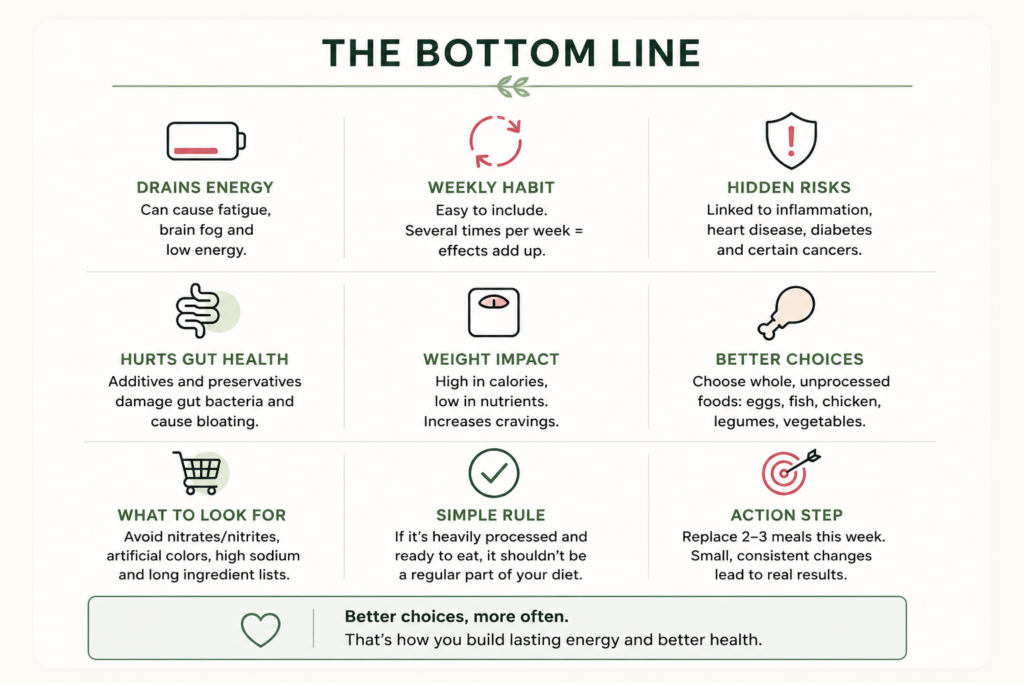
A simple way to look at it is this: if a food is heavily processed, packaged, and ready to eat without any preparation, it probably shouldn’t be a regular part of your diet.
That doesn’t mean you have to avoid it completely. It just means it shouldn’t be something you rely on every week without thinking.
The more your meals are based on fresh, simple ingredients like eggs, fish, meat, vegetables or legumes, the easier it is to maintain stable energy and better overall health.
It’s not about perfection. It’s about making slightly better choices, more often.
Action step
Start simple.
This week, replace two or three meals that include processed meat with fresh alternatives. It could be as easy as swapping deli ham for grilled chicken, choosing eggs instead of bacon for breakfast, or using tuna instead of processed cold cuts in a sandwich.
You don’t need to change everything at once. Small, consistent changes are what actually make a difference over time.
If you make this adjustment and pay attention to how you feel after eating, you’ll start to notice it. More stable energy, lighter digestion, and fewer ups and downs during the day.
That’s where real progress starts.