

Quick Answer
Why does my neck crack? Most of the time, that sound comes from one of three things: gas bubbles releasing inside the fluid-filled joints of your cervical spine (called cavitation), tendons or ligaments snapping over bony structures as you move, or stiff, poorly-lubricated joints producing friction noise. None of these are inherently dangerous — but they do often signal something worth paying attention to.
What’s Actually Happening When Your Neck Cracks
Why does my neck crack every time you turn your head? It feels strange when you think about it. A quiet room, a small head rotation, and suddenly — pop.
There isn’t one single cause. The noise can come from completely different mechanisms depending on when it happens and what it feels like. Here’s the real breakdown.
1. Synovial Joint Cavitation
Your cervical spine contains small, fluid-filled facet joints between each vertebra. That fluid — synovial fluid — contains dissolved gases, primarily carbon dioxide and nitrogen. When the joint capsule stretches quickly during movement, the pressure inside drops, and those gases form a bubble that collapses almost instantly.
That collapse is the pop you hear.
This is the same mechanism that happens when someone «cracks their knuckles.» Research published in PLOS ONE using real-time MRI imaging confirmed this — the crack coincides with the rapid formation of a gas-filled cavity in the joint, not the bubble bursting, as was previously believed.
After cavitation occurs, it typically takes 15–30 minutes for the gases to dissolve back into the synovial fluid — which is why you can’t usually crack the same spot twice in quick succession.
2. Tendons and Ligaments Snapping Over Structures
Not every neck click is a joint releasing gas. Sometimes the sound comes from soft tissue — a tendon or ligament momentarily catching on a bony prominence before sliding back into place as you rotate or tilt your head.
This is more likely the culprit when the click happens in the same spot every time, is painless, and occurs with a specific, repeatable movement. It’s analogous to the clicking some people experience in their shoulder or hip. Not concerning on its own, but often a sign that the tissue is under repetitive mechanical stress.
3. Roughened Cartilage and Crepitus
Crepitus in the neck — a grinding, grating, or popping that’s less sharp and more persistent — is different in character. This often comes from cartilage surfaces that have lost some of their smooth texture. As the joint surfaces move against each other, they create audible friction.
Mild crepitus is extremely common as people get older and is usually asymptomatic. More consistent grinding, especially with pain or reduced range of motion, deserves a clinical evaluation.
Why Neck Cracking and Stiffness So Often Happen Together
Here’s something most people don’t realize: the sound isn’t the problem. The stiffness that drives you to crack your neck in the first place — that’s the part worth examining.
When joints spend long periods in the same position, the synovial membrane produces less fluid, the cartilage receives less nutrient delivery, and the surrounding muscles adapt by shortening and tightening. You feel the pull, the restriction, the urge to rotate and release.
So when you finally do move and get that satisfying pop — you haven’t fixed anything. You’ve just triggered a momentary pressure change. The stiffness mechanics are still in place.
This is why neck cracking and stiffness tend to cycle together. The stiffness creates the urge. The crack provides temporary proprioceptive feedback — a brief sense of release — but the underlying tension pattern remains unchanged without addressing the root cause.
What’s Driving Cervical Spine Stiffness
Several things converge to reduce natural neck mobility:
- Reduced movement variability — when your head spends 8–10 hours moving within a narrow range of positions (fixed screen gaze, desk work), the joints adapt to that restricted range
- Muscle guarding — the brain perceives certain positions as threatening to spinal structures and unconsciously recruits muscles to limit movement
- Fascial restriction — the connective tissue surrounding neck muscles thickens when not regularly moved through full range, further limiting mobility
- Dehydrated discs — the intervertebral discs act as shock absorbers and maintain spacing between vertebrae; poor hydration and inactivity reduce disc height over time, altering joint mechanics
The Hidden Role of Posture and Tech Neck
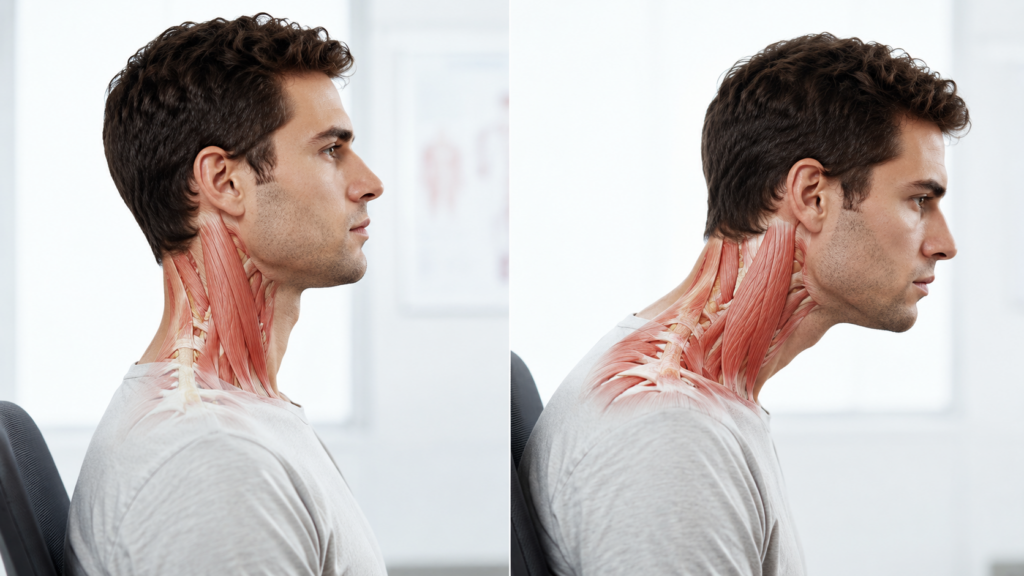
Forward head posture might be the single biggest lifestyle driver of why so many people are asking «why does my neck crack when I turn it» in 2024.
Every inch your head moves forward from its neutral position (ears over shoulders) increases the effective load on your cervical spine. A head weighs approximately 10–12 pounds in neutral. At three inches forward — a typical smartphone posture — that load effectively becomes around 42 pounds of compressive force on the cervical structures. At four to five inches, it approaches 60 pounds.
Your upper trapezius, levator scapulae, and suboccipital muscles work overtime to prevent your head from dropping further forward. They become chronically shortened and overactive. The deep neck flexors — the muscles designed to stabilize the cervical spine from the front — become inhibited and weak.
This muscular imbalance changes how the facet joints move, compresses the posterior joint spaces, and creates the conditions for both stiffness and cracking. Tech neck symptoms aren’t just cosmetic — they represent a real functional shift in how your cervical spine operates.
Office Posture and the Slow Damage of Screen Time
The problem with desk posture isn’t usually one dramatic position. It’s the cumulative hours spent slightly slouched, with the chin slightly jutted, with the screen slightly too low or too far away.
Over weeks and months, the body adapts to what it does most. Muscles that hold you forward get stronger and tighter. Muscles that pull you back and open the chest get longer and weaker. This is called postural adaptation, and it doesn’t reverse itself just because you stand up and stretch for 30 seconds.
Why Your Neck Feels Better After Cracking It
It’s not just in your head — there’s real neurological feedback happening.
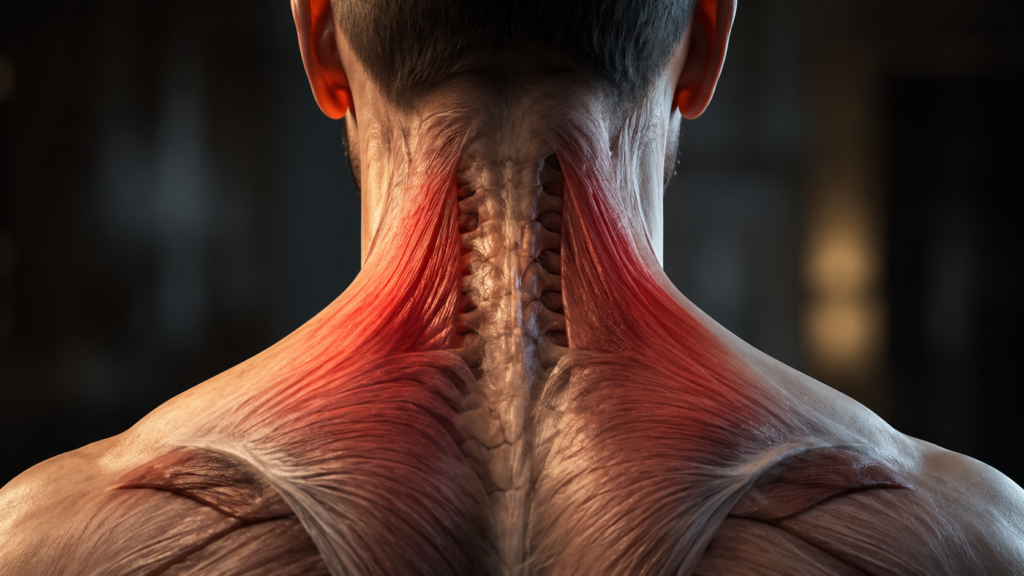
When a joint pops, sensory receptors in and around that joint send a burst of proprioceptive information to the brain. This briefly overrides the pain or tension signals from nearby sensitized tissue. There’s also evidence that joint manipulation (including self-manipulation) triggers a short-term release of endorphins and produces muscle relaxation via reflex inhibition of the surrounding musculature.
This is partly why neck cracking feels so satisfying in the moment — and why it can become habitual. The brain learns that this action produces a brief sense of relief.
The catch: you’re addressing the sensation of tension without addressing the cause of it. Over time, if the underlying postural or muscular problem persists, the nervous system may become more sensitized to cervical dysfunction — meaning the same threshold of stiffness starts producing more discomfort, and the urge to crack becomes more frequent and more compulsive.

Daily Habits Making Your Neck Worse
Some of these will be obvious. Some won’t.
Screen position. A monitor set too low forces sustained downward cervical flexion — the same position as looking at your phone. A monitor set too high forces sustained extension and can compress posterior cervical structures. Eye level is the target.
Sleeping on your stomach. Prone sleep forces your neck into sustained rotation — often 6–8 hours of it. This compresses facet joints on one side, over-stretches ligaments on the other, and is a reliable recipe for waking up stiff and reaching immediately for a neck crack.
One-sided gym training. Heavy pressing movements (bench press, overhead press) without adequate pulling volume overloads the anterior shoulder and chest, reinforcing rounded shoulders and forward head posture. Rows, face pulls, and rear delt work restore the balance.
Carrying a bag on one shoulder. This elevates one shoulder, laterally flexes the neck to compensate, and chronically recruits the ipsilateral upper trap. Over time this creates a real asymmetry in cervical muscle tension.
Stress. Psychological stress is one of the most underestimated drivers of neck tension. The trapezius is one of the primary muscles involved in the threat response — when you’re anxious, it fires. Chronic low-grade stress means chronic low-grade trap activation, meaning persistent stiffness even without any postural or structural trigger.

When Neck Cracking Could Be a Warning Sign
Most neck cracking is benign. But there are patterns that warrant a medical conversation sooner rather than later.
| ✅ Normal Neck Cracking | ⚠️ Potential Warning Signs |
|---|---|
| Painless popping or clicking sounds | Cracking with sharp or radiating pain |
| Happens during normal movement | Pain, numbness, or tingling into the arm or hand |
| Occasional and not getting worse | Cracking after a recent injury or fall |
| No weakness or loss of strength | Dizziness or visual changes during neck movement |
| Feels better after gentle movement | Stiffness that keeps worsening despite mobility work |
| No history of neck trauma | Loss of bladder or bowel control — seek medical help immediately |
If neck clicks are accompanied by headaches originating at the base of the skull, weakness or numbness in the arms, or any neurological symptoms, that’s your cue to stop self-treating and get a proper evaluation. A physiotherapist, osteopath, or orthopedic specialist can assess whether the issue is structural.
Practical Ways to Reduce Neck Stiffness
Fix the Root, Not Just the Symptom
The goal isn’t to stop your neck from cracking — it’s to reduce the stiffness that drives you toward it.
Increase movement variability. Set a timer every 45–60 minutes during desk work and simply take your neck through its full range: chin tucks, lateral flexion both ways, rotation both ways, gentle extension. Not as a formal exercise — just to remind the joints that they can move.
Strengthen your deep neck flexors. These small muscles — the longus colli and longus capitis — are the «core» of the cervical spine. They provide segmental stability and are inhibited in people with forward head posture. The classic exercise: lying on your back, gently nod your chin toward your chest (not a full sit-up, just a small curl), hold 5–10 seconds, repeat 10–15 times.
Address the upper trapezius and levator scapulae. Sustained stretching (30+ seconds) of the upper trap — ear to shoulder, adding gentle downward pressure with the opposite hand — combined with heat can meaningfully reduce baseline tension before mobility work.
Improve thoracic spine mobility. The neck doesn’t move in isolation. A rigid thoracic spine (upper/mid back) forces the cervical spine to compensate with excessive movement and compression. Thoracic extensions over a foam roller, cat-cow, and thoracic rotation drills all reduce the demand placed on the cervical segments.
Check your workstation. Monitor at eye level. Keyboard positioned so elbows sit at 90 degrees. Chair height allowing feet flat on the floor. Laptop on a stand with an external keyboard — not propped up on a lap.

Best Daily Habits for a Healthier Cervical Spine
Think of these as maintenance, not treatment:
- Morning neck mobility routine — 3–5 minutes of gentle range-of-motion work before sitting down to screens. It doesn’t need to be dramatic. Slow, controlled movement through full range is enough.
- Chin tucks throughout the day — the single most evidence-supported self-correction for forward head posture. Pull your chin straight back (not down), creating a subtle «double chin.» Hold 5 seconds. Repeat 10 times per session.
- Hydration — the intervertebral discs are 80% water in young adults and gradually lose hydration capacity with age. Consistent hydration (not just «drinking more water») supports disc integrity and synovial fluid production.
- Progressive resistance training — particularly rows, face pulls, and reverse flies — to strengthen the posterior shoulder girdle and support proper head carriage.
- Sleep posture correction — side sleeping with a pillow sized to fill the space between your shoulder and your head (maintaining neutral cervical alignment) is generally ideal. Avoid stomach sleeping.
One thing that genuinely helps many people reduce morning neck stiffness is switching from a completely flat pillow to a cervical-support pillow that keeps the neck in a more neutral position during sleep.
Myths vs. Reality
| ❌ Myth | ✅ Reality |
|---|---|
| Neck cracking causes arthritis | No strong evidence supports this. One of the most famous studies followed a man who cracked the knuckles on only one hand for over 60 years — no difference in arthritis rates was found. |
| If it cracks, something is wrong | Usually not. Most neck cracking comes from normal joint mechanics. The sound alone is rarely the problem — symptoms and context matter more. |
| Cracking your neck “realigns” your spine | Neck cracking does not reposition the spine. The popping sound is mostly related to gas release and joint movement, not structural realignment. |
| Stretching is the same as mobility work | Stretching focuses on tissue length, while mobility training improves controlled movement through strength and range of motion. Both help, but they are not identical. |
| Neck pain is an inevitable part of aging | Neck discomfort is common, but lifestyle factors like posture, movement habits, sleep setup, and stress often matter more than age itself. |
FAQ
Why does my neck crack when I turn it?
When you rotate your cervical spine, the pressure inside your facet joints changes rapidly. This can cause dissolved gases in the synovial fluid to form and collapse in a micro-second — producing that pop. Alternatively, a tendon or ligament may briefly catch on a bony surface before sliding back into position. Both are very common and usually painless.
Is neck cracking dangerous?
For most people, no. Research has not established that self-cracking or audible joint noises cause joint damage, arthritis, or structural harm. The exception is forceful, ballistic self-manipulation of the cervical spine — that carries a rare but real risk of arterial strain. Gentle, self-initiated movement that happens to produce a crack is generally fine.
Why is my neck stiff and cracking?
Stiffness and cracking tend to appear together because the same factors that restrict joint movement — prolonged static posture, reduced movement variability, muscle tightness, fascial restriction — also create the conditions for audible cavitation or tissue snapping. Addressing the stiffness (through mobility work, posture correction, and movement habits) typically reduces the frequency of both.
Can posture cause neck cracking?
Yes. Forward head posture changes the load distribution through the cervical facet joints, compresses certain joint spaces, and alters the resting tension of surrounding muscles. This creates an environment where movement produces more noise — and more frequent desire to crack or stretch the neck for relief.
Should I stop cracking my neck?
The occasional, self-initiated crack during normal movement is unlikely to cause harm. However, if you find yourself compulsively needing to crack your neck multiple times per day for relief, that’s a sign the underlying tension or stiffness is not being addressed. Focus on the root cause rather than the relief behavior.
Can stress cause neck tension and popping?
Yes — and this is underappreciated. The upper trapezius is heavily involved in the physiological stress response. Chronic psychological stress keeps this muscle in a state of low-level activation, leading to persistent tension, reduced range of motion, and the sensation of stiffness that drives neck cracking behavior. Stress management — sleep, exercise, breathwork — is legitimately a part of neck health.
This article is for informational purposes only and does not constitute medical advice. If you experience pain, neurological symptoms, or symptoms that worsen, consult a qualified healthcare professional.
*Disclosure: Some of the links on this site are affiliate links. This means that if you choose to make a purchase through them, we may earn a small commission at no additional cost to you. We only recommend products or tools that are relevant to the content and that we believe can provide value. This helps support the site and allows us to continue creating useful, free content.