

You know that feeling — it’s 3pm, you’ve been staring at your screen for hours, and your shoulders feel like they’ve been welded to your ears. You roll your neck, maybe shrug a few times, and nothing really changes.
If that sounds familiar, you’re not alone. Tight, aching shoulders are one of the most common physical complaints in the modern world — and most of it comes down to how we live, sit, and handle stress. The good news? Learning how to release shoulder tension doesn’t require a massage therapist or a fancy foam roller. A focused 5-minute routine, done consistently, can genuinely change how you feel.
This guide covers the real causes, a practical routine you can do anywhere at home, and the daily habits that keep the tightness from coming back.
Quick Answer Box
| ❓ Question | 💡 Short Answer |
|---|---|
| Why do shoulders get tight? | Stress, poor desk posture, phone use, shallow breathing, and weak upper back muscles are some of the most common causes. |
| What helps fastest? | Shoulder rolls, upper trap stretches, mobility work, and deep breathing can noticeably reduce tension in under 5 minutes. |
| How long until relief? | Many people feel looser within 5–10 minutes, but lasting relief usually comes from consistent daily movement habits. |
Why Your Shoulders Feel Tight All The Time
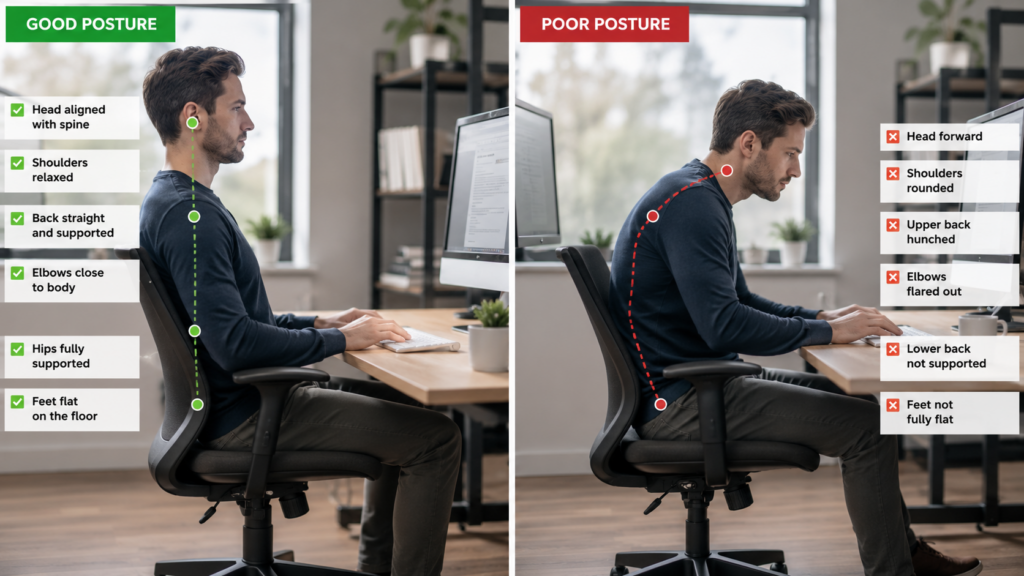
Most people assume their shoulders hurt because they «slept funny» or «overdid it at the gym.» But chronic shoulder tightness is almost never one thing — it’s usually a stack of small daily habits piling up on the same overworked muscles.
Here’s what’s actually happening in your body:
| 🧩 Cause | 🧠 What Happens In The Body | ⚠️ Common Signs |
|---|---|---|
| Prolonged desk posture | Head shifts forward and the upper traps overwork to support the neck for long periods. | Neck aches, stiff traps, tension headaches |
| Stress response | The nervous system increases muscle guarding, causing the shoulders to unconsciously rise. | Tight upper traps, jaw clenching |
| Phone use (“text neck”) | Looking downward dramatically increases load on the cervical spine and surrounding muscles. | Soreness at the base of the skull and upper back |
| Shallow breathing | Neck and upper trap muscles become accessory breathing muscles and get overloaded. | Upper chest tightness, constant tension |
| Inactivity | Thoracic spine mobility decreases, limiting shoulder blade movement and posture control. | Difficulty fully raising arms, clicking sensations |
| Poor ergonomics | Incorrect monitor or desk positioning forces awkward reaching and uneven loading. | Trap imbalance, elbow or wrist discomfort |
| Weak mid/lower traps | The upper traps compensate for missing shoulder blade stabilization strength. | Persistent knot near the shoulder blade |
| One-sided bag carrying | Uneven shoulder loading gradually creates postural imbalance and muscle asymmetry. | One shoulder sitting noticeably higher than the other |
The traps — your trapezius muscles — are constantly implicated here. They run from the base of your skull down your neck and across your upper back. When they’re overworked (which is basically always in desk workers), they shorten and harden. And because they’re connected to the cervical spine, tight traps often contribute to tension headaches from the shoulders — a miserable experience that many people don’t even realize originates in the neck and upper back.
Related reading: [Lower Back Pain]
The 5-Minute Shoulder Tension Release Routine
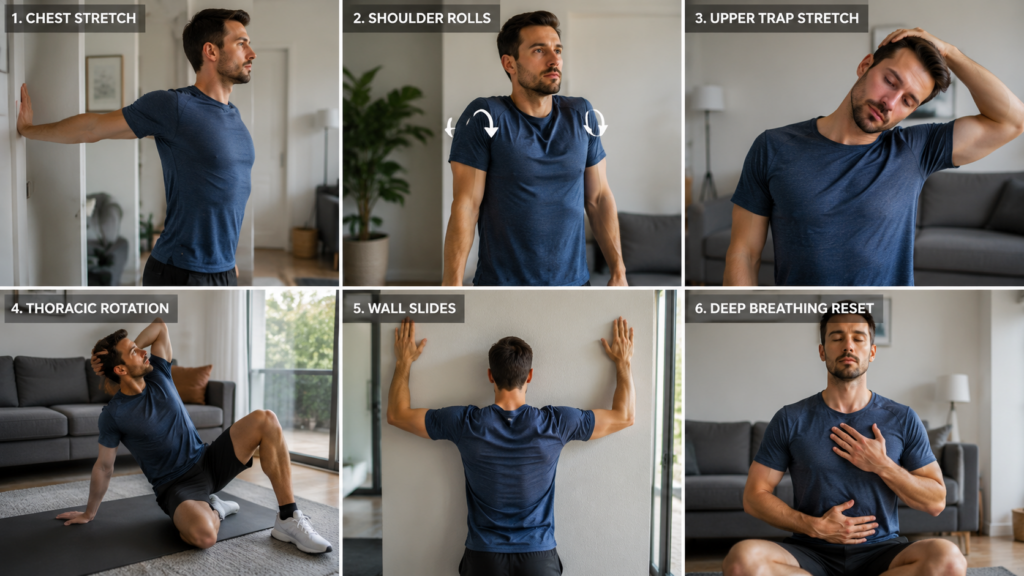
This is the part that actually matters. No equipment needed — just floor space, a doorway, and about five minutes of your day.
The routine is sequenced deliberately. It starts by warming up the joint, opens the chest to take load off the traps, mobilizes the thoracic spine (which most stretching routines completely ignore), then finishes with a nervous system reset through breathing. Skip the order and you’ll get half the results.
Routine Summary Table
Shoulder Rolls
45 secHelps warm up the shoulders, improve circulation, and release surface-level tension from desk posture.
Chin Tucks
45 secDecompresses the cervical spine and helps reset forward-head posture caused by screens and phone use.
Doorway Chest Stretch
60 secOpens tight chest muscles and reduces upper trap overcompensation linked to rounded shoulders.
Thoracic Rotation
60 secImproves upper spine mobility and restores smoother shoulder blade movement.
Upper Trap Stretch
60 secTargets the most common tension area directly and helps reduce stiffness around the neck and shoulders.
Deep Breathing Reset
30 secCalms the nervous system and encourages proper diaphragm breathing instead of neck breathing.
1. Shoulder Rolls — 45 Seconds
Why it works: Shoulder rolls increase synovial fluid circulation in the glenohumeral joint and gently activate the rotator cuff. They also interrupt the «frozen» posture your shoulders have been holding for hours.
How to do it: Stand or sit tall. Roll your shoulders slowly backward — up toward your ears, back, and down. Think about drawing large circles. Breathe steadily throughout. After 20 seconds, switch directions and roll forward.
Common mistake: Going too fast. This isn’t about momentum — it’s about getting the joint moving through its full range. Slow, deliberate circles do more.
What you should feel: Warmth around the joint, mild clicking (normal), and a gradual loosening at the top of the movement.
2. Chin Tucks — 45 Seconds
Why it works: After hours of forward head posture, the small muscles at the back of your neck (deep cervical flexors) become weak and inhibited. Chin tucks reactivate them and decompress the upper cervical spine — which directly reduces pull on the upper traps.
How to do it: Sit up straight or stand against a wall. Without tilting your chin up or down, slide your head straight backward — like you’re making a double chin. Hold 3 seconds, release. Repeat 8–10 times.
Common mistake: People tilt their chin down instead of sliding back. The movement is horizontal, not angular.
What you should feel: A gentle stretch at the base of the skull and a light engagement in the front of your neck. Nothing sharp.
3. Doorway Chest Stretch — 60 Seconds

Why it works: Tight pectoralis minor is one of the most underappreciated causes of shoulder tension. When pec minor shortens, it pulls the shoulder blade forward and downward — forcing the upper traps and levator scapulae to work overtime just to hold your shoulders in place. Stretching the chest takes that pressure off immediately.
How to do it: Stand in a doorway. Place both forearms on the door frame with elbows bent at 90 degrees. Step one foot forward. Lean your body gently through the door until you feel a stretch across the front of your chest and shoulders. Hold 30 seconds each side, or hold both sides simultaneously.
Common mistake: Flaring the ribs out and arching the lower back to «feel» the stretch more. Keep your core lightly engaged and your ribs down.
What you should feel: A comfortable stretch across the chest and the front of the shoulders. Not pain in the shoulder joint itself.
4. Thoracic Spine Rotation — 60 Seconds
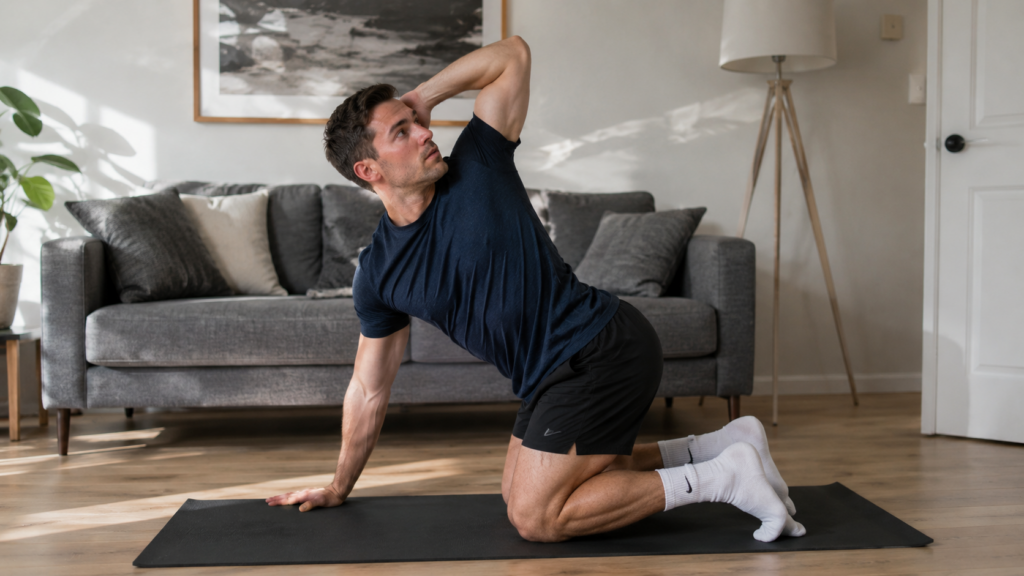
Why it works: The thoracic spine (the mid-upper back) is supposed to provide most of your rotational movement. When it stiffens — which it does rapidly with a sedentary lifestyle — the shoulder blade loses its stable base of movement. This forces the shoulder joint itself to compensate, creating chronic tension and eventual pain.
How to do it: Sit sideways on a chair, or sit cross-legged on the floor. Cross your arms over your chest. Keeping your lower body still, slowly rotate your upper body to the right as far as comfortable. Hold 2–3 seconds. Return to center and rotate left. Complete 8 rotations per side.
Common mistake: Rotating from the hips instead of the thoracic spine. If your pelvis moves, you’re cheating — and bypassing the joint that actually needs the work.
What you should feel: A gentle opening sensation through the mid-back and slight movement freedom around the shoulder blades.
5. Upper Trap Stretch — 60 Seconds
Why it works: This targets the levator scapulae and upper trapezius directly — the two muscles most people are referring to when they say their «neck and shoulder tension» is unbearable. Gentle sustained stretching relaxes the muscle spindles (the receptors that maintain muscle tension) and temporarily reduces tone.
How to do it: Sit tall. Drop your right ear toward your right shoulder. Now take your right hand and gently rest it on top of your head — don’t pull, just let the weight of your hand add mild pressure. Hold 30 seconds. Breathe deeply. Repeat on the left side.
Common mistake: Actively pulling the head with the hand. This activates a stretch reflex and can actually increase muscle tension — the opposite of what you want.
What you should feel: A sustained, tolerable stretch running from behind your ear down to the outer shoulder. If it’s sharp or pinching, reduce the range.
6. Deep Breathing Reset — 30 Seconds
Why it works: Diaphragmatic breathing directly activates the parasympathetic nervous system — the «rest and digest» mode that counteracts the stress response driving your shoulder tension. Many people breathe with their upper chest, which overworks the scalenes and upper traps as accessory breathing muscles. Retraining belly breathing removes that chronic load.
How to do it: Sit or lie down. Place one hand on your chest and one on your belly. Inhale slowly for 4 seconds, making your belly expand (not your chest). Exhale for 6 seconds. Repeat 4–5 times.
Common mistake: Forcing the belly out with effort instead of letting the diaphragm drop naturally. Relax the belly — don’t push it.
What you should feel: Calm. Warmth in the shoulders. A noticeable drop in general tension. This is the body’s built-in stress reset.
What You Should Feel vs. What You Shouldn’t
| ✅ Normal / Good | 🚫 Stop and Reassess |
|---|---|
| Mild soreness that improves during the stretch | Sharp or stabbing pain |
| Gentle pulling or lengthening sensation | Pain traveling down the arm |
| Light clicking or popping without pain | Numbness or tingling sensations |
| Warmth and improved mobility afterward | Dizziness or feeling lightheaded |
| Muscle fatigue during strengthening exercises | Severe pain that worsens during the movement |
Why Stress Makes Shoulder Tension Worse

There’s a well-documented link between psychological stress and muscle tension — specifically in the upper traps and neck. When your nervous system perceives a threat (including the low-grade, constant stress of deadlines and full inboxes), it triggers what’s called the «startle reflex» or muscle guarding response.
Your shoulders literally rise. Your jaw clenches. Your breathing shallows. And if that threat never fully resolves — which is the nature of modern stress — your muscles stay in that braced state for hours, days, and eventually years.
The cortisol connection is real too. Chronic stress keeps cortisol elevated, which promotes inflammation in connective tissue and reduces the body’s ability to fully relax skeletal muscle. Over time, even muscles that should be relaxed at night hold baseline tension. That’s why people wake up stiff despite sleeping 7–8 hours.
There’s also a jaw-neck-shoulder chain worth knowing about. The muscles around your jaw and the muscles of the suboccipital region (base of the skull) share fascial connections with the upper cervical spine. People who clench their jaw under stress almost always carry that tension into the neck and shoulders too.
Practical Lifestyle Fixes
- Screen breaks every 45–60 minutes. Set a timer. Get up, look away from the screen, and roll your shoulders for 30 seconds. The Pomodoro technique works well here.
- Nasal breathing throughout the day. Mouth breathing increases accessory muscle use in the neck and chest.
- Walking. Even 10–15 minutes of walking triggers endorphin release and actively reduces muscle guarding. It also gets the thoracic spine moving.
- Posture resets. Every time you sit down at your desk, do one chin tuck and roll your shoulders back. Make it a reflex.
Best Daily Habits To Prevent Tight Shoulders

Desk Ergonomics
This is unglamorous but important. Most shoulder tension in office workers comes from sustained, awkward positions — not one dramatic injury. Small ergonomic fixes compound over time.
- Monitor at eye level. If you’re constantly looking down, your head is pulling forward and your traps are pulling back to compensate. Use a stand or stack of books to raise it.
- Keyboard and mouse close. Reaching forward or to the side all day loads the rotator cuff and upper traps asymmetrically. Reaching forward or to the side all day loads the rotator cuff and upper traps asymmetrically. Keeping your mouse and keyboard closer — especially with an ergonomic mouse setup — can reduce unnecessary shoulder strain over time.
- Chair height: Your feet should be flat on the floor, knees at roughly 90 degrees. Sitting too high or too low shifts your entire spinal alignment.
- Armrests: If your armrests are too high, your shoulders are permanently shrugged. Lower them or remove them. A supportive ergonomic chair with adjustable armrests can also help keep the shoulders relaxed instead of slightly shrugged all day without noticing.
Sleep Position

Sleeping on your stomach is consistently the worst position for shoulder and neck tension — it forces your cervical spine into sustained rotation for hours.
Side sleeping is fine if your pillow keeps your neck neutral (not drooping down or propped up). The pillow should fill the gap between your ear and shoulder.
Back sleeping is the most spine-friendly option, but requires a pillow that supports the natural cervical curve without pushing your chin toward your chest. Avoid overly thick pillows in this position.
Pillow note: Memory foam pillows work well for most people because they contour to the cervical curve. Buckwheat pillows offer more adjustability. Avoid pillows so soft that your head sinks through them or so firm that your neck is in constant flexion.
Other Habits That Make a Real Difference
- Hydration. Fascia (the connective tissue surrounding your muscles) is primarily water. Dehydration makes it stiffer and less pliable. Aim for at least 2 liters of water per day.
- Move frequently. No position — even «perfect posture» — should be held for hours. The best posture is your next posture. Change positions regularly.
- Strengthen the mid and lower traps. Face pulls, rows, and band pull-aparts train the muscles that take load off the upper traps. Even 10 minutes of this work twice a week makes a meaningful difference over time.
- Stretch the thoracic spine daily. A foam roller placed horizontally under the mid-back (not the lower back) for 60–90 seconds is one of the highest-value things a desk worker can do for their shoulders.
Daily Reset Checklist
Simple habits that help reduce shoulder tension, improve posture, and keep your body feeling better throughout the day.
Posture Self-Test
Take 30 seconds right now:
- Stand naturally. Don’t correct anything yet.
- Look down at your hands. Which way do your palms face? If they face backward (thumbs pointing inward toward each other), your shoulders are internally rotated — a strong sign of tight pecs and weak mid-back.
- Now look at a mirror from the side. Is your ear behind your shoulder, or in front of it? If in front, you have measurable forward head posture.
- Shrug both shoulders to your ears, then let them drop completely. Where do they land? Many people discover one sits noticeably higher than the other — often the dominant hand side, or the side where they carry their bag.
None of these are alarming on their own. But they tell you where to focus your attention.
Mistakes That Make Shoulder Tension Worse
Common Mistakes to Avoid
Stretching aggressively when muscles are cold
Forcing a tight shoulder into an intense stretch before warming up can trigger a protective muscle response that increases tension instead of reducing it.
Using a massage gun directly on irritated upper traps
High-intensity percussion on an already sensitive muscle may worsen irritation and inflammation rather than helping recovery.
Only stretching without strengthening
Tight upper traps are often overloaded because weaker muscles underneath are not doing enough work. Stretching alone rarely fixes the root issue.
Carrying a heavy bag on one shoulder daily
Uneven loading forces one side of the upper traps to stay contracted for long periods, creating chronic imbalance and tension.
Overtraining upper traps at the gym
Excessive shrugs and upright rows can overpower the upper traps without balancing them with proper pulling and stability work.
Trying to maintain “perfect posture” all day
Holding rigid posture for hours creates unnecessary tension. The body is designed for movement, not static positioning.
When Shoulder Tension Could Be Something More Serious
The vast majority of shoulder tension is postural, stress-related, and entirely benign. But some symptoms are worth taking to a doctor or physiotherapist rather than stretching out at home.
See a professional if you experience:
- Numbness or tingling running down your arm, into your hand, or into specific fingers — this may indicate nerve compression in the cervical spine or thoracic outlet
- Significant weakness in the arm or hand, especially if it comes on suddenly
- Severe pain at rest that doesn’t respond to any movement, position change, or over-the-counter pain relief
- Pain that woke you up repeatedly for several nights running
- Chest pain combined with shoulder tension — this needs immediate medical attention, as it can be a symptom of cardiac issues
- A recent fall, collision, or trauma followed by new shoulder pain
- Pain that is getting progressively worse over several weeks without any mechanism of injury
Experiencing one or two of these doesn’t mean something is catastrophically wrong — but it does mean you deserve a proper assessment rather than a YouTube stretch routine. A good physiotherapist can differentiate between muscular tension, rotator cuff issues, cervical radiculopathy, and thoracic outlet syndrome relatively quickly.
FAQ
Can stress cause shoulder tension?
Yes — and this is well-supported by research. The stress response activates the sympathetic nervous system and triggers muscle guarding, particularly in the upper trapezius and neck muscles. Chronic stress keeps cortisol elevated, which sustains this muscular bracing pattern even when no immediate stressor is present. Many people’s shoulder tension worsens during demanding work periods and improves during holidays — a direct reflection of this connection.
Why do my shoulders feel tight after sleeping?
A few reasons: your sleeping position may put your neck or shoulder in a sustained stretch or compression. A pillow that’s too thick or too thin alters your cervical alignment all night. And the body naturally has lower circulation and lymphatic clearance during sleep, so minor inflammation from the previous day’s tension can feel worse first thing in the morning. Some people also unconsciously clench their jaw or shoulders during sleep, especially if they’re anxious or stressed.
How often should I stretch tight shoulders?
Daily — ideally. Short, consistent sessions (5–10 minutes) every day produce better results than one long session once a week. Think of it like brushing your teeth: the frequency matters more than the duration. If you’re in an active period of tension, twice a day (morning and after work) will accelerate your progress.
Can posture really cause shoulder pain?
Absolutely. Forward head posture and rounded shoulders are the two most common postural patterns in desk workers, and both create predictable patterns of muscular overload. When the head shifts forward by just one inch, the load on the cervical spine approximately doubles. That load doesn’t disappear — it gets absorbed by the traps, levator scapulae, and suboccipital muscles, creating chronic tension over time.
Is heat or ice better for shoulder tension?
For chronic muscle tension (not acute injury), heat is generally more effective. Heat increases local circulation, relaxes muscle spindles, and reduces the perception of pain. A heat pad or warm shower before your stretching routine makes the stretches significantly more effective. Ice is more appropriate immediately after a fresh injury or acute inflammation — not for day-to-day tightness.
Can anxiety tighten shoulder muscles?
Yes, and the mechanism is physiological, not psychological. Anxiety activates the fight-or-flight response, which includes a whole-body muscle bracing pattern. The upper traps and neck are particularly affected. People with generalized anxiety disorder often report chronic upper body tension even when life circumstances seem manageable. Addressing the underlying anxiety — through breathing, movement, therapy, or appropriate medical support — is usually more effective than any stretch for this type of tension.
Why do desk workers get shoulder tension more than other people?
A combination of sustained static posture, psychological stress, poor breathing habits, and lack of movement. A desk worker might hold the same shoulder and neck position for 6–8 hours a day, which is something the human body absolutely did not evolve for. Add a stressful workload and shallow breathing, and you have the perfect conditions for chronic upper body tension. Manual workers move more and vary their posture constantly — which is ironically more protective, even though the work is physically harder.
What sleeping position is best for shoulder tension?
Back sleeping with a medium-thickness pillow that supports the natural cervical curve is generally the most shoulder-friendly option. Side sleeping is also acceptable with the right pillow height. Avoid stomach sleeping — it forces the cervical spine into rotation for hours and is strongly correlated with morning neck and shoulder stiffness. If you’re a habitual stomach sleeper, transitioning to side sleeping with a pillow between your knees takes a few weeks but is worth it.
Conclusion
Shoulder tension rarely comes from one dramatic cause. It builds quietly — through hours of the same position, the background hum of daily stress, breathing that never quite reaches the belly, and muscles that are overworked and never properly restored.
The good news is that the solution is equally unglamorous: five minutes, done consistently, changes things. Not overnight, and not without building the habits around it — but the routine in this guide gives your body exactly what it needs to start unwinding what’s been winding up.
Start with the 5-minute routine today. Then look at one ergonomic thing you can fix this week. Then build the habit of moving every hour. Small changes, compounded over time, are how most people genuinely resolve chronic shoulder tension — not with a single magic stretch or an expensive gadget.
Your shoulders have been trying to protect you. Give them a reason to let go.
This article is for informational purposes only and does not constitute medical advice. If you are experiencing severe or worsening pain, numbness, or other concerning symptoms, please consult a qualified healthcare professional.
*Disclosure: Some of the links on this site are affiliate links. This means that if you choose to make a purchase through them, we may earn a small commission at no additional cost to you. We only recommend products or tools that are relevant to the content and that we believe can provide value. This helps support the site and allows us to continue creating useful, free content.