
You don’t need a gym to lose fat — but you do need to understand something most fitness content gets completely wrong.
Fat loss is not about suffering through 90-minute workouts or surviving on salads. It’s a biological process driven by energy balance, hormones, and habits. Once you understand the actual mechanism, fat loss without gym becomes not just possible — it becomes straightforward.
This fat loss guide breaks it all down without the fluff.

The Real Mechanism of Fat Loss (And Why Most People Get It Wrong)
Energy Balance: The Foundation of Everything
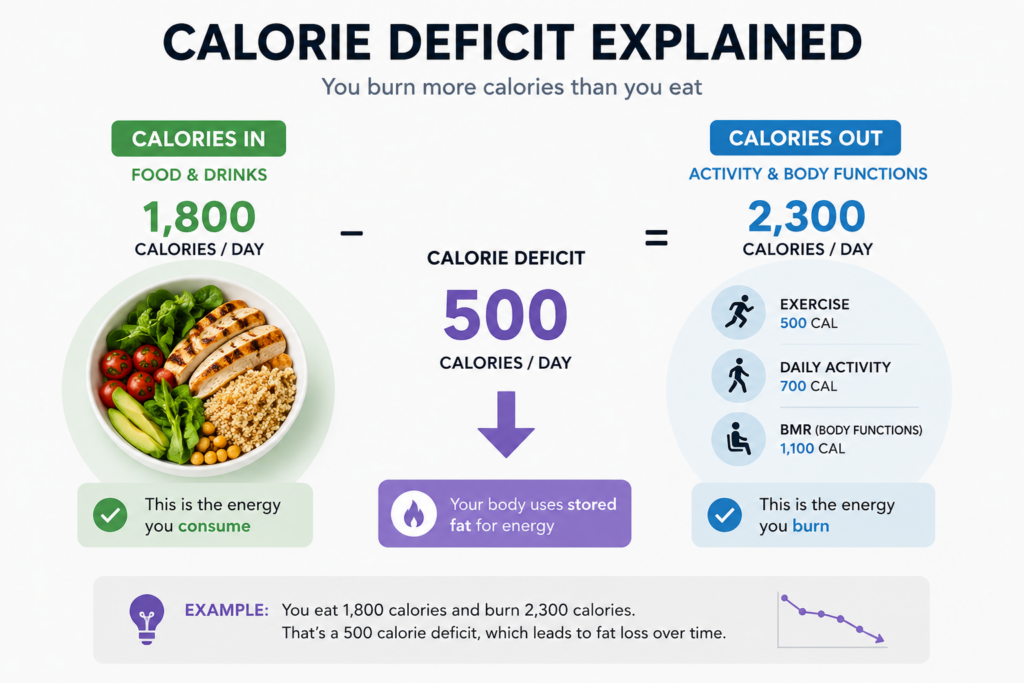
Fat loss comes down to one principle: you must burn more energy than you consume. Your body stores excess energy as fat. When you eat less than you burn, your body turns to those fat stores for fuel.
This is called a calorie deficit, and it’s non-negotiable. No food, supplement, or workout routine bypasses this law of physics.
But here’s where it gets interesting. Most people think «just eat less and move more» — and technically, that’s correct. The problem is how people try to do it.
Why Diets Keep Failing
Crash diets, extreme restriction, and cutting out entire food groups create a temporary deficit — but they also trigger your body’s survival mechanisms. Hunger hormones spike. Energy levels crash. Cravings intensify. Eventually, most people give up.
The research is clear on this. According to a review published by the National Institutes of Health, the majority of people who lose weight through severe caloric restriction regain it within 1–5 years — often with extra body fat due to muscle loss during the diet.
Sustainable fat loss requires a moderate deficit — typically 300–500 calories per day — not a starvation protocol.
Metabolism Basics (No PhD Required)
Your Total Daily Energy Expenditure (TDEE) is the total number of calories your body burns each day. It’s made up of:
- Basal Metabolic Rate (BMR): Calories burned at rest (breathing, circulation, organ function) — roughly 60–70% of TDEE
- Thermic Effect of Food (TEF): Calories burned digesting food — about 10%
- Non-Exercise Activity Thermogenesis (NEAT): All movement that isn’t formal exercise — 15–30%
- Exercise: Formal workouts — often only 5–10% for most people
That last point surprises people. Exercise matters — but it’s not the biggest lever. Which is exactly why fat loss without gym is completely achievable.
[Related: How to Calculate Your TDEE and Set a Realistic Calorie Deficit]
Why You Don’t Need a Gym to Lose Fat
NEAT: The Underrated Fat Loss Engine
Most people dramatically overestimate how many calories they burn exercising and dramatically underestimate how much their daily movement matters.
NEAT — Non-Exercise Activity Thermogenesis — includes everything from walking to the kitchen, fidgeting, doing laundry, taking the stairs, and pacing while on a phone call. For some people, NEAT accounts for up to 2,000 extra calories burned per day compared to sedentary individuals.
That’s not a typo. And that gap isn’t from going to the gym.
Walking: The Most Underrated Fat Loss Tool
A brisk 30-minute walk burns approximately 150–200 calories. Do that twice a day and you’ve created a meaningful energy deficit without a single dumbbell.
More importantly, walking doesn’t spike your hunger the way intense exercise can. High-intensity sessions often trigger compensatory eating — meaning people unconsciously eat back the calories they burned. Walking doesn’t have the same effect.
Research from Harvard Health shows that regular walking reduces the risk of obesity and supports weight management — and it’s one of the most sustainable forms of daily movement humans can do.
Gym vs. Lifestyle Activity: What Actually Moves the Needle
| Concepto | Valor | Estado |
|---|---|---|
| Calorías | 2200 kcal | Óptimo |
| Proteína | 150 g | Correcto |
| Grasas | 90 g | Alto |
| Carbohidratos | 180 g | Balanceado |
The gym burns more calories per hour. But lifestyle activity happens every single day — and consistency beats intensity for long-term fat loss.
Nutrition: What Actually Matters for Fat Loss
Calories vs. Food Quality — Can You Have Both?
You can lose fat eating nothing but chocolate. Technically. If you’re in a calorie deficit, your body doesn’t care where the energy comes from.
But here’s the reality: food quality directly impacts how easy it is to maintain a calorie deficit. Highly processed, hyper-palatable foods are engineered to override your body’s natural hunger signals. They make it nearly impossible to stop eating at the right amount.
Whole, minimally processed foods are not magic — they’re just easier to eat in appropriate portions.
Why Protein Is Non-Negotiable
Protein is the single most important macronutrient for fat loss. Here’s why:
- High thermic effect: Your body burns roughly 20–30% of protein calories just digesting it
- Muscle preservation: During a calorie deficit, protein prevents your body from breaking down muscle for fuel
- Satiety: Protein is the most filling macronutrient — it keeps hunger in check more effectively than carbs or fat
- Body composition: More protein = more muscle retained = better metabolism long-term
Target: Aim for 1.6–2.2g of protein per kg of bodyweight (or ~0.7–1g per pound). For a 75kg person, that’s roughly 120–165g per day.
High-Satiety Foods: Eat More, Feel Fuller
These foods help you stay in a calorie deficit without feeling deprived:
| Food | Protein (per 100g) | Satiety | Calories |
|---|---|---|---|
| 🍗 Chicken breast | 31g | Very High | 165 kcal |
| 🥣 Greek yogurt (0%) | 10g | High | 59 kcal |
| 🥚 Eggs | 13g | Very High | 155 kcal |
| 🌱 Lentils | 9g | High | 116 kcal |
| 🧀 Cottage cheese | 11g | Very High | 98 kcal |
| 🥣 Oats | 3g | High | 71 kcal |
| 🥦 Broccoli | 3g | Very High | 34 kcal |
| 🐟 White fish (cod) | 18g | Very High | 82 kcal |
These foods give you more volume and protein per calorie — making it significantly easier to eat less overall.
The Simplest Fat Loss System (No Gym Required)
Here’s a practical, step-by-step system that works without any equipment:
Step 1: Get Calorie Aware
You don’t need to count calories forever. But you do need to understand roughly how much you’re eating.
Use a free app like MyFitnessPal or Cronometer for 2–3 weeks. Most people are shocked by the gap between what they think they eat and what they actually eat. Even underestimating by 300–500 calories per day is enough to stall all progress.
After a few weeks of tracking, you’ll have an intuitive sense of portion sizes that lasts a lifetime.
Step 2: Hit Your Protein Target
Calculate your protein goal using the formula above. Then build every meal around a protein source first — chicken, eggs, fish, Greek yogurt, lentils, cottage cheese — and fill in the rest.
This alone often reduces total calorie intake because protein keeps you full longer.
Step 3: Move Daily (Start With Steps)
Aim for 7,000–10,000 steps per day. This is your baseline. If you’re currently at 2,000 steps, don’t jump to 10,000 on day one — increase by 1,000–1,500 steps per week.
Buy a cheap pedometer or use your phone. What gets measured gets managed.
Step 4: Add Simple Home Workouts (Optional, but Recommended)
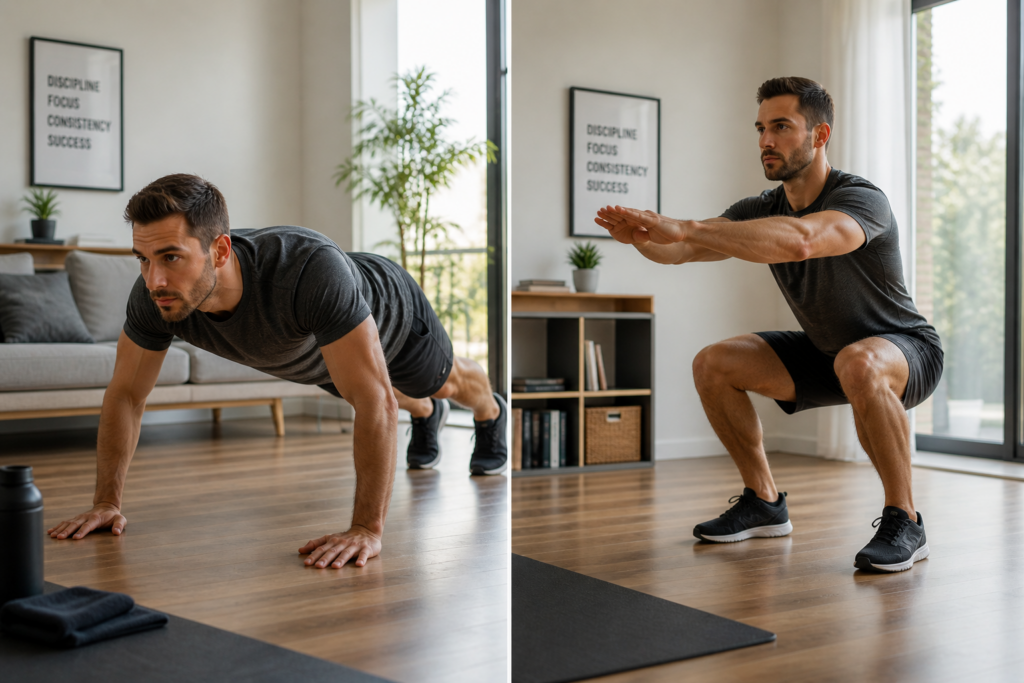
Home workouts are not required for fat loss — but they help preserve muscle mass during a calorie deficit, improve how your body looks as you lose fat, and boost daily energy.
Even 2 sessions per week of bodyweight training makes a meaningful difference.
Home Workouts That Actually Work
Bodyweight Training: More Effective Than You Think
Resistance training — even without weights — signals your body to preserve lean muscle tissue during fat loss. That matters because muscle is metabolically active tissue: it burns more calories at rest than fat does.
You don’t need a barbell. Bodyweight exercises like push-ups, squats, lunges, glute bridges, and rows (using a table edge) provide enough stimulus to maintain and even build muscle.
A Simple 3-Day Home Workout Plan
Each session: 25–35 minutes | No equipment needed
Day A (Lower Body + Core):
- Bodyweight squats — 3×15
- Reverse lunges — 3×10 each leg
- Glute bridges — 3×20
- Plank — 3×30 seconds
Day B (Upper Body + Core):
- Push-ups (any variation) — 3×10–15
- Inverted rows or table rows — 3×10
- Pike push-ups — 3×10
- Dead bug — 3×10 each side
Day C (Full Body Circuit):
- Jump squats or squat pulses — 3×15
- Push-ups — 3×12
- Hip thrusts — 3×15
- Mountain climbers — 3×20 seconds
Rest 60–90 seconds between sets. Progress by adding reps, slowing the tempo, or adding pauses.
The Biggest Mistakes People Make When Trying to Lose Fat
Eating «Healthy» But Still in a Surplus
Avocado, olive oil, nuts, granola, whole grain bread — all genuinely nutritious foods. Also calorie-dense ones. You can eat a perfectly «healthy» diet and still consume 500+ more calories than you burn every day.
Healthy eating and eating in a calorie deficit are not automatically the same thing.
Overestimating Exercise Calories
Most gym machines, fitness apps, and watches overestimate calorie burn by 20–70%. A 45-minute cycling class might show 600 calories burned. The real number is often closer to 350.
This leads people to «reward» themselves with food that more than cancels out the session.
Being Inconsistent
Losing 1kg per week for 2 weeks, then gaining it back over the weekend, then starting over on Monday — this cycle feels productive but leads nowhere. Moderate consistency outperforms intense inconsistency every time.
A 300-calorie daily deficit applied consistently for 12 weeks beats a 1,000-calorie deficit for 2 weeks followed by 10 weeks of overeating.
Crash Dieting
Very low calorie diets (VLCDs) under 800–1,000 calories accelerate fat loss in the short term but cause disproportionate muscle loss, drop your metabolic rate, and make the deficit unsustainable. The WHO recommends gradual weight loss of 0.5–1kg per week as the sustainable, evidence-based target.

Habits That Make Fat Loss Automatic
Environment Design
Willpower is finite and unreliable. Environment is not. If your kitchen counter has a bowl of fruit instead of a bag of chips, you’ll eat more fruit — not because you’re disciplined, but because it’s there.
- Keep protein-rich foods at eye level in the fridge
- Remove ultra-processed snacks from the house (or put them out of sight)
- Pre-portion snacks into individual servings
- Prep 3–4 meals in advance every Sunday
Meal Structure
Eating randomly throughout the day makes it harder to track intake and easier to overeat. A loose structure — even just 3 defined mealtimes — helps regulate hunger hormones and prevents mindless grazing.
You don’t need to follow a rigid meal plan. Just eat protein at every meal, prioritize whole foods, and stop eating when you’re satisfied (not stuffed).
Sleep: The Overlooked Fat Loss Factor
Chronic sleep deprivation — less than 7 hours per night — dramatically increases ghrelin (hunger hormone) and suppresses leptin (satiety hormone). Sleep-deprived people eat an average of 300–400 more calories per day, according to research from the University of Chicago.
Fat loss becomes exponentially harder when you’re consistently under-slept.
Stress Management
Chronic stress elevates cortisol, which promotes fat storage — particularly around the abdomen. Stress also drives emotional eating, poor sleep, and reduced motivation.
Simple stress management doesn’t require meditation retreats. Even 10 minutes of walking outside, a consistent sleep schedule, and reduced caffeine after noon can meaningfully reduce cortisol over time.
Realistic Timeline: What to Actually Expect
Most people want fat loss to be faster than biology allows. Setting realistic expectations prevents the frustration that kills consistency.
| Timeframe | Realistic Expectation |
|---|---|
| Week 1–2 | 1–3kg lost (mostly water and glycogen, not fat) |
| Week 3–4 | 0.5–1kg fat loss per week begins |
| Month 2 | Body composition changes visible in the mirror |
| Month 3 | 3–5kg fat lost if consistent |
| 6 Months | Significant transformation possible |
Progress photos and body measurements often show change better than the scale during the first 4–6 weeks.
Conclusion: The Simplest Path Forward
You now have everything you need to start losing fat without ever setting foot in a gym.
The summary is simpler than most people expect:
- Eat in a moderate calorie deficit (300–500 kcal/day)
- Hit your protein target (1.6–2.2g/kg bodyweight)
- Move daily (7,000–10,000 steps as your baseline)
- Sleep 7–9 hours consistently
- Build your environment to support good choices automatically
- Add home workouts 2–3x per week if you want to preserve or build muscle
That’s the system. It’s not exciting. It doesn’t require supplements, expensive equipment, or a gym membership. What it requires is understanding, patience, and consistency.
Start today. Not Monday. Today.
Pick one thing from this guide — your protein target, a 20-minute walk, tracking your food for one day — and do it.