
Waking up and wondering why does my shoulder hurt after sleeping? Discover the most common causes and simple fixes that actually work.
If you’ve ever woken up wondering why does my shoulder hurt after sleeping, you’re not alone.
Waking up with shoulder pain can ruin your entire day before it even starts. One morning it feels like simple stiffness, and the next you can barely lift your arm without discomfort.
If this keeps happening, it is not random. In most cases, there is a clear reason behind it, and the good news is that it is usually fixable.
In this guide, you will understand what is actually causing your shoulder pain after sleeping and what you can start changing tonight to fix it.
Shoulder pain after sleep is more common than you think…
Many people keep asking why does my shoulder hurt after sleeping without realizing it is usually caused by small posture habits.
Shoulder pain is one of the most common musculoskeletal issues worldwide. Reports from the World Health Organization and research published in journals like The Lancet Rheumatology highlight that posture, repetitive strain, and poor sleep ergonomics are key contributors.
So if this is happening to you, it does not mean something is seriously wrong. It usually means your body is reacting to small habits repeated every night.
1. Sleeping on your side with poor support
Sleeping on your side is not the issue. Most people do it.
The problem is what happens to your shoulder when you stay in that position for hours without realizing it.
When you lie on your side, your shoulder is basically pinned between your body weight and the mattress. If everything is aligned, your body can handle it. If not, that pressure builds up slowly through the night.
And you only notice it when you wake up.
What usually goes wrong
In most cases, it is not just one thing. It is a combination.
Your pillow might be slightly too low, so your head drops and your shoulder rolls forward.
Or it might be too high, pushing your neck the other way and creating tension down into the joint.
At the same time, your shoulder is taking constant pressure, and because you are not moving much during sleep, that pressure stays there for hours.
If you always sleep on the same side, it gets worse. It is the same joint, same angle, every night.
That is why the pain often shows up on one side only.
The part people don’t expect
A lot of people think they injured their shoulder.
But many times, nothing is actually “injured”.
It is just accumulated stress from small positioning issues repeated night after night.
Fix the position, and the pain often fades much faster than expected.
What actually helps (realistic changes)
You do not need to force yourself to sleep on your back.
Just clean up your setup:
- Use a pillow that keeps your head in line with your spine
- Put a pillow in front of you and rest your top arm on it
- Do not let your shoulder collapse fully into the mattress
- If you can, alternate sides during the week
These are small adjustments, but they take a lot of load off the joint.
2. Your pillow is not supporting your neck properly
If you often wonder why does my shoulder hurt after sleeping, your pillow, mattress, or sleeping position could be the reason.
A lot of people think they have a shoulder problem when they wake up with pain.
In reality, it often starts with the pillow.
If your neck is not properly supported, your shoulder ends up doing extra work all night to compensate. You do not notice it while sleeping, but your body is constantly adjusting to stay stable.
By morning, that tension shows up as stiffness or pain.
What usually goes wrong
Most pillows fail in one of two ways.
They are either too flat, so your head drops downward and your shoulder rolls forward.
Or they are too high, pushing your head up and putting your neck at an angle that creates tension through the upper back and into the shoulder.
In both cases, your spine is not aligned. And when your spine is off, your shoulder joint is forced into a slightly unnatural position for hours.
That is enough to create discomfort even if nothing is actually injured.
Why this matters more than people think
Your neck and shoulder are directly connected through muscles like the trapezius and surrounding stabilizers.
If your neck is out of position, those muscles stay slightly active all night instead of relaxing.
Over time, this creates:
- Tightness
- Reduced recovery
- Morning pain that seems to come out of nowhere
There is research in sleep ergonomics and physical therapy showing that proper pillow height can significantly reduce muscle tension during sleep.
What actually helps (this is where things change)
You do not need a “perfect” pillow. You need one that fits your sleeping position.
For most people:
- Side sleepers need a medium to higher pillow to fill the space between head and mattress
- Back sleepers need a lower pillow with neck support
- The goal is always the same: keep your neck in a neutral line
If your head is tilting in any direction, something is off.
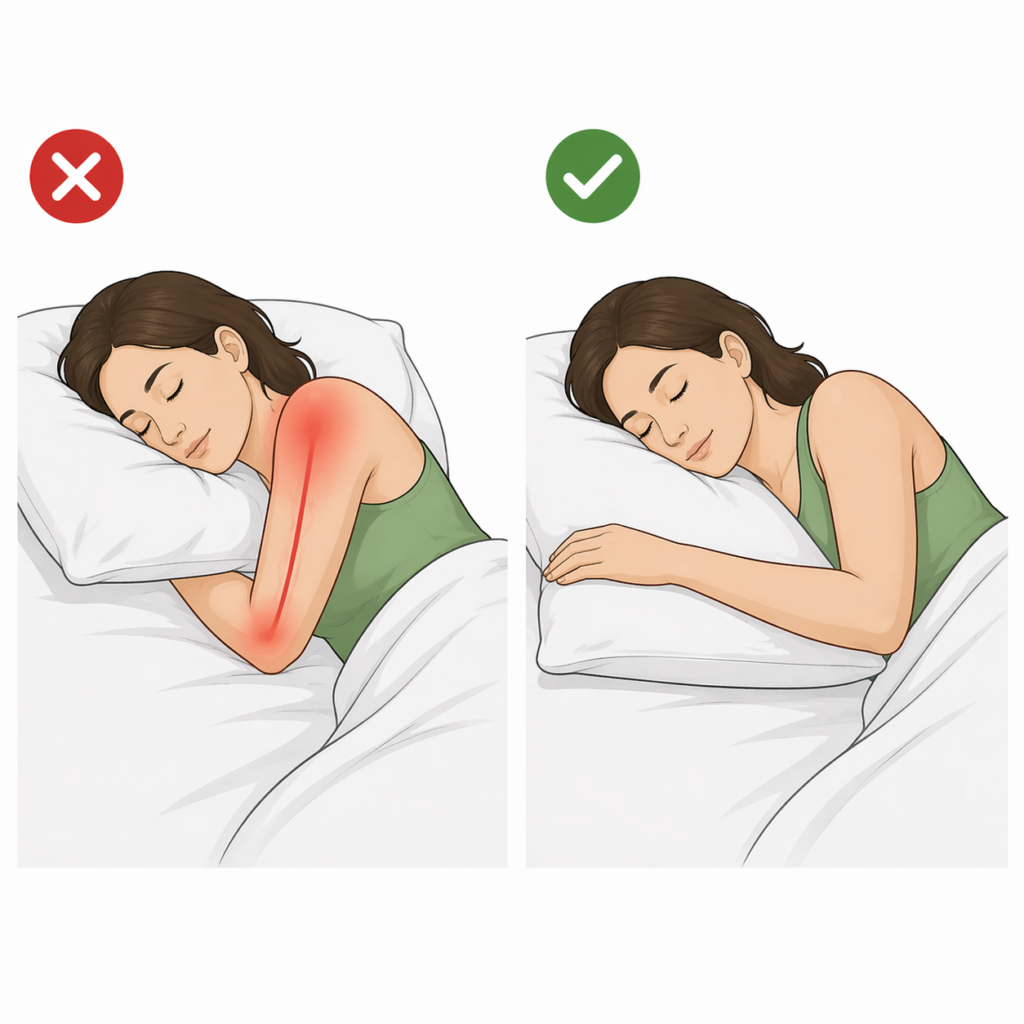
3. Sleeping with your arm trapped
This is one of those habits that feels comfortable in the moment but causes problems over time.
A lot of people sleep with their arm under the pillow or even under their body without thinking about it. It can feel natural, especially if you sleep on your side.
The issue is what happens while you stay in that position for hours.
What is actually happening
When your arm is trapped under your head or body, you are putting constant pressure on nerves and blood vessels.
At first, nothing happens.
But after a while:
- Circulation slows down
- Nerves get compressed
- The shoulder joint stays in a fixed, stressed position
That is why you might wake up with:
- Shoulder pain
- Tingling
- A numb or “dead” arm
And then it slowly goes away once you start moving.
Why this turns into real pain
If this happens occasionally, it is not a big deal.
But if you sleep like this every night, your shoulder never fully relaxes. It spends hours in a compressed position without recovery.
Over time, this can lead to:
- Irritation in the joint
- Muscle tightness
- Increased sensitivity when you wake up
It is not a serious injury, but it builds up.
The fix is simpler than you think
You do not need to completely retrain how you sleep.
You just need to remove the pressure.
Try this:
- Keep your arms in front of your body instead of underneath
- Use a pillow to “hug” so your top arm has somewhere to rest
- If you wake up with numbness, gently reposition instead of ignoring it
At first, it may feel unnatural.
But after a few nights, your body adapts.
4. Your mattress is working against you
Most people focus on pillows and forget something bigger.
Your mattress.
If your shoulder pain keeps showing up no matter how you sleep, your mattress might be part of the problem.
Because even with a good position, if the surface underneath you is wrong, your body cannot stay aligned.
What usually goes wrong
There are two common scenarios.
If your mattress is too soft, your shoulder sinks too much into it.
That creates an uneven position where your spine curves and your shoulder stays compressed.
If it is too firm, the opposite happens.
Your shoulder cannot sink at all, so it takes the full pressure of your body weight.
In both cases, your body compensates without you noticing.
And after hours in that position, you feel it in the morning.
Why this matters more over time
Unlike your pillow, which only affects your upper body, your mattress affects your entire posture.
That means:
- Your spine alignment
- Pressure distribution
- How your joints recover overnight
Sleep research has shown that medium firm surfaces tend to reduce pressure points and improve comfort for most people.
Not perfect for everyone, but a good baseline.
A quick way to know if this is your problem
Ask yourself this:
- Do you feel better sleeping in another bed (hotel, sofa, etc.)?
- Does the pain get worse over time, not suddenly?
- Is your mattress more than 7 to 10 years old?
If the answer is yes to any of these, your mattress is likely playing a role.
What actually helps
You do not always need to replace your mattress immediately.
Start here:
- If your mattress feels too firm, adding a soft memory foam topper can reduce pressure on your shoulder without replacing the whole mattress.
- If it feels too soft → you may need more support (or eventually change it)
- If your mattress is too old or no longer supportive, switching to a medium-firm mattress designed for pressure relief can make a noticeable difference over time.
Even small changes in surface feel can reduce shoulder stress a lot.
5. Hidden inflammation that feels worse in the morning
Sometimes, the problem is not just how you sleep.
It is what is already happening inside your shoulder.
You can have mild irritation or inflammation without realizing it during the day. It might feel like normal tightness or fatigue.
But at night, things change.
Why it feels worse after sleeping
When you sleep, your body stays still for hours.
That means:
- Less movement
- Slower circulation
- More stiffness building up in the joint
If your shoulder is already slightly irritated, this makes it more noticeable in the morning.
That is why the pain often feels worse right after waking up and then improves as you start moving.
What could be behind it
You do not need a serious injury for this to happen.
Common causes include:
- Mild tendon irritation
- Early-stage bursitis
- Overuse from daily activities
This is very common in people who:
- Work at a desk
- Train upper body frequently
- Spend a lot of time on their phone
Nothing extreme, just accumulated stress.
The important part
This does not mean something is “broken”.
But it does mean your shoulder is not fully recovering.
And if you ignore it, the discomfort can slowly become more persistent.

What actually helps
You do not need complicated treatments.
Start simple:
- Gentle shoulder movement in the morning
- Light stretching before bed
- Avoid overloading the shoulder for a few days if it feels irritated
The goal is to reduce stiffness and help your shoulder recover naturally.
6. What you do during the day is catching up with you
It is easy to blame your pillow or your sleeping position.
But in many cases, the real cause starts long before you go to bed.
Your shoulder is being used all day. And sometimes, it is being overused without you noticing.
What is actually happening
Small habits add up.
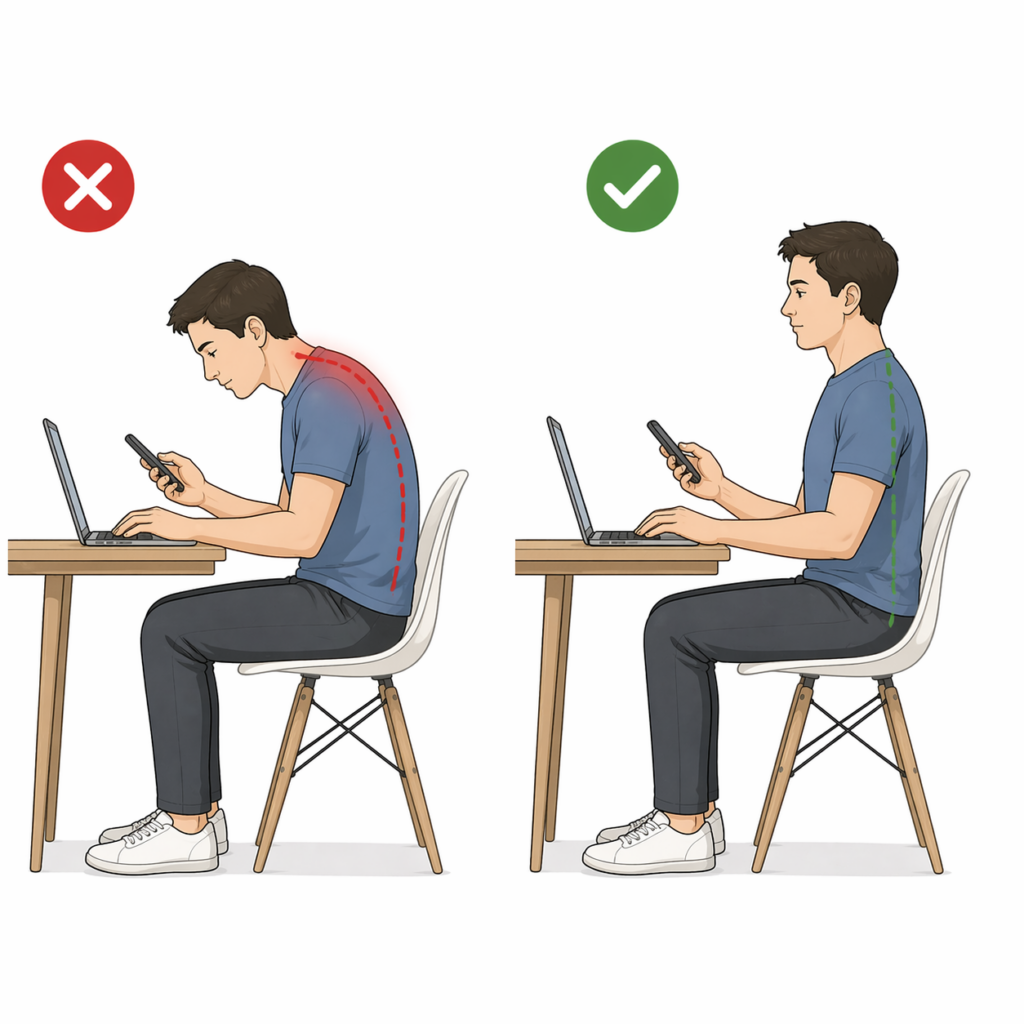
Spending hours sitting with your shoulders slightly forward.
Looking down at your phone.
Training shoulders at the gym without enough recovery.
None of these things seem like a problem on their own.
But together, they create constant low-level stress in the joint.
By the time you go to sleep, your shoulder is already fatigued.
Why you only notice it in the morning
During the day, your body is moving.
At night, it is not.
So all that accumulated tension stays there, without being released.
That is why you wake up feeling it more clearly. Sleep does not create the problem. It reveals it.
Signs this might be your case
- You sit a lot during the day
- You use your phone frequently
- You train upper body regularly
- The pain improves as the day goes on
If this sounds familiar, your daily habits are likely part of the issue.
What actually helps
You do not need to change your whole routine.
Just reduce the load slightly:
- Keep your shoulders relaxed instead of rounded forward
- Take short breaks if you sit for long periods
- Avoid training shoulders intensely if they already feel irritated
- Add a bit of movement during the day
These small adjustments reduce the stress that builds up before you even go to sleep.
What you can do starting tonight
Waking up with shoulder pain is frustrating, especially when it keeps happening and you do not know why.
In most cases, it is not a serious problem.
It usually comes down to small things that add up over time. Your sleeping position, your pillow, your mattress, and even your daily habits all play a role.
The good part is that you do not need a drastic change to start feeling better.
A simple adjustment like improving your pillow, reducing pressure on your shoulder, or fixing your posture can make a noticeable difference in just a few nights.
If you have been wondering why does my shoulder hurt after sleeping, now you know it is rarely just one cause. It is usually a combination of small factors that you can actually fix.
*Disclosure: Some of the links on this site are affiliate links. This means that if you choose to make a purchase through them, we may earn a small commission at no additional cost to you. We only recommend products or tools that are relevant to the content and that we believe can provide value. This helps support the site and allows us to continue creating useful, free content.