

You’re Probably Thinking About Fat Loss the Wrong Way
You’ve cut carbs. You’ve skipped dinner. You’ve done the 7am runs. And yet — the scale barely moves, or worse, you lose a few pounds and it all comes back within a month.
Here’s the thing: most people fail at fat loss not because they lack discipline, but because they don’t understand the actual mechanism. They follow rules without understanding the why — and that’s a recipe for frustration, yo-yo dieting, and eventually giving up on the whole thing.
Sound familiar?
The good news is that once you understand how fat loss actually works — the real science, not the Instagram version — everything starts to make sense. The confusion disappears. And you stop wasting time on approaches that were never going to work.
This article breaks down exactly how calorie deficit fat loss works — not with bro-science or vague advice, but with real, evidence-based explanations you can actually use starting today.
What Is Body Fat, Really?
Body fat isn’t just «extra weight» or a sign you’ve been lazy. Before we talk about losing it, it helps to understand what it actually is.
Body fat is stored energy. When you eat more calories than your body uses, it converts the surplus into triglycerides — a form of fat — and stores them in specialized cells called adipocytes. These cells can expand dramatically to hold more fat, and they can also shrink when that stored energy is mobilized and burned.
Think of your fat tissue like a savings account. Every time you eat more than you need, your body makes a deposit. Every time you’re in an energy deficit, your body makes a withdrawal — pulling from those fat stores to power everything from your morning run to your brain activity throughout the day.
Fat loss = making consistent withdrawals from that account.
This matters because it immediately reframes the whole process. You’re not «burning fat» through willpower or eating certain magic foods. You’re creating the conditions that force your body to access its own stored energy. And those conditions come down to one thing: a calorie deficit.
The Science of Energy Balance (Kept Simple)
Your body runs on energy, measured in calories. Every single thing it does — breathing, blinking, digesting food, maintaining body temperature, walking to the fridge, thinking — requires energy.
The energy balance equation looks like this:
Calories In – Calories Out = Energy Balance
- Positive balance (surplus): More in than out → the body stores the excess, primarily as fat
- Zero balance (maintenance): In equals out → weight stays roughly the same
- Negative balance (deficit): Less in than out → the body draws from stored fat to make up the difference
This is not a theory or a diet philosophy. It’s thermodynamics — the first law, specifically, which states that energy cannot be created or destroyed, only converted. Your body is not exempt from the laws of physics. Nobody’s is.
Now, it’s not perfectly linear. Hormones, food quality, gut microbiome composition, sleep, and metabolic adaptation all influence things at the edges. But the energy balance model is the non-negotiable foundation. Every successful diet in human history — keto, low-fat, Mediterranean, carnivore, intermittent fasting — works because it helps people achieve and maintain a negative energy balance. Not for any other reason.
Understanding this is genuinely liberating. It means you’re not at the mercy of some mysterious metabolic fate. You have more control than you think.
Calorie Deficit Explained: What It Is and How It Works
A calorie deficit means you’re consistently consuming fewer calories than your body burns over time.
Your body has a daily calorie «budget» — often called your Total Daily Energy Expenditure (TDEE). This is the total number of calories your body burns across an entire day, and it has four main components:
- BMR (Basal Metabolic Rate): The calories burned just to stay alive — keeping your heart beating, lungs breathing, organs functioning. This accounts for roughly 60–70% of your total daily burn.
- NEAT (Non-Exercise Activity Thermogenesis): All movement that isn’t structured exercise — walking, fidgeting, gesturing, cleaning, taking the stairs. Far more variable than people realize, and a powerful lever for fat loss.
- EAT (Exercise Activity Thermogenesis): Your actual workouts. Despite what most people assume, this is usually the smallest piece of the puzzle — often just 5–10% of total daily expenditure.
- TEF (Thermic Effect of Food): The energy required to digest and process what you eat. Protein costs the most (20–30% of its calories are burned in digestion), followed by carbs (5–10%), then fat (0–3%).
When you eat below your TDEE consistently — even by a moderate amount — your body must find fuel elsewhere. And with adequate protein intake and a reasonable deficit size, «elsewhere» means your fat stores.
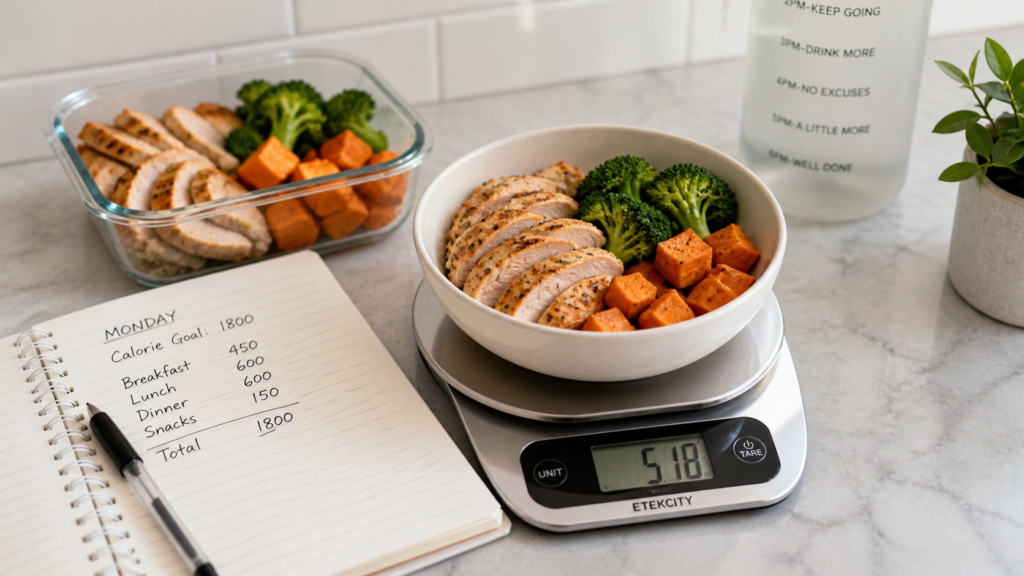
A deficit of roughly 300–500 calories per day is generally considered the sweet spot for sustainable fat loss. That translates to roughly 0.5–1 lb of fat lost per week — which sounds slow, but compounds into serious, visible results over time without destroying muscle or collapsing your metabolism.
The Three Energy States: What’s Happening in Your Body
| State | Calories vs. TDEE | What Happens |
|---|---|---|
| Calorie Surplus | More than TDEE | Body stores excess energy as fat; muscle gain is also possible with resistance training |
| Calorie Maintenance | Equal to TDEE | Weight stays stable; body composition holds roughly steady |
| Calorie Deficit | Less than TDEE | Body draws on stored fat and glycogen for fuel; muscle loss is possible without adequate protein |
The size of your deficit matters a great deal. A deficit that’s too small produces fat loss so slow it’s hard to detect or stay motivated through. A deficit that’s too large — say, cutting 1,000+ calories daily — increases the risk of muscle breakdown, hormonal disruption (particularly in women), energy crashes, and rebound overeating that wipes out weeks of progress overnight.
Sustainable, meaningful fat loss lives in the middle zone. Not aggressive. Not timid. Consistent.
How Fat Loss Works at a Cellular Level
When you’re in a calorie deficit, your body goes through a specific sequence to find fuel.
First, it burns through circulating blood glucose. Then it taps into glycogen — stored carbohydrate in your liver and muscles. As glycogen depletes (which is also why you lose several pounds quickly at the start of a diet — those stores hold significant water), your body ramps up fat oxidation.
Fat cells release stored triglycerides into the bloodstream. These get broken down into fatty acids and glycerol, which your cells then use to produce ATP — the actual energy currency your body runs on. The byproducts of this process are ultimately expelled as carbon dioxide (through breathing) and water (through urine and sweat). Literally: you breathe out most of the fat you lose.
This is also why «spot reducing» fat doesn’t work. You can’t target which fat cells release their stores by doing crunches or leg raises. Fat is mobilized systemically, driven by hormonal signals — primarily insulin suppression and adrenaline release — not locally based on which muscle you’re working. The body decides where to pull from, and it’s largely genetically determined.
It’s also why the scale isn’t the whole story. Early weight loss reflects glycogen and water depletion. Actual fat tissue loss takes consistency across weeks, not days.
Why I Don’t Lose Fat (Even When I Think I’m Dieting)
This is the section most fat loss articles completely skip. But it’s arguably the most useful part — because understanding why things go wrong is what separates people who finally make real progress from those who keep trying and failing.
1. Underestimating Calories
Research consistently shows that people underestimate their calorie intake by 30–50% on average — and even trained dietitians underestimate by around 20%. A handful of mixed nuts (200+ calories), a tablespoon of olive oil (120 calories), a «light» dressing that’s anything but, a piece of someone’s leftover birthday cake — it adds up faster than anyone expects. Most people who say «I barely eat anything» are genuinely shocked when they weigh and log everything carefully for just one week.
2. Liquid Calories
A morning oat milk latte, a glass of orange juice, a couple of glasses of wine at dinner, and a post-workout protein shake can add 700–1,000 calories to your day. The problem is that liquids largely bypass your body’s satiety signaling — they don’t stretch your stomach wall or trigger the same fullness hormones that solid food does. So you consume the calories without feeling like you ate much of anything. These are genuinely invisible to most dieters, and they are one of the most common reasons people plateau without explanation.
3. Weekend Overeating
You eat at a meaningful deficit Monday through Friday — say, 400 calories under each day, a total of -2,000 calories. Then Friday dinner out adds an extra 500 calories, Saturday is a social day with brunch, drinks, and a big dinner, and Sunday means a relaxed family lunch plus some snacking. That weekend surplus easily totals 2,000–3,000 calories. The week ends flat or in surplus. And you genuinely felt like you were dieting the entire time. This pattern is extremely common and explains why many people can diet for months without meaningful progress.
4. NEAT Reduction
This one operates entirely below conscious awareness and is one of the more frustrating realities of fat loss. When your body senses an energy deficit, it unconsciously signals you to move less. You fidget less. You take elevators instead of stairs without thinking about it. You sit down more. You gesture less when you speak. Research shows NEAT can drop by 300–500 calories per day in response to extended dieting — partially or entirely cancelling out the deficit you created through food restriction. Your body is defending its fat stores, and it’s very good at it.
5. Sleep and Stress
Poor sleep is one of the most underrated fat loss disruptors in existence. Even a single night of inadequate sleep increases ghrelin (the hormone that signals hunger) and suppresses leptin (the hormone that signals fullness and satisfaction). The measurable result: you consume an average of 300–500 extra calories the following day, driven largely by cravings for high-fat, high-sugar comfort foods.
Chronic stress operates through a different mechanism. Elevated cortisol promotes fat storage — particularly dangerous visceral fat around the abdomen — and simultaneously drives appetite and food-seeking behavior. You’re not imagining it: stress makes fat loss physiologically harder, not just psychologically harder.
6. Adaptive Thermogenesis
The longer and more aggressively you diet, the more your metabolism adapts downward. Your TDEE shrinks — not just because you weigh less and therefore your BMR is lower, but because your body actively downregulates energy expenditure beyond what your weight loss alone would predict. Thyroid hormone output decreases. Muscle efficiency increases (meaning your muscles do the same work with fewer calories burned). This is called metabolic adaptation, and it’s a well-documented phenomenon. The 500-calorie deficit you calculated and started with in week one may no longer exist in week ten — even if you’re eating the exact same amount.
Read more: Best Foods for Fat Loss
Fat Loss vs. Weight Loss: A Distinction That Actually Matters
This is one of the most important clarifications in all of nutrition, and it’s almost always glossed over.
Weight loss = any reduction in total body weight. This includes water, muscle tissue, bone density shifts, and fat.
Fat loss = specifically reducing stored body fat while ideally preserving or building lean muscle mass.
These are very different outcomes with very different consequences for how you look and feel.
When you cut carbohydrates aggressively, you deplete glycogen, and since each gram of glycogen is stored with 3–4 grams of water, you can lose 4–6 lbs in the first week alone. That’s water. It comes back within days of reintroducing carbs. This is weight loss — dramatic, satisfying on the scale, and completely meaningless from a body composition perspective.
More concerning: when you diet aggressively without adequate protein, your body increasingly breaks down muscle tissue for fuel. You can lose significant scale weight while simultaneously getting fatter as a percentage of your total body composition. Your clothes can fit worse even as the number on the scale drops. This is a real, common failure mode — especially with extreme calorie restriction, crash diets, and liquid cleanses.
The goal isn’t a lower number on a scale. The goal is less fat and preserved muscle — and that requires a moderate deficit, high protein intake, and ideally some resistance training to signal to your body that muscle is necessary and worth keeping.

How to Actually Create a Calorie Deficit (Without Making Your Life Miserable)
Here’s the practical side. Creating a sustained calorie deficit doesn’t require suffering through hunger, giving up entire food groups, or overhauling your entire lifestyle overnight. It requires building smarter habits that lower your intake and raise your expenditure — and importantly, habits that don’t depend on willpower to maintain.
Step 1: Know Your Starting Number
You can’t navigate without a map. Use an online TDEE calculator — the Mifflin-St Jeor equation is the most clinically validated formula for the general population. Input your age, height, weight, and activity level. This gives you an estimated maintenance calorie number to work from.
Then subtract 300–500 calories from that number. That’s your daily fat loss target. Simple.
Step 2: Prioritize Protein Above Everything Else
Protein is the single most important dietary lever during a fat loss phase, for multiple reasons.
It’s the most satiating macronutrient — it keeps you fuller per calorie than carbohydrates or fats. It has a high thermic effect, meaning your body burns more calories processing it. And critically, it preserves muscle tissue while you’re in a deficit, which protects your metabolism and ensures the weight you lose is actually fat rather than lean mass.
Aim for 1.6–2.2g of protein per kg of bodyweight per day. For an 80kg person, that’s roughly 130–175g of protein daily. Prioritize lean sources: chicken breast, turkey, white fish, eggs, Greek yogurt, cottage cheese, and legumes.
Step 3: Smart Food Swaps That Create a Deficit Almost Effortlessly
Strategic swaps often produce your entire deficit without any feeling of restriction:
- Plain Greek yogurt instead of flavored yogurt → saves ~100 calories
- Sparkling water or still water instead of soda → saves 140+ calories
- Grilled or baked chicken instead of fried → saves 150–200 calories
- Black coffee or Americano instead of a sugary latte → saves 200–400 calories
- Air-popped popcorn instead of chips for an evening snack → saves ~100 calories
None of these feel like sacrifice. Together, they can easily produce a 400–600 calorie daily deficit without any dramatic changes to your eating patterns.
Step 4: Walk More — This Is Genuinely Underrated
If there’s one underrated fat loss tool, it’s walking. The difference between 3,000 steps and 10,000 steps per day is roughly 400–500 calories for most people. That’s a substantial and essentially free deficit — one that doesn’t spike hunger the way intense cardio often does.
Take calls while walking. Park farther away. Take the stairs by default. Walk to lunch instead of sitting at your desk. A daily step goal is often more sustainable than any gym cardio protocol and easier to maintain through travel, busy weeks, and life disruptions.
Step 5: Use Portion Awareness if Calorie Counting Feels Overwhelming
Tracking calories is effective but genuinely isn’t for everyone. If logging every gram sounds like a fast track to anxiety, use visual hand portions as a practical guide:
- Protein: one palm-sized serving per meal
- Carbohydrates: one fist-sized serving per meal
- Fats: one thumb-sized serving per meal
- Vegetables: fill half your plate at every meal, no restriction needed
This isn’t perfectly precise — but it’s dramatically better than estimating nothing. And for many people, it’s the approach that actually sticks.
A Real-Life Calorie Deficit Example (With Actual Numbers)
Let’s make this completely concrete.
Profile: 35-year-old woman, 75kg (165 lbs), office job, gym 3 times per week.
Estimated TDEE: ~2,000 calories/day
Target deficit: ~500 calories/day → 1,500 calories/day
Sample day:
| Meal | What She Eats | Approx. Calories | Protein |
|---|---|---|---|
| Breakfast | 2 whole eggs + 150g plain Greek yogurt + 80g blueberries | ~350 kcal | ~30g |
| Lunch | Large grilled chicken salad with olive oil and lemon dressing | ~450 kcal | ~40g |
| Snack | 1 apple + 20g almonds | ~200 kcal | ~5g |
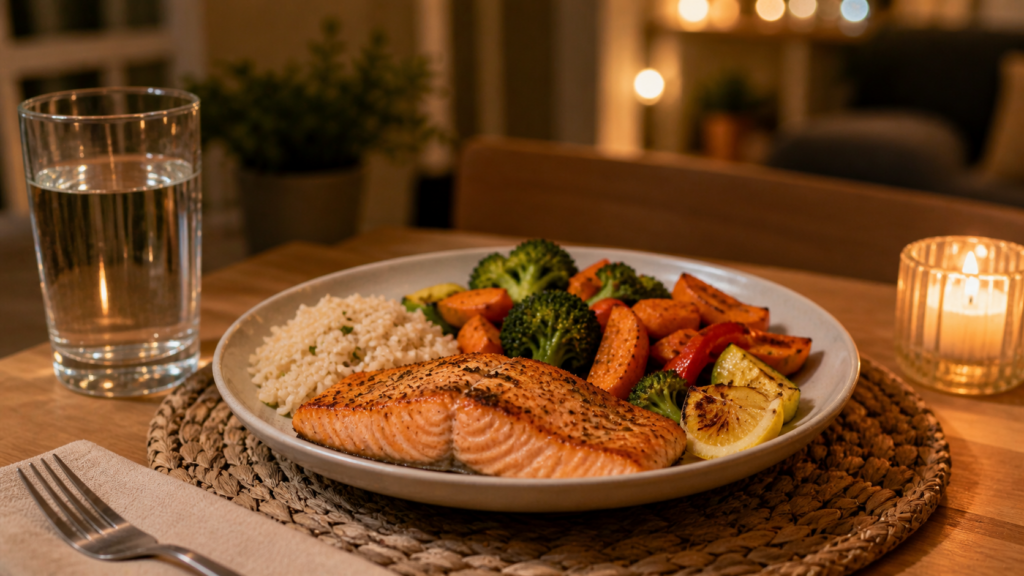
| Dinner | 150g salmon + roasted vegetables + 70g cooked white rice | ~500 kcal | ~38g |
| Total | ~1,500 kcal | ~113g protein |
That’s a 500-calorie daily deficit. Over one week: -3,500 calories — approximately the energy content of 1 lb of body fat.
Over 12 weeks of this kind of consistency: 10–12 lbs of actual fat loss. Not water. Not muscle. Fat.
Not dramatic. Not miserable. No hunger that can’t be managed. No food groups cut out. Just boring, consistent math executed patiently — week after week.
This is the part no one wants to hear, but it’s also the most freeing part: fat loss is not complicated. It just requires time and consistency.
How Long Does It Actually Take to See Results?
This is the question most people avoid answering honestly. Here it is:
Visible fat loss — changes you can see in photos or that others notice — typically takes 4–8 weeks of consistent deficit eating. Scale changes appear sooner (2–4 weeks), but those early numbers are heavily influenced by water and glycogen fluctuations.
The scale will not move in a straight line. It will go up 1–2 lbs some mornings. It will stay completely flat for a week or two. This is completely normal — it reflects water retention from sodium intake, hormonal fluctuations (particularly in women across their menstrual cycle), digestion timing, and glycogen refilling after exercise. None of it represents actual fat gain.
Track trends over 4-week periods, not daily numbers. Monthly progress photos are far more motivating and accurate than the scale. Waist circumference measurements tell you more than weight alone. And pay attention to how your clothes fit — that’s often the most honest metric of all.
The people who ultimately get the results they want aren’t the ones who found the perfect diet or the optimal macro split. They’re the ones who stayed consistent when progress felt invisible and resisted the urge to blow everything up and restart something more extreme every six weeks.
Key Takeaways
- A calorie deficit is the non-negotiable requirement for fat loss — every effective diet works by creating one
- Your TDEE includes far more than your workouts — daily movement (NEAT) is often the biggest and most controllable lever
- Most people plateau because they’re unknowingly at maintenance or surplus, not actually in a deficit
- Fat loss and weight loss are not interchangeable — muscle preservation requires adequate protein and a moderate (not aggressive) deficit
- A deficit of 300–500 calories/day is the sustainable sweet spot for most people
- Sleep and stress directly impact hunger hormones and fat storage — they are not soft factors
- Walking more is an underrated and powerful tool for increasing calorie expenditure
- Results take time — track 4-week trends, not daily scale numbers
The Bottom Line
Calorie deficit fat loss isn’t a hack, a trend, or a marketing concept. It’s the mechanism. It’s how human metabolism works, and no amount of supplement marketing or diet branding changes that underlying reality.
Everything you’ve heard about — keto, intermittent fasting, low-carb, carb cycling, eating windows, fat burner pills — only produces results when and because it helps you create or sustain a calorie deficit. Strip away the branding, the rules, and the pseudoscience, and that’s what’s underneath every approach that has ever worked for anyone, anywhere.
Once you truly internalize that, the decision fatigue largely disappears. You stop jumping between diets every six weeks. You stop wondering if some new eating protocol or macro split is the secret missing piece. You stop blaming your metabolism or your genetics when the real issue is a miscalibrated deficit.
Eat a moderate amount less than you burn. Eat enough protein to protect your muscle. Sleep well. Manage stress where you can. Move throughout your day, not just during your workouts. And give it significantly more time than feels comfortable.
That’s how fat loss works. Now you understand it.