
Most people don’t fail fat loss because they lack willpower. They fail because their plan is either too complicated, too extreme, or designed to last exactly two weeks before life gets in the way.
If you’ve ever started strong on Monday, hit a wall by Thursday, and decided to «restart next week» — you already know what I mean. The problem isn’t you. It’s the plan.
A well-structured weekly fat loss routine removes that chaos. Instead of winging it day by day, you follow a repeating system that builds momentum over time. Simple, sustainable, and backed by how your body actually works.
That’s what this guide is about. Not a crash diet. Not a two-hour daily workout. Just a realistic weekly structure you can stick to.
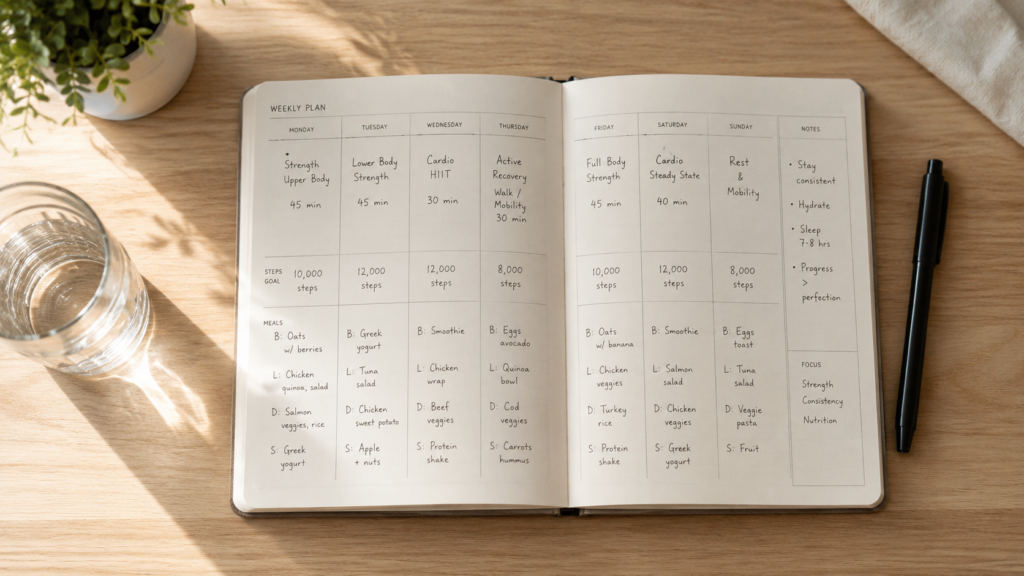
Why a Weekly Structure Actually Works (The Science Behind It)
Here’s the thing about fat loss: your body doesn’t care if you’re perfect today. It cares about what you do consistently over weeks and months.
Fat loss comes down to energy balance — specifically, burning more calories than you consume over time. Not perfectly every single day, but on average. A study published in Obesity Reviews confirmed that adherence to a plan — not the intensity of it — is the strongest predictor of long-term fat loss success.
A weekly routine works because:
- It creates predictability. When your brain knows what’s coming, resistance drops. You don’t have to make decisions from scratch every day.
- It allows recovery. Your body needs rest to actually burn fat efficiently. A well-designed week builds that in automatically.
- It accumulates NEAT. NEAT (non-exercise activity thermogenesis) — things like walking, standing, and fidgeting — can account for up to 30% of your daily calorie burn. A weekly structure that keeps you moving outside the gym matters just as much as your workouts.
The goal isn’t perfection. It’s a consistent average that creates a calorie deficit over time.
The Three Pillars of Fat Loss (Keep It Simple)
Before we get into the actual weekly plan, you need to understand what you’re optimizing for. Fat loss is built on three things:
1. Movement — Both structured exercise (workouts) and daily activity (steps, walking, not sitting for 8 hours straight).
2. Nutrition — Eating in a way that creates a modest calorie deficit without destroying your metabolism or leaving you miserable. No elimination diets required.
3. Recovery — Sleep, rest days, and stress management. These aren’t optional extras. Without recovery, your body holds onto fat and breaks down muscle instead.
That’s it. Every effective fat loss plan in existence is just a variation of these three things. The question is how to arrange them in a week that doesn’t feel like punishment.
The Simple Weekly Fat Loss Routine
Here’s a realistic weekly schedule built for beginners and intermediate trainees. It requires no more than 45–60 minutes of structured exercise per day, three to four times a week.
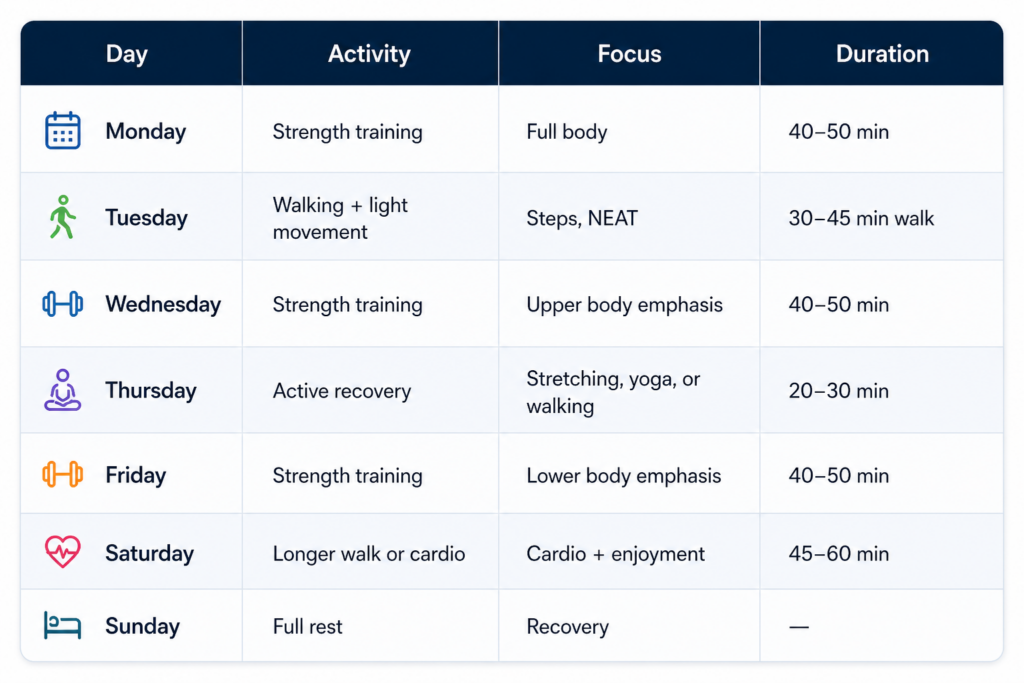
This isn’t rigid. Life will interrupt it — and that’s fine. If you miss Wednesday, you do it Thursday and shift everything one day. The structure is a guide, not a contract.
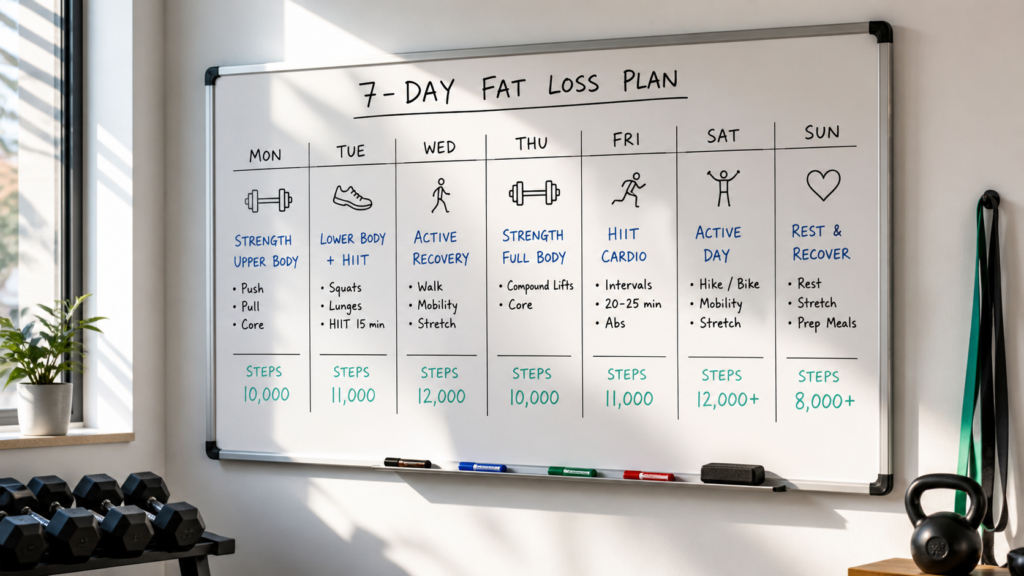
Workout Structure: What to Actually Do (Step-by-Step)
Vague advice like «do some strength training» is useless without knowing what that means. Here’s exactly what to do on each workout day.
Full Body Strength (Monday & Wednesday)
Do these exercises as a circuit or straight sets. Either works.
The Routine:
| Exercise | Sets | Reps | Rest |
|---|---|---|---|
| Goblet squat (or bodyweight squat) | 3 | 10–12 | 60 sec |
| Push-up (incline if needed) | 3 | 8–12 | 60 sec |
| Dumbbell row (or resistance band row) | 3 | 10 each side | 60 sec |
| Romanian deadlift (or hip hinge) | 3 | 10–12 | 60 sec |
| Plank | 3 | 20–30 sec | 45 sec |
At home? Replace goblet squat with bodyweight squat, rows with doorframe rows or a resistance band, and deadlifts with a single-leg hip hinge using your own bodyweight. It’s not about equipment — it’s about loading the right muscles.
Intensity level: You should feel challenged but not destroyed. The last 2–3 reps of each set should be hard. If they’re easy, add weight or slow down the movement.
Lower Body Emphasis (Friday)
| Exercise | Sets | Reps | Rest |
|---|---|---|---|
| Bulgarian split squat | 3 | 8–10 each leg | 75 sec |
| Glute bridge or hip thrust | 3 | 12–15 | 60 sec |
| Lateral lunge | 3 | 10 each side | 60 sec |
| Calf raise | 2 | 15–20 | 45 sec |
| Dead bug (core) | 3 | 6–8 each side | 45 sec |
Cardio Days (Tuesday, Saturday)
Tuesday is a casual walk — 30 to 45 minutes at a comfortable pace, aiming for 6,000 to 8,000 steps minimum. This isn’t about burning calories in the gym. It’s about keeping your NEAT high throughout the week.
Saturday is more intentional: a longer walk (45–60 minutes), a light jog, a bike ride, or a fitness class you enjoy. The goal is to stay active and get some cardiovascular work in without burning yourself out before Monday.

Nutrition: What to Eat to Lose Fat (Without a Diet)
You don’t need to count every calorie obsessively. But you do need a rough understanding of how much you’re eating and whether it supports a deficit.
What a Calorie Deficit Actually Means
Your body burns a certain number of calories each day just to function — this is your TDEE (Total Daily Energy Expenditure). To lose fat, you need to eat slightly less than that number, typically 300–500 calories below your TDEE.
That’s it. No elimination. No detoxes. A 400-calorie deficit per day adds up to roughly 0.8 lbs of fat loss per week — which is sustainable and realistic.
To estimate your TDEE, use this calculator and input your age, weight, height, and activity level. Then aim to eat about 300–500 calories below that number.
TDEE Calculator
How to Structure Your Meals
You don’t need six meals a day or specific eating windows. Most people do well with three balanced meals and a snack if needed.
The formula for each meal:
- A source of protein (keeps you full, preserves muscle)
- A source of complex carbs (energy, fiber)
- Vegetables (volume, micronutrients)
- A small amount of fat (hormones, satiety)
Here’s what that looks like in practice:
| Meal | Example |
|---|---|
| Breakfast | Greek yogurt + oats + mixed berries |
| Lunch | Grilled chicken breast + brown rice + roasted broccoli |
| Dinner | Baked salmon + sweet potato + steamed spinach |
| Snack (optional) | Cottage cheese + a handful of almonds |
Why Protein Is Non-Negotiable
Protein does two critical things during fat loss. First, it preserves lean muscle mass — without it, a calorie deficit eats into muscle, not just fat. Second, it’s the most satiating macronutrient, meaning it keeps you full longer and reduces cravings.
Aim for approximately 0.7–1g of protein per pound of bodyweight daily. For a 160 lb person, that’s 112–160g of protein per day.
High-protein foods include: chicken breast, eggs, Greek yogurt, cottage cheese, tuna, salmon, lean beef, tofu, tempeh, and legumes.
What to Reduce (Not Eliminate)
No food needs to be completely off-limits. But these tend to contribute calories without much satiety or nutrition:
- Ultra-processed snacks (chips, cookies, packaged pastries)
- Liquid calories (soda, juice, alcohol, fancy coffee drinks)
- Large portions of refined carbs with no protein or fiber alongside them
The goal is to eat mostly whole foods that fill you up, not to make yourself miserable.
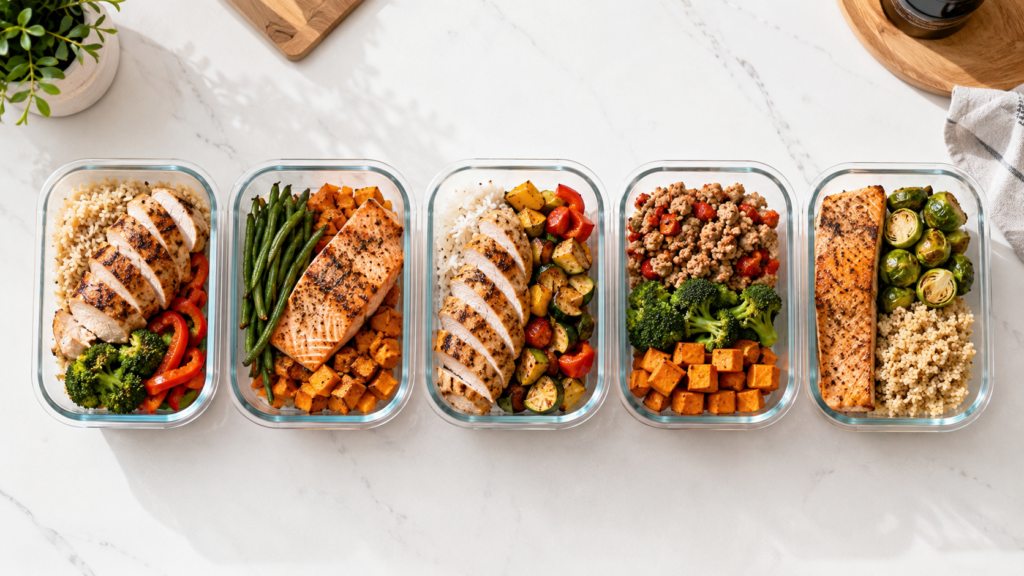
Daily Habits That Quietly Accelerate Fat Loss
Beyond workouts and meals, the habits you carry through each day add up more than most people realize.
Hit 8,000–12,000 Steps Per Day
Walking is underrated for fat loss. Research from Medicine & Science in Sports & Exercise found that people who habitually walked 10,000 steps per day maintained significantly lower body fat percentages than sedentary counterparts — even without formal exercise.
You don’t need to do this all at once. A 15-minute walk after each meal is enough to hit 8,000 steps on most days.
Sleep 7–9 Hours
Sleep debt doesn’t just make you tired — it actively drives fat storage. A study from the Annals of Internal Medicine showed that participants in a calorie deficit who slept only 5.5 hours lost 55% less fat than those who slept 8.5 hours, despite eating the same amount.
Sleep governs hunger hormones (ghrelin and leptin). When you’re underslept, ghrelin spikes (you feel hungrier) and leptin drops (fullness signals weaken). You’re fighting biology every time you skimp on sleep.
Drink Enough Water
Aim for 2–3 litres per day. Dehydration is frequently mistaken for hunger. Drinking a large glass of water before meals has also been shown to reduce calorie intake at that meal by roughly 13%.
Break Up Long Sitting Periods
If you work at a desk, stand up and move for 5 minutes every hour. This keeps your NEAT high even on rest days and prevents the metabolic slowdown that comes from prolonged sedentary behaviour.
Common Mistakes That Kill Fat Loss Results
Understanding what not to do is just as important as knowing what to do.
Doing Too Much Too Fast
Jumping into six workouts a week on day one feels motivated. Three weeks later, you’re injured, exhausted, or burned out. Start with three sessions and build from there. Sustainability beats intensity every time.
Ignoring Calorie Intake
Exercise burns fewer calories than most people think. A 45-minute strength session burns roughly 200–300 calories — which is one protein bar. You cannot out-train a poor diet. Nutrition must be part of the equation.
Relying Only on Cardio
Cardio burns calories in the moment, but strength training builds muscle that raises your resting metabolic rate. More muscle means you burn more calories even when you’re not working out. A routine without strength training is leaving results on the table.
Expecting Linear Progress
The scale will fluctuate. Water retention, hormones, and food volume all affect your daily weight. Judging progress week-to-week (rather than day-to-day) gives you a far more accurate picture. Take measurements, progress photos, and notice how your clothes fit.
How to Actually Stick to This Routine
The best routine is the one you follow. Here’s how to make this one stick.
Make it frictionless. Lay your gym clothes out the night before. Keep healthy food visible and easy to grab. Remove obstacles before they appear.
Habit stack. Attach new habits to existing ones. Walk after dinner. Drink a glass of water before every meal. Do your mobility work while watching TV. This eliminates the need for motivation.
Track progress simply. You don’t need an elaborate system. A note on your phone logging workouts done, steps, and how meals felt is enough. Consistency is easier to maintain when you can see it.
Make room for imperfection. Miss a workout? Fine. The rule is never miss twice. One missed day doesn’t ruin a week. Two days in a row starts a new pattern.
Find your why. Not «I want to lose 15 lbs» — go deeper. More energy for your kids, confidence, health at 60. A surface-level goal fades fast. A meaningful reason doesn’t.
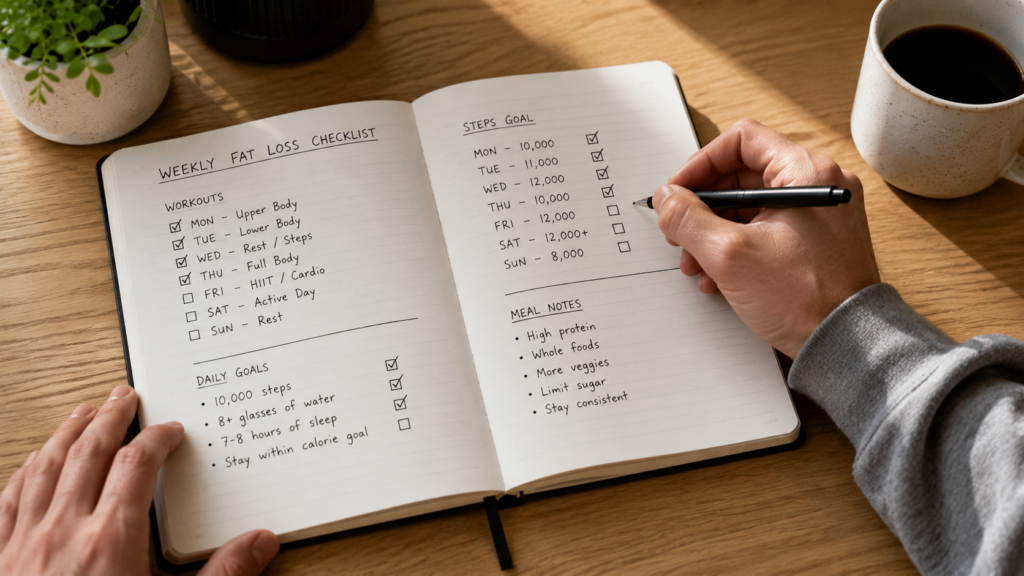
Your Simple Weekly Fat Loss Checklist
Use this each week to stay on track without overthinking it.
Movement
- 3 strength training sessions completed
- 8,000–12,000 steps hit every day
- At least one longer walk or cardio session done
Nutrition
- Protein goal hit most days (aim for 0.7–1g per lb of bodyweight)
- Ate mostly whole, unprocessed foods
- Stayed within your calorie target on most days (not necessarily all)
- Drank 2–3 litres of water daily
Recovery
- Slept 7+ hours most nights
- Took at least one full rest day
- Broke up long sitting periods during the day
Mindset
- Didn’t panic over scale fluctuations
- Got back on track after any slip-up
- Focused on the process, not just the outcome
You don’t need to check every box every week. Hitting 80% of these consistently is enough to lose fat steadily over time.
Conclusion: Simplicity Is the Strategy
Fat loss isn’t about finding the perfect diet or the most brutal workout program. It’s about building a system you can actually sustain — week after week, even when motivation isn’t there.
The routine above isn’t magic. But it covers everything that matters: consistent movement, a modest calorie deficit, sufficient protein, daily steps, and proper recovery. Done week after week, that’s what fat loss looks like in the real world.
Start with the first week. Don’t try to optimize every detail on day one. Pick up the habits gradually, track what matters, and trust that consistency — not perfection — is what moves the needle.
The people who lose fat and keep it off aren’t the ones who suffered the most. They’re the ones who built a routine they didn’t have to abandon.
Start simple. Stay consistent. The results will follow.