

Why Does Lying Down Make Back Pain Worse?
Here’s the thing that confuses most people: rest is supposed to help pain, not create it.
So when your lower back hurts more after lying down — or you wake up feeling worse than when you went to bed — it feels counterintuitive, even unfair. You did everything «right.» You rested. You stayed off your feet. And now you can barely stand up straight.
The reality is that lower back pain after lying down isn’t a sign that rest is failing you. It’s a signal that something specific is happening to your spine, muscles, and soft tissues during those hours of inactivity — and understanding what is the key to actually fixing it.
This isn’t about being unlucky or getting older. There are real, explainable reasons why lying down can intensify lower back pain, and most of them are correctable.
What Actually Happens to Your Spine While You Sleep
Your lumbar spine — the five vertebrae that form the curve of your lower back — is under constant mechanical pressure during the day. When you stand or sit, the discs between those vertebrae absorb compressive load. That’s their job. They’re built for it.
But when you lie down, something interesting happens: the pressure changes rather than disappears.
Spinal discs are hydrophilic — they absorb fluid when the compressive load is removed. Throughout the night, your discs rehydrate and expand slightly. You actually wake up marginally taller than when you went to bed. This sounds harmless, and for most people it is. But for someone with disc irritation, herniation, or significant inflammation, this rehydration process can increase pressure on surrounding nerves and tissues — which is one reason why lower back pain when lying down tends to feel more acute, not less.
There’s another piece most people miss. When you’re upright and moving, your paraspinal muscles — the long muscles running alongside your spine — are actively engaged. That constant low-level muscle activity keeps everything stable and helps manage spinal forces dynamically. When you lie still for hours, those muscles relax completely, and the structural load shifts entirely onto your joints, ligaments, and discs. If any of those structures are already compromised, that shift in load distribution can trigger or amplify pain.
The spine doesn’t just «rest» at night. It shifts responsibility from muscles to passive structures — and passive structures have no give.
The Inflammation Problem Nobody Explains Properly
Inflammation gets blamed for everything these days, to the point where it’s lost meaning. But in the context of back pain at night, it’s worth understanding mechanically rather than just as a buzzword.
When tissues in your lower back are inflamed — whether from a disc problem, a facet joint irritation, sacroiliac joint dysfunction, or plain old muscle strain — inflammatory cytokines accumulate in the area. During movement, those chemicals are dispersed somewhat through increased circulation and lymphatic activity. Movement literally flushes them out.
Lying still for six to eight hours without significant movement does the opposite. Circulation slows. Lymphatic clearance slows. Inflammatory mediators pool. The result: that dull throb you feel at 3am, or that stiffness that hits the moment you try to get out of bed.
This is also why so many people with lower back stiffness after resting find that their pain actually decreases within 20–30 minutes of moving around in the morning. The pain wasn’t lying — movement is genuinely helping, not just distracting.
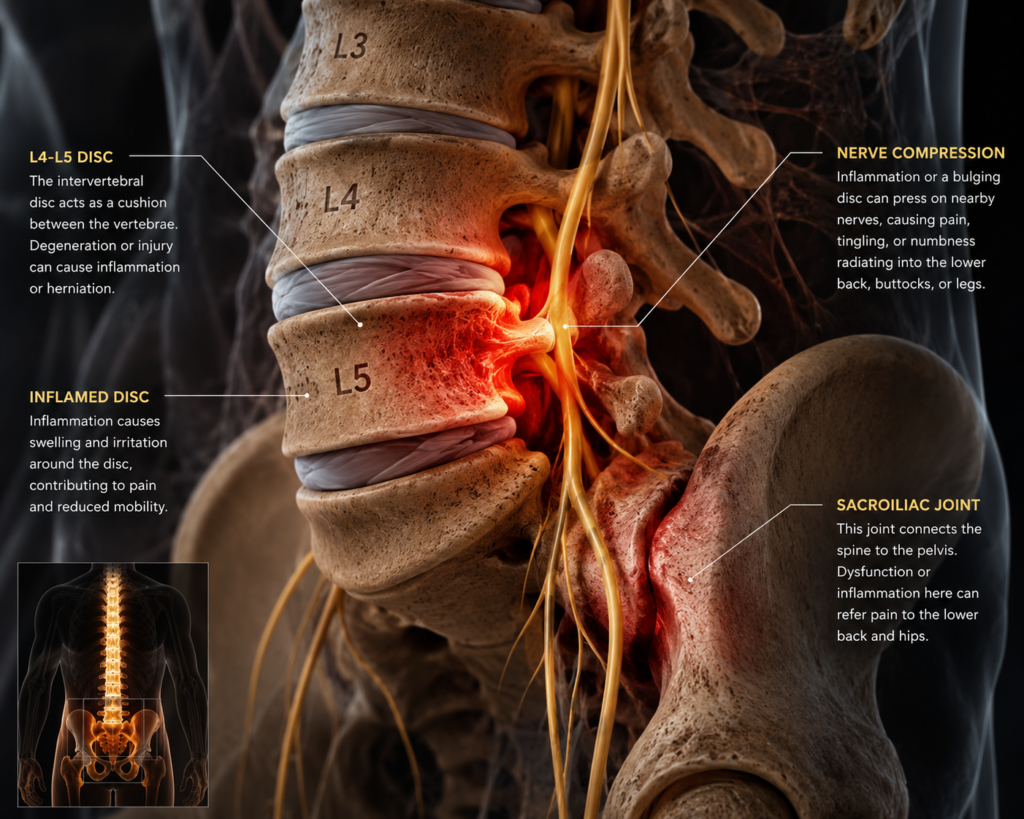
There’s also something called inflammatory pain cycling: pain disrupts sleep quality, poor sleep increases systemic inflammation markers (particularly interleukin-6 and C-reactive protein), and elevated inflammation makes pain more intense and harder to manage. It’s a self-reinforcing loop that purely passive rest doesn’t break.
How Your Mattress Could Be the Hidden Culprit
Let’s talk about the mattress, because it’s often blamed for everything and also often genuinely responsible for quite a lot.
The problem isn’t as simple as «firm is better» or «soft is better.» Lumbar alignment during sleep requires your mattress to do something specific: conform enough to your body’s natural curves without letting your heavier body parts (hips and shoulders) sink so far that your spine sags out of neutral alignment.
A mattress that’s too soft lets your hips sink disproportionately, which increases lumbar lordosis (the inward curve of the low back) and puts stretch and compression on structures that are already compromised. A mattress that’s too firm creates pressure points at the hips and shoulders — and if you’re a side sleeper, your spine ends up in a lateral curve all night.
🛏️ Mattress Firmness vs. Sleep Position
The “best” mattress depends heavily on how you sleep. Proper spinal alignment matters more than choosing the softest or firmest option.
| Sleep Position | Ideal Firmness | Why It Works |
|---|---|---|
| 💤 Side sleeper | Medium → Medium-soft | Allows hips and shoulders to sink slightly while keeping the spine aligned naturally |
| 🛌 Back sleeper | Medium → Medium-firm | Supports the lumbar curve without excessive arching or collapsing |
| ⚠️ Stomach sleeper | Firm | Helps reduce excessive lumbar arching, although this position is usually problematic overall |
| 🔄 Combination sleeper | Medium | Balances pressure relief and support across multiple sleep positions |
Back pain from a bad mattress often feels worse in the mornings and eases once you’ve been up for 30–60 minutes. If your pain is present during the day regardless of position, your mattress is probably not the primary driver. This is a reason to find a good mattress acording to you.
How to Test Your Mattress in 2 Minutes
Lie on your back in your normal sleep position. Slide your hand into the gap between your lower back and the mattress. If your hand slides in and out easily with lots of space, your mattress may be too firm and failing to support your lumbar curve. If you can barely fit your hand in at all, your hips are probably sinking too far into a soft surface.
Not definitive, but useful as a quick check.
Sleep Positions That Silently Overload the Lower Back
Stomach Sleeping: The Quiet Wrecker
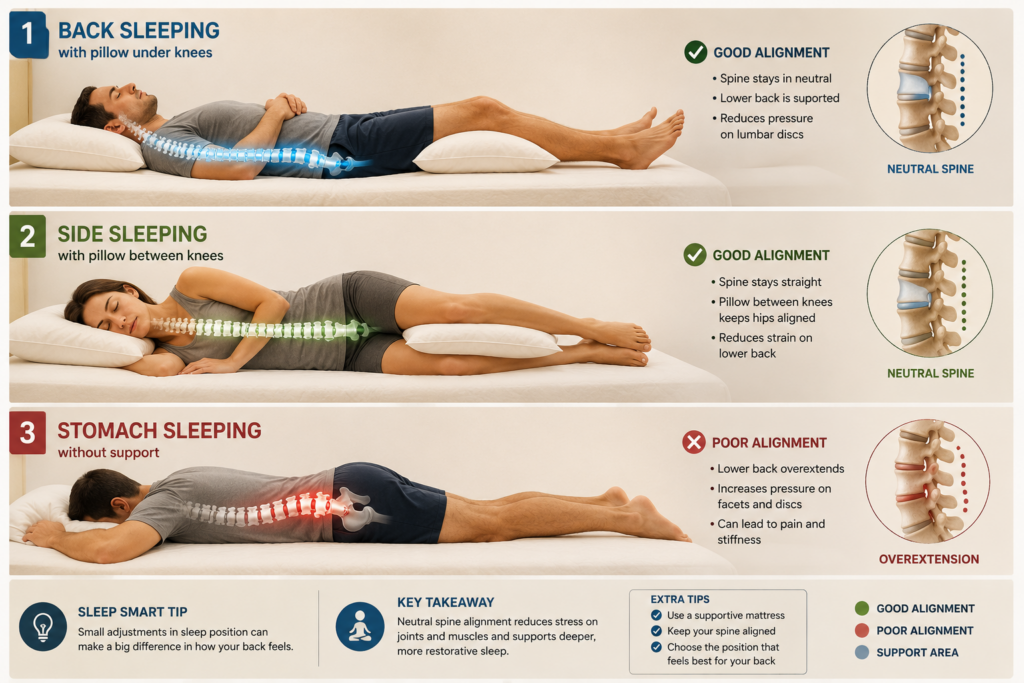
Sleeping on your stomach forces your lumbar spine into prolonged hyperextension. You’re essentially spending eight hours compressing the posterior elements of your vertebrae — the facet joints, the laminae, the spinous processes — while simultaneously rotating your cervical spine to breathe. The lumbar lordosis increase this creates can pinch facet joints and compress intervertebral foramina (the openings through which spinal nerves exit).
If you wake up with lower back pain and you’re a stomach sleeper, this is almost certainly contributing. The fix isn’t simple — it’s a habit that takes time to break — but placing a pillow under your pelvis (not your stomach) can reduce the extension strain while you work on changing positions.
Side Sleeping Done Wrong
Side sleeping is generally well-tolerated for lumbar pain, but only if you do it correctly. The most common error: letting your top knee drop forward. That knee-drop pulls the pelvis into internal rotation and creates a lateral flexion torque through the lower lumbar segments. Over eight hours, that adds up.
The solution is as simple as it sounds: a pillow between the knees. It keeps the pelvis level, reduces hip internal rotation, and dramatically reduces the torque through L4-L5 and L5-S1 — the levels where most lower back problems occur.
Back Sleeping With the Wrong Pillow Setup
Back sleeping is mechanically optimal for most people with lower back pain — when done correctly. Without a pillow under the knees, the weight of your legs pulls your pelvis into anterior tilt, which increases lumbar lordosis. If your lower back is already irritated, that additional curve compresses the posterior disc and facets.
A simple pillow under the knees — not a huge one, just enough to flex the hips and knees slightly — takes the lumbar spine out of excessive lordosis and dramatically reduces contact stress on the facet joints
Tight Hip Flexors, Weak Glutes, and Why Your Bed Isn’t to Blame Alone
This is where daytime habits become nighttime pain.
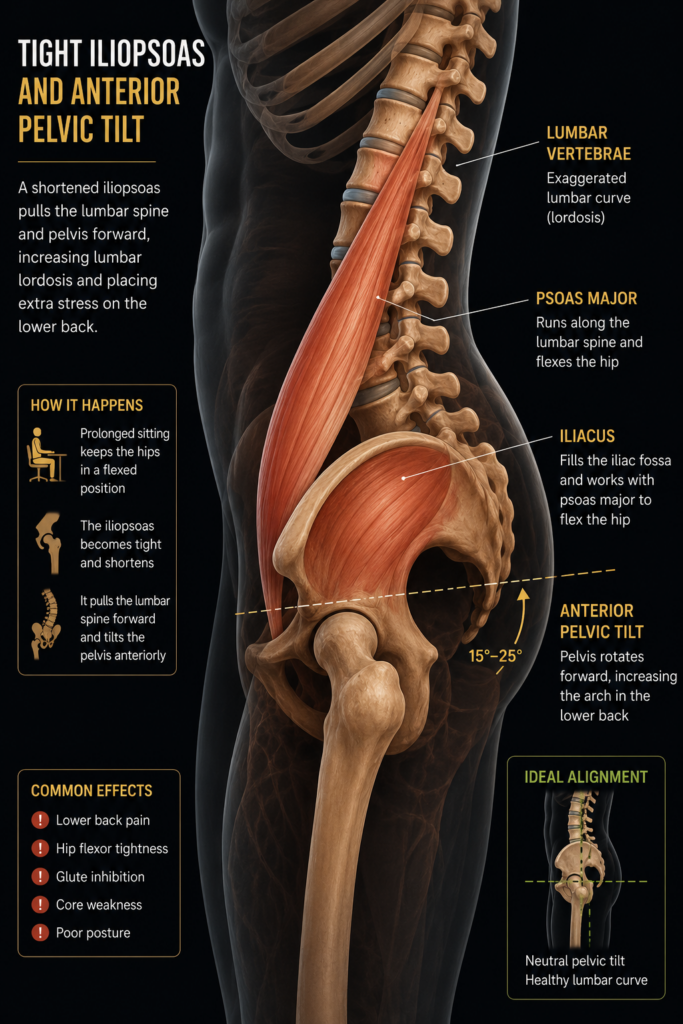
The iliopsoas — a muscle group comprising the psoas major and iliacus — runs from the front of your lumbar vertebrae, through your pelvis, and attaches to the top of your femur. When it’s chronically shortened (which happens to virtually everyone who sits for more than a few hours a day), it pulls the lumbar spine into anterior tilt even when you’re supposedly relaxed.
Lying on your back with tight hip flexors means the lumbar spine is being pulled into lordosis from the inside. You’re not in neutral — you’re in a sustained extension position — even on a good mattress.
Weak glutes compound this. The glutes serve as counterbalancing muscles to the hip flexors, among many other functions. When they’re underactivated — which happens when you sit all day — the hip flexors essentially «win» the tug-of-war, and the pelvis tips forward. The lower back takes up the slack, and does so hour after hour, night after night.
This is why some people’s back pain gets measurably better after a sustained period of stretching hip flexors and strengthening glutes — not because they found a magic exercise, but because they corrected a muscle imbalance that was loading their lumbar spine constantly, including during sleep.
A simple test: lie on your back on a flat surface and bring one knee to your chest. If the opposite leg rises off the surface, your hip flexors on that side are tight (Thomas test). It’s not a clinical diagnosis, but it tells you something real.
The Nervous System Factor Most People Miss
Pain is not purely structural. That’s not a new-age claim — it’s established neuroscience, and it’s particularly relevant to lower back pain at night.
When your nervous system is in a heightened state — sustained stress, anxiety, poor sleep quality — pain sensitivity increases at a neurological level. This is called central sensitization. Your nervous system, tuned to threat by cortisol and sympathetic nervous system activation, amplifies the pain signals coming from your lumbar tissues. What might register as mild discomfort in a calm state becomes significant pain when your threat detection system is dialed up.
This partly explains why nighttime back pain is frequently worse than daytime pain for the same physical problem. During the day, you’re distracted. The descending pain-modulating systems in your brain are more active. At night, quiet and still, with cortisol naturally lower but overall nervous system vigilance potentially still elevated — pain has the floor.
It also explains why people who report high stress levels consistently show worse pain outcomes, and why interventions like sleep improvement, relaxation techniques, and cognitive approaches to pain can produce genuine physical relief — not just psychological coping.
Why Morning Stiffness Happens — And Why It Usually Fades

Morning lower back stiffness — that «rusty hinge» feeling when you first try to stand up — has a few overlapping causes.
First, there’s the rehydrated disc issue mentioned earlier. The expanded, rehydrated discs of the morning are under slightly more tension than they’ll be later in the day, once compressive loading during movement squeezes some of that fluid back out.
Second, the synovial fluid in your facet joints — the small joints at the back of each vertebral level — becomes less viscous after hours of inactivity. Joint lubrication is activity-dependent. Moving redistributes synovial fluid and warms it, reducing friction and stiffness. Lying still for eight hours does the opposite.
Third, the muscles that support your lumbar spine have been static for hours. They’re not «rested» in the way we’d like to imagine. They’ve been held in isometric contraction in whatever position you slept, and they wake up stiff, not refreshed. If you slept in a poor position, they’ve been doing compensatory work all night.
The good news: for most people without serious underlying pathology, morning stiffness that fades within 30–60 minutes of moving is considered a normal variant of musculoskeletal pain, not an emergency. The movement itself is the treatment.
If stiffness persists beyond an hour consistently, or gets progressively worse over weeks, that’s a different picture — and warrants investigation.
⚠️ Common Mistakes People Make When Their Back Hurts at Night
Try This Tonight: Small Fixes With Real Impact
Quick Setup Checklist for Tonight
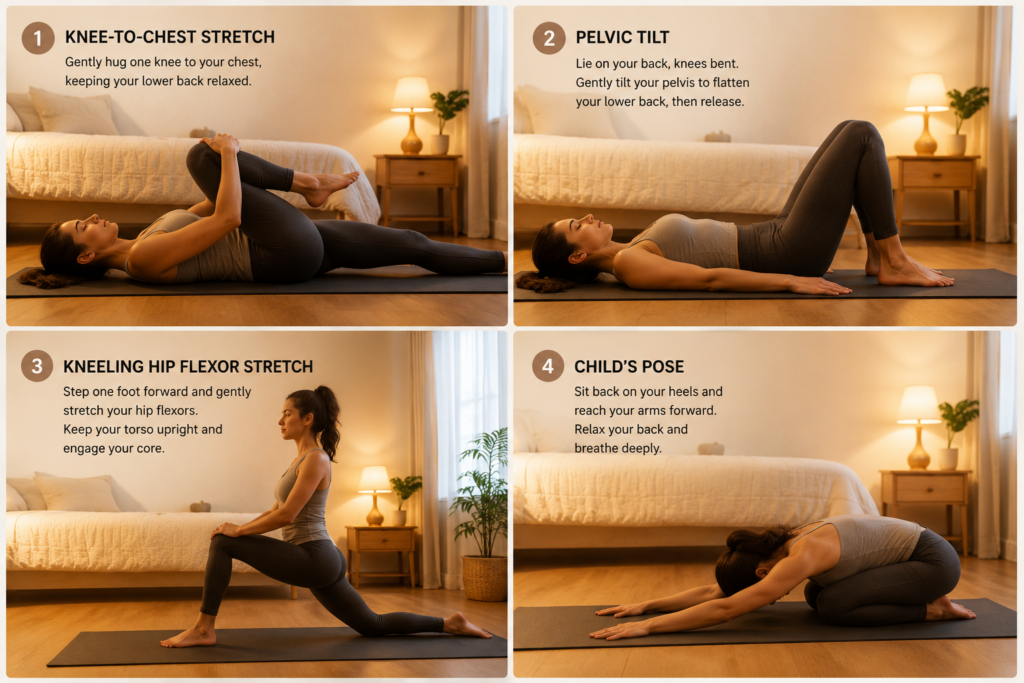
Before Bed: 4-Minute Lower Back Routine
2 × 30 seconds each side. Helps reduce compression and loosen the lower back muscles.
10 slow repetitions. Flatten your lower back gently into the mattress and hold for 3 seconds.
60 seconds each side. Releases tension through the front of the hips and pelvis.
Hold for 60 seconds before bed to gently decompress the lumbar spine.
When to See a Doctor
Lower back pain at night is usually benign and mechanical. But some symptoms require prompt medical evaluation.
Recommended Internal Links
For a fuller picture of how your daily habits, environment, and body patterns affect lower back pain, these articles extend what’s covered here:
FAQ
Why does my lower back hurt after lying down for a long time?
Prolonged lying down reduces muscle activity, slows circulation, and allows inflammatory chemicals to pool in affected tissues. For people with disc issues, the discs also rehydrate during rest and can expand slightly, increasing pressure on nearby nerves. The result is that pain often intensifies with inactivity rather than resolving with it.
Why does my lower back hurt more in the morning than at night?
Morning lower back pain is typically caused by a combination of disc rehydration, reduced synovial fluid viscosity in the facet joints, and muscle stiffness from hours of static positioning. If your pain eases within 30–60 minutes of movement, this is consistent with inflammatory or mechanical pain rather than serious pathology.
Can a mattress cause lower back pain after sleeping?
Yes, absolutely. A mattress that’s too soft or too firm can compromise lumbar alignment during sleep, leading to increased load on the discs and facet joints overnight. Back pain that’s worst in the morning and eases during the day is a classic sign that sleep surface and positioning are significant contributors.
What is the best sleeping position for lower back pain?
Back sleeping with a pillow under the knees is generally considered optimal for lumbar alignment, as it reduces lordosis and facet joint compression. Side sleeping with a pillow between the knees is also well-tolerated. Stomach sleeping is consistently the most problematic position and should be avoided if you have lower back pain.
Why does my back feel better after moving around in the morning?
Movement redistributes synovial fluid in your spinal joints, flushes inflammatory mediators through improved circulation, and reactivates the muscle support system that takes over from passive spinal structures. The 20–30 minute improvement period after waking is essentially your body «warming up» systems that rested overnight.
Can stress cause lower back pain at night?
Yes. Psychological stress activates the sympathetic nervous system and increases cortisol, both of which elevate muscle tension (particularly in the paraspinal muscles) and can amplify pain sensitivity through central sensitization. Nighttime is often when this effect is most noticeable because there are fewer distractions moderating pain perception.
How do I know if my hip flexors are causing my lower back pain?
Try the Thomas test: lie flat on a hard surface and pull one knee to your chest. If the opposite leg rises off the surface, your hip flexors on that side are likely shortened. Tight hip flexors pull the lumbar spine into anterior tilt, which increases lower back loading even during sleep.
Is it normal for lower back pain to be worse at night?
Nighttime worsening of mechanical lower back pain is common and usually related to inflammation, inactivity, and sleep position. However, pain that consistently and severely wakes you from sleep — especially when combined with other symptoms — can indicate more serious conditions and warrants medical evaluation.
*Disclosure: Some of the links on this site are affiliate links. This means that if you choose to make a purchase through them, we may earn a small commission at no additional cost to you. We only recommend products or tools that are relevant to the content and that we believe can provide value. This helps support the site and allows us to continue creating useful, free content.