
That Heavy, Airless Feeling — You’re Not Imagining It
You walk into the bedroom after a few hours away and immediately feel it — a kind of invisible thickness. Not a smell, exactly. Not heat, exactly. Just… stagnation. The air feels used up. You open a window and nothing much changes. You light a candle, spray something, crack the door. Still there.
That sensation is real, and it has a measurable cause. Rooms accumulate carbon dioxide, moisture, volatile organic compounds (VOCs), and particulate matter just from normal daily life — breathing, sleeping, cooking nearby, using fabric softener. When ventilation is poor, those things don’t leave. They layer.
The goal of this article is to explain what’s actually happening in that air — and how to make a stuffy room feel fresher naturally, without sprays, plug-ins, or pretending an open window always solves it.
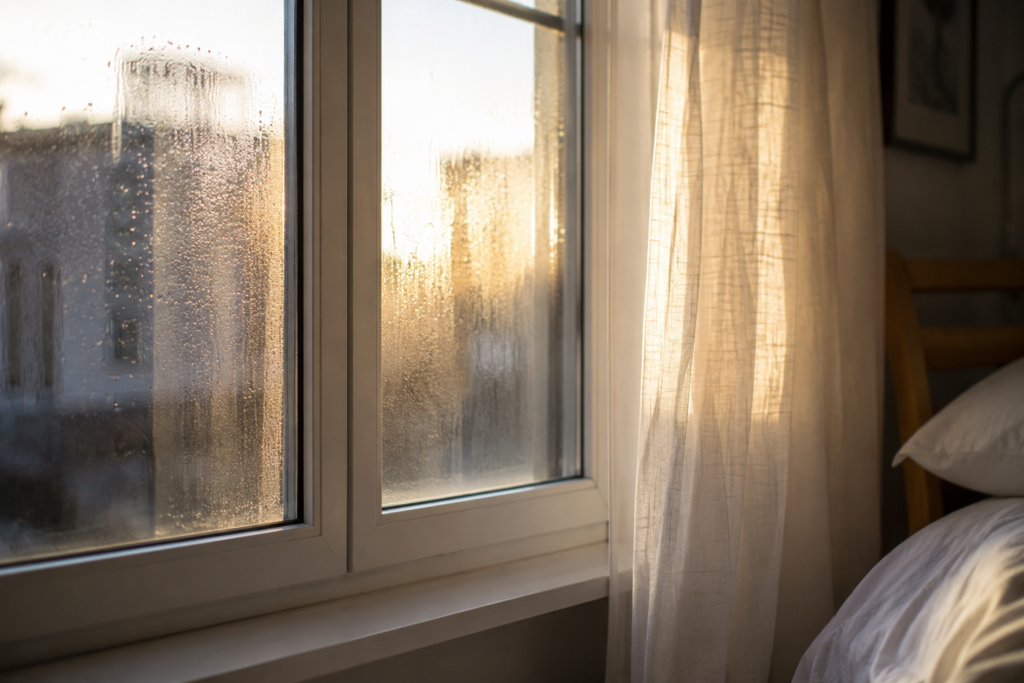
Why Rooms Actually Feel Stuffy
Most explanations stop at «not enough fresh air.» But there are at least four distinct things happening at once when a room feels stale.
CO₂ Is Building Faster Than You Think
Every breath you exhale contains about 4% carbon dioxide. Outdoor air typically contains 0.04% (around 400 ppm). Inside a closed bedroom where one or two people have slept all night, CO₂ levels can climb past 2,000–3,000 ppm or higher.
At those levels, research has consistently shown measurable effects: slower decision-making, reduced concentration, headaches, and a general sense of cognitive fog. You don’t feel «poisoned» — you just feel off. Tired even after sleep. Sluggish without an obvious reason.
That heavy, tired feeling after an unventilated night? CO₂ is often responsible.
Moisture Without Movement
Human bodies release about 40–60g of water vapor per hour through breathing and skin evaporation. More during sleep. Without airflow, that moisture has nowhere to go. It raises relative humidity, which:
- Makes the air feel heavier and warmer than it is
- Encourages dust mites and mold spore activity
- Makes odors linger longer (humid air carries scent molecules more effectively)
High humidity doesn’t just feel uncomfortable. It actively changes what you smell and how your body regulates temperature.
VOCs From Everyday Objects
Volatile organic compounds off-gas from furniture, carpets, paint, cleaning products, synthetic fabrics, and even some candles. They’re invisible and largely odorless at low concentrations, but they accumulate in poorly ventilated spaces over time. New furniture is a significant source — that «new» smell is VOC off-gassing. A room with a relatively new mattress, wardrobe, or carpet is emitting compounds continuously. In these situations, a HEPA air purifier with an activated carbon filter can help reduce airborne particles and trap some VOCs, making the air feel noticeably fresher, especially in rooms with limited airflow.
Temperature Stratification
Hot air rises. If a room has poor circulation, you get a warm, stagnant layer near the ceiling and cooler air near the floor, with minimal mixing. This thermal stratification feels uncomfortable in ways that are hard to pin down — not too hot, not too cold, just somehow wrong. It also reduces the effectiveness of any ventilation you do attempt.
Hidden Causes Most People Never Consider
Most people don’t realize: The stuffiness they’re fighting might have nothing to do with the room itself — and everything to do with what’s outside it.
Your Building’s Ventilation Path Is Blocked
Air needs a path in and a path out. Opening one window without an exhaust point creates almost no actual airflow — pressure equalizes quickly and nothing moves. Many people open a window, feel briefly better, then wonder why the room still feels the same an hour later.
Furniture Placement Is Blocking Air Circulation
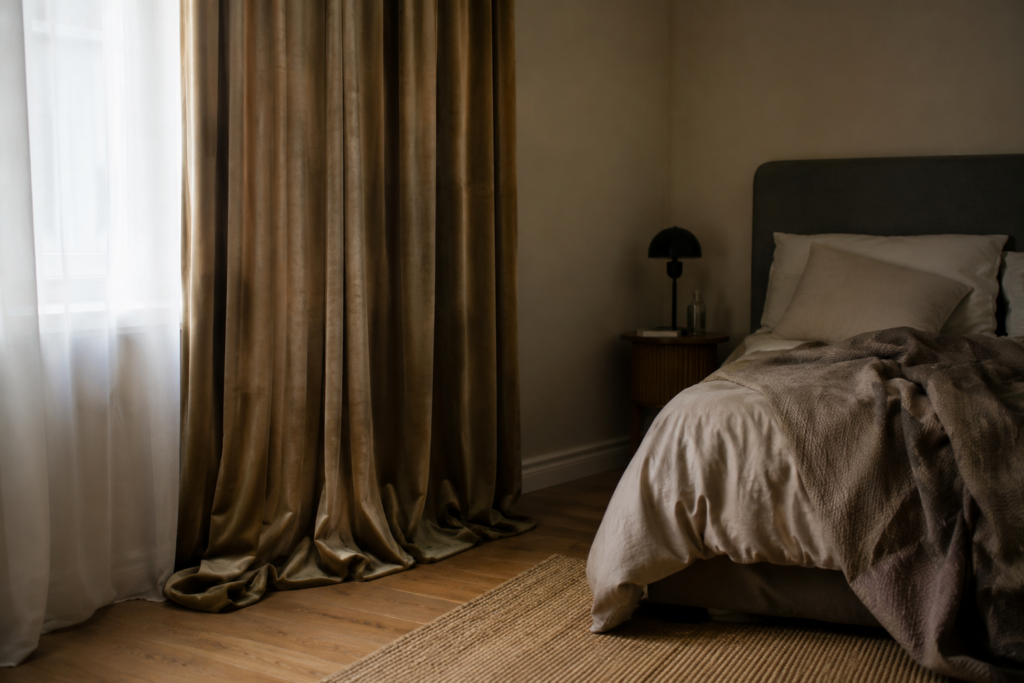
A wardrobe against an external wall, a bed pushed into a corner, heavy curtains falling to the floor — these aren’t just style choices, they’re airflow decisions. Furniture that covers vents or fills corners creates dead zones where air becomes truly static. Dust accumulates heavily in these spots, and so does everything else.
Your Soft Furnishings Are a Reservoir
Curtains, pillows, rugs, mattresses, and upholstered furniture absorb moisture and odors over time and re-release them slowly. A bedroom that smells clean after washing the sheets will often revert within days because the curtains, rug, and mattress are gently exhaling what they’ve absorbed. This is one of the most overlooked contributors to persistent staleness.
The Room Has No Regular «Flush»
Unlike kitchens and bathrooms, which get opened and aired somewhat naturally, bedrooms often stay closed for long stretches — especially if you work from home or keep them dark during the day. That means the air inside can go weeks without a proper turnover.
Signs Your Room Air Is Already Affecting You
Poor indoor air quality often masquerades as other problems. These are worth paying attention to — especially if they improve when you spend time outdoors or in different rooms.
Signs of Poor Indoor Air Quality in Your Bedroom
These aren’t dramatic symptoms — that’s partly why they go unaddressed for so long. If you’ve been attributing a persistent low-grade tiredness to stress or screen time, it’s worth checking your bedroom air quality first.
(Related: Signs Your Bedroom Air Quality Is Making You Tired | Morning Headaches: Common Causes Nobody Thinks About)
How to Improve Airflow Without a Full Renovation
The goal with natural ventilation isn’t just «get some air in.» It’s creating actual movement — a path for stale air to leave and fresh air to enter.
Cross-Ventilation: The Real Version
Cross-ventilation requires two openings on opposite or adjacent sides of a space, not the same wall. Ideally, one should be lower (for cooler incoming air) and one higher (where warm, stale air exits naturally). Even in a room with one window, opening the bedroom door and a window in the hallway creates cross-draft movement.
The time of day matters too. Early morning is often the best window for ventilation — cooler outdoor air drops in naturally, CO₂ levels indoors are at their highest after a night of sleep, and temperature difference aids the exchange.
The 20-Minute Morning Rule
Opening your bedroom window for just 15–20 minutes in the morning — before you leave the room — can significantly reduce overnight CO₂ and moisture buildup. It’s not a luxury; it’s maintenance.
Fans as Air Directors, Not Air Movers
Most people use fans to cool themselves. But strategically placed fans can pull stale air toward an exit point, creating consistent directional airflow even when outdoor conditions don’t cooperate.
Positioning that works:
- Fan facing outward in the window exhaust stale air from the room
- Fan in the doorway blowing inward pushes outdoor corridor air through the space
- Box fan at floor level pointed toward a higher opening creates vertical circulation
Rethinking Furniture for Air Movement
Pull beds at least a few inches from the wall. Keep a gap under curtains if possible. Avoid placing large wardrobes directly against the only exterior wall. These small changes allow air to circulate rather than pool.
Humidity and Temperature: The Invisible Comfort Layer
If you’ve ever walked into a room and immediately felt at ease without knowing why, humidity and temperature were likely responsible. The reverse is also true.
What’s the Right Humidity for a Bedroom?
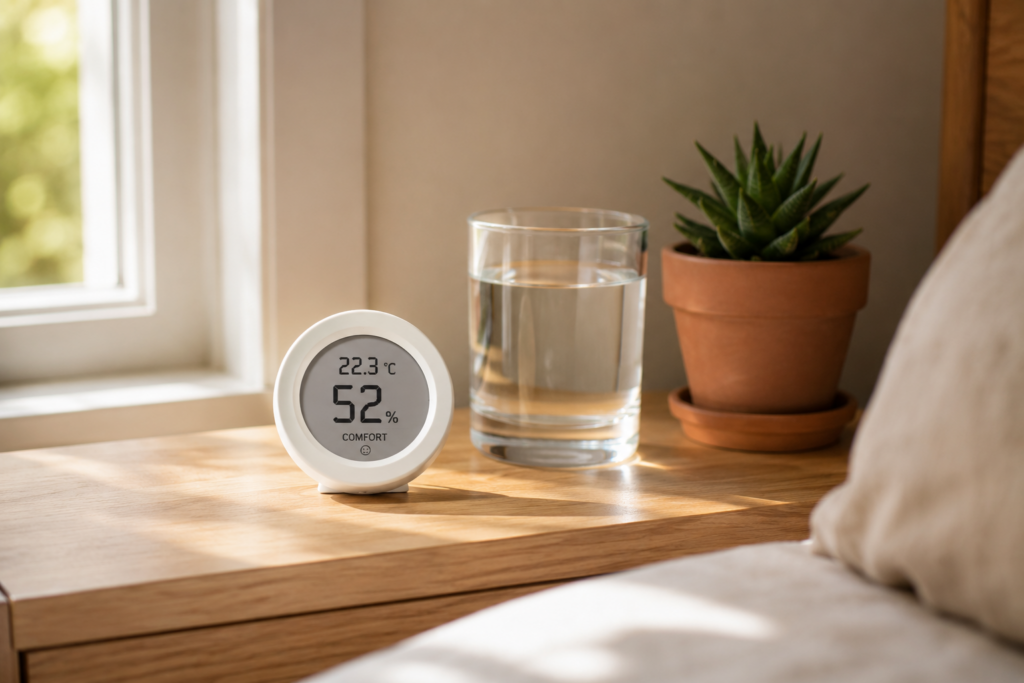
The sweet spot for indoor relative humidity is 40–60%. Below 40%, the air feels dry — nasal passages get irritated, skin feels taut, and static electricity increases. Above 60%, the air feels heavy and muggy, dust mites thrive, and mold risk rises significantly.
Bedroom Humidity: What Actually Feels Best
| Relative Humidity | How It Feels | Common Problems |
|---|---|---|
| Below 30% | Dry, scratchy | Nose bleeds, dry skin, static buildup |
| 30–40% | Slightly dry | Irritated membranes and throat dryness |
| 40–60% | Comfortable | Optimal zone |
| 60–70% | Heavy, slightly muggy | Dust mite growth increases |
| Above 70% | Oppressive | Mold risk and stronger stale odors |
A basic hygrometer costs very little and tells you exactly where you stand. Most people are surprised to find their bedroom humidity is either far too low in winter (due to central heating) or far too high in summer (due to poor ventilation).
Natural Ways to Adjust Humidity
To raise it:
- A bowl of water near a heat source (simple evaporation)
- Houseplants — though their effect is mild, multiple together do contribute
- Drying laundry in the room (effective but raises it quickly — monitor carefully)
To lower it:
- Ventilate actively, especially after showering or cooking nearby
- A bag of silica gel or natural charcoal (modest absorption)
- Avoid drying laundry indoors if already humid
Temperature and Air Quality Are Linked
Warmer air holds more moisture. A room that feels fine at 18°C might feel suffocating at 24°C with the same humidity level. If you’re running heating and the room feels stuffy despite «fresh» air, reducing the temperature by a degree or two can change the experience dramatically.
Your Bedroom Air and Your Sleep Are Deeply Connected
This connection gets underestimated because the effects are gradual. You don’t wake up coughing — you just don’t feel rested. Over time, that adds up.
Sleep researchers have found that elevated CO₂ in the sleep environment measurably affects sleep architecture — specifically reducing slow-wave sleep (the deepest, most restorative phase) and increasing arousal frequency. You might sleep eight hours but miss out on the quality that makes eight hours feel like enough.
Temperature plays an equally direct role. Core body temperature drops naturally as part of sleep onset. A room that stays too warm interferes with that drop and delays sleep onset. The widely recommended bedroom temperature of 16–19°C (61–66°F) isn’t arbitrary — it supports the body’s thermal regulation during sleep.
Combine elevated CO₂ with slightly-too-high humidity and a room that never gets a proper air flush, and you have a consistent recipe for unrefreshing sleep — which gets blamed on stress, screens, and everything else before the room itself.
(Related: Bedroom Air Quality and Sleep | Best Sleeping Position for Lower Back Pain)
Natural Freshness vs. Fake Fragrance {#natural-freshness-vs-fake-fragrance}
There’s a meaningful difference between air that smells fresh and air that is fresh. Air fresheners, scented candles, and plug-in diffusers mask odors by adding more compounds to the air — some of which are themselves VOCs.
Many conventional air fresheners contain synthetic musks, phthalates, and other compounds that technically worsen indoor air quality while making it smell better. The room smells cleaner. The air isn’t.
What Actually Neutralizes Odors
- Ventilation removes the molecules causing the smell
- Activated charcoal absorbs odor compounds passively and genuinely
- Baking soda absorbs acidic odor molecules (effective in small enclosed spaces)
- Beeswax candles are claimed by some to release negative ions; the research is limited, but they produce far fewer VOCs than paraffin candles
- Certain houseplants process some airborne compounds — peace lily, spider plant, and snake plant have been noted in NASA air filtration studies, though their real-world impact in normal-sized rooms is modest. They’re not a replacement for ventilation, but a small complement to it.
Natural Scents That Don’t Compromise Air Quality
If you want your room to smell good and actually be better air:
- Fresh eucalyptus or cedar (natural, low VOC, antimicrobial properties)
- Opening windows after rain — petrichor is genuinely refreshing and carries no pollutants
- Dried lavender sachets (passive, low-emission, effective in drawers and near pillows)
- A drop or two of essential oil on a porous stone, not synthetic reed diffusers
Mistakes People Make When Trying to Fix Stuffy Rooms
Opening one window and expecting circulation. Without a path for air to exit, inflow stalls within minutes. You need cross-ventilation — two points, not one.
Relying on air freshener as a fix. It’s a cosmetic layer over the actual problem. The CO₂ is still there. The humidity is still there. You’ve just added perfume.
Running the heating and leaving windows closed «to save energy.» The energy trade-off is real, but so is the cost of sleeping in degraded air for eight hours every night. A short, efficient ventilation burst (15–20 minutes with windows fully open) exchanges far more air than a slightly-cracked window left all day.
Neglecting soft furnishings. Washing sheets regularly while ignoring curtains, pillows, and rugs is like cleaning the floor while leaving wet towels piled in the corner. Fabrics are reservoirs. Wash or air them out periodically.
Ignoring the mattress. Mattresses accumulate years of moisture, dead skin cells, and dust mites. Airing the mattress — stripping bedding and letting it breathe for a few hours — makes a noticeable difference. Ideally done once a week.
Keeping doors closed all day. Closed bedroom doors during the day prevent any passive air exchange with the rest of the home. Unless noise or privacy is an issue, leaving the door ajar during the day allows constant low-level air movement.
Quick Wins: Fresher Air in Under 10 Minutes
Quick Fix Checklist
None of these require buying anything. They take under ten minutes. And they make a measurable difference in how the room feels within the hour.
Long-Term Habits That Keep Air Quality High
Getting a stuffy room fresher once is easy. Keeping it that way requires a few small, consistent habits rather than occasional drastic fixes.
Daily:
- Open windows for 15–20 minutes in the morning (cross-ventilation if possible)
- Leave the bedroom door ajar during the day
- Strip the bed back when you get up rather than making it immediately (lets the mattress breathe)
Weekly:
- Wash bedding on high heat — 60°C kills dust mites
- Vacuum with particular attention to corners, under the bed, and around curtain bases
- Shake out or briefly air throw blankets, pillows, and soft furnishings
Monthly:
- Air the mattress fully for a few hours
- Wash or vacuum curtains
- Check and clean any ventilation grilles or extractor filters nearby
- Consider moving heavy furniture slightly to clear airflow paths
Seasonally:
- Deep clean soft furnishings that can’t be washed regularly
- Reassess furniture placement for airflow
- Swap out heavy winter curtains for lighter ones if possible during warmer months
- Check your indoor humidity with a hygrometer and adjust accordingly
FAQ
Bedroom Air Quality FAQ
Final Takeaway
A stuffy room isn’t a mystery. It’s CO₂ that accumulated while you slept, moisture your body released that had nowhere to go, and compounds slowly off-gassing from the things you’ve filled the room with. The fix isn’t complicated — but it does require understanding what’s actually happening, because the instinctive responses (spraying something, lighting a candle, briefly cracking a window) don’t address the root causes.
Cross-ventilate in the morning. Let your mattress breathe. Monitor your humidity. Address the soft furnishings, not just the sheets. Keep a path open for air to move during the day.
The goal isn’t a room that smells fresh. It’s a room where the air genuinely is.
That distinction changes how you think about it — and it changes how you sleep, focus, and feel in the space you spend the most time in.
All claims in this article are consistent with publicly available indoor air quality research including studies from the EPA, Harvard T.H. Chan School of Public Health, and the International Journal of Environmental Research and Public Health.
*Disclosure: Some of the links on this site are affiliate links. This means that if you choose to make a purchase through them, we may earn a small commission at no additional cost to you. We only recommend products or tools that are relevant to the content and that we believe can provide value. This helps support the site and allows us to continue creating useful, free content.