

You swing your legs over the side of the bed and the first thing your body feels stiff, this remind you it was not ready. Your lower back locks up. Your neck protests. Your hips feel like someone tightened them overnight. For a few minutes you move like you’re navigating around invisible obstacles.
Then, twenty minutes later, you feel mostly fine.
This pattern — stiff and creaky in the morning, functional by mid-morning — is so common that most people assume it’s just part of aging. Some chalk it up to a bad mattress. Others blame their sleep position. A few decide they need to stretch more.
All of those things can play a role. But morning body stiffness is more layered than most people realize, and the biggest contributing factors often have nothing to do with what happens while you sleep. A lot of it starts the evening before.
What Actually Happens to Your Body Overnight
Sleep isn’t passive for your body — but movement is largely removed from the equation. You’re horizontal, mostly still, for seven or eight hours. And while that stillness is necessary for repair, it also creates the conditions for stiffness to build.
Here’s the core of what’s happening:
Circulation slows. During sleep, your heart rate drops and blood moves more slowly through the body. Muscles receive less oxygen-rich blood. Metabolic waste products — the byproducts of cellular activity — clear out more gradually. This is completely normal, but it means tissues that were already under tension arrive at morning feeling more compressed and resistant.
Fascia loses its pliability. Fascia is the web of connective tissue that wraps around every muscle, organ, and structure in your body. It’s gel-like, responsive, and highly sensitive to movement. When you stay still for hours, the fluid within fascia redistributes unevenly. Think of it like a wet sponge that’s been left compressed — it doesn’t spring back instantly. The stiffness you feel in your muscles first thing in the morning often has as much to do with fascial tension as it does with the muscles themselves.
Synovial fluid settles. Your joints are lubricated by synovial fluid, which gets distributed through movement. When you’re immobile for hours, this fluid pools rather than circulates. That grating, grinding feeling in your knees when you first stand up? That’s your joints waking up too.
Temperature drops. Core body temperature naturally decreases during sleep. Connective tissue is stiffer when cold. It’s the same principle that makes rubber bands snap in winter — the material hasn’t changed, but its behavior at lower temperatures is fundamentally different.
None of this is alarming. It’s biology. But understanding it changes how you approach the solution.
The Hidden Problem: Eight Hours of Not Moving

There’s a reason you sometimes feel more stiff after sleeping ten hours than after sleeping seven. Duration alone isn’t the issue — it’s prolonged inactivity.
Your body interprets extended stillness as a signal to tighten protective tone in the muscles. This is partly a neurological response. The nervous system doesn’t fully disengage during sleep; it monitors body position, applies small corrections, and maintains baseline muscle tension to keep you from injuring yourself while vulnerable. Over a long night, that protective tension can accumulate rather than release.
This is also why waking up stiff and sore on weekend mornings — when you’ve slept in longer than usual — feels paradoxically worse than weekday mornings after less sleep. More hours of immobility, not fewer.
Why Stress Comes to Bed With You
Most people underestimate how much the nervous system’s state at bedtime shapes what they feel in the morning.
When you’re chronically stressed — and most people are, to varying degrees — your nervous system spends more time in sympathetic activation. This is the «threat response» mode, and it has a direct physical effect: muscles tighten. Not dramatically. Gradually. Subtly. Your jaw might clench slightly. Your shoulders sit a millimeter higher. Your hip flexors stay slightly contracted.
Over a full night, that baseline tension calcifies. You wake up with muscles that never fully let go.
There’s also the cortisol angle. Cortisol, the stress hormone, has a natural rhythm — it’s lowest in the early hours of sleep and begins rising sharply before you wake, peaking around 30–45 minutes after waking. This cortisol spike is actually part of why you feel stiff early in the morning and improve as the day progresses: as cortisol rises and you start moving, inflammation is suppressed and tissues mobilize.
But when stress is chronically elevated, cortisol rhythms can be disrupted. The natural anti-inflammatory signal becomes blunted, and morning stiffness can be more pronounced as a result.
💡 Expert Insight: The connection between psychological stress and physical tension isn’t metaphorical — it’s physiological. The muscles most affected by stress-related guarding are typically the neck, jaw, upper trapezius, and hip flexors. These are also frequently the sites people report stiffness body after sleeping.
Dehydration: The Quiet Culprit
You’re breathing all night. And depending on your room temperature, your sleeping environment may be drier than you realize. By morning, even someone who drank adequate water the day before can be mildly dehydrated.
This matters more than people think.
Fascia, cartilage, and muscle tissue all require adequate hydration to function correctly. The gel-like matrix of connective tissue — the glycosaminoglycans if you want the biology term — holds water and uses it to maintain elasticity and reduce friction. When hydration is low, these structures become less pliable. They don’t glide smoothly. They resist movement.
Dehydration and muscle stiffness are genuinely linked, though the effect is subtle at normal dehydration levels. You won’t feel like beef jerky after one dry night. But people who consistently under-hydrate, or who sleep in dry rooms without humidification, often report more pronounced morning tightness — particularly in the neck and lower back.
There’s also an often-overlooked connection: dry mouth in the morning can sometimes indicate mouth breathing during sleep, which increases fluid loss significantly over eight hours.
The Bedroom Environment Nobody Talks About

Cold rooms do more than make you shiver. Connective tissue behaves differently at lower temperatures — it contracts slightly and becomes less elastic. Most sleep research suggests a bedroom temperature between 16–19°C (60–67°F) is optimal for sleep quality, but the very low end of that range can increase stiffness perception in the morning, particularly in people with existing tension or joint sensitivity.
Humidity matters too. Very dry air doesn’t just dry out your airways — it can affect your overall hydration status over the course of a night. People who sleep in particularly dry environments (common in winter with central heating) often notice more pronounced morning body stiffness, though this is an under-researched area.
And then there’s the mattress. A mattress that doesn’t distribute pressure effectively keeps certain muscle groups in sustained contraction through the night. This is especially problematic for side sleepers with hips that are wider than their shoulders — the spine tilts, one side of the hip flexors stays shortened all night, and morning tightness in the lower back is the entirely predictable result.
Pillows are equally underestimated. If your pillow pushes your neck into flexion or extension for eight hours, the muscles on the shortened side will wake up guarded and stiff. Air quality in your bedroom is another factor that quietly degrades sleep quality and recovery — more than most people realize.
Sleep Positions That Quietly Work Against You
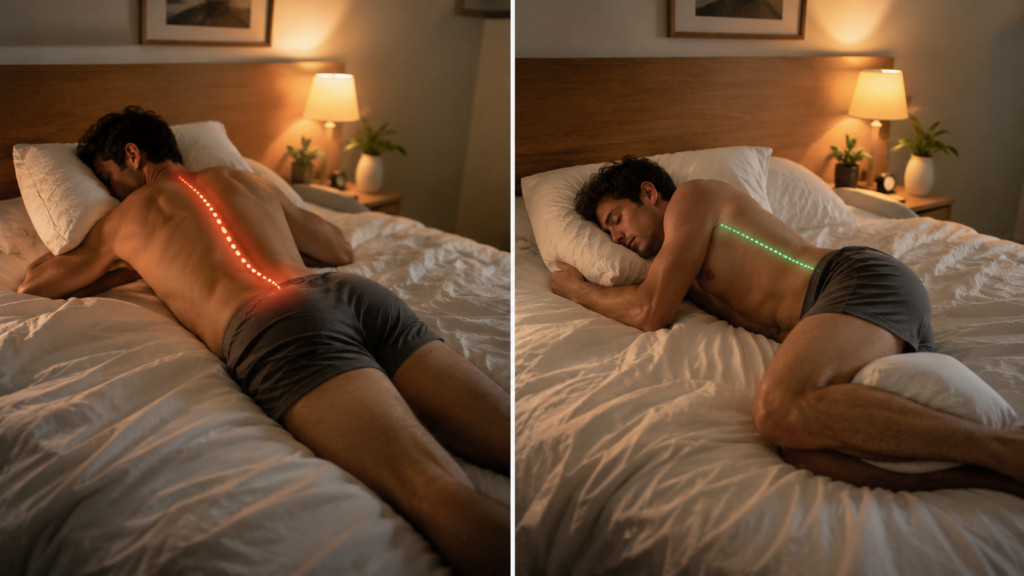
Not all sleep positions are created equal for morning stiffness causes.
Stomach sleeping is the most problematic for most people. It forces the neck into sustained rotation — often for hours at a time — and places the lumbar spine into extension. The muscles along one side of the neck spend the entire night in a shortened position. The hip flexors do too. Waking up with neck stiffness and tight lower back after stomach sleeping isn’t bad luck — it’s predictable mechanics.
Back sleeping is generally considered the most spine-neutral position, but it comes with its own trap: if your pillow is too thick, it pushes the chin toward the chest, shortening the front of the neck all night. And without a pillow under the knees, back sleepers often have the lumbar spine in sustained extension, which can contribute to that tight-across-the-lower-back feeling.
Side sleeping is widely recommended for most people, especially those with lower back pain. But without a pillow between the knees, the top hip rotates downward, putting the hip abductors and piriformis in a sustained stretch and the opposite side in sustained compression. Hip stiffness in the morning, for many side sleepers, comes directly from this position.
For more detail on optimizing this, Best Sleeping Position for Lower Back Pain covers the specifics well.
Why Yesterday’s Desk Session Shows Up Today

This one surprises people. The stiffness you feel on Thursday morning might have as much to do with how you sat on Wednesday as with how you slept Wednesday night.
Prolonged sitting keeps the hip flexors in a shortened position for hours. The thoracic spine — the mid-back — rounds into sustained flexion. The glutes stay underactivated. The neck extends forward as you lean toward screens. All of this creates a pattern of sustained, one-sided muscle loading.
Now take that patterned body into sleep. The muscles that were shortened all day don’t suddenly reset at bedtime. They carry their tension into the night. The connective tissue adapts to the position it spent the most time in. By morning, the tightness isn’t from sleeping badly — it’s from sitting badly the day before.
Sedentary lifestyle stiffness compounds over time. It’s not just about one long day at a desk. Over weeks and months of limited movement, the fascia literally remodels itself to accommodate the shortened positions you habitually maintain. Morning stiffness becomes the daily reminder.
And then there’s the phone. Neck stiffness after scrolling before bed is increasingly common. The neck in full flexion, staring down at a screen for 45 minutes before sleep, can pre-load the cervical muscles with tension before you even close your eyes. It’s a small thing that adds up fast. 7 Habits That Quietly Destroy Your Posture Every Day gets into this in more detail.
Morning Habits That Make It Worse
Most people respond to morning stiffness in ways that don’t actually help — and sometimes make things worse.
The aggressive stretch. Yanking yourself into a forward fold or forcing a hamstring stretch within the first five minutes of waking is the most common mistake. Cold, poorly hydrated tissue under sudden load doesn’t lengthen cleanly — it protects. The stretch reflex kicks in harder when tissue is cold, which means aggressive early-morning stretching often produces more guarding, not less.
The total stillness response. Some people lie in bed waiting for stiffness to pass. It won’t, meaningfully. Blood flow and fascial hydration both require gentle movement to initiate. Passive waiting is the least effective option.
Skipping hydration until later. Drinking water first thing matters more than people credit. Even 250–300ml of water within fifteen minutes of waking begins rehydrating connective tissue and initiating the fluid dynamics that reduce stiffness.
Jumping straight into intense exercise. Going hard in a morning workout before the body has had time to warm gradually tends to result in either injury or paradoxically increased post-workout stiffness the following morning.
What the Research Suggests
The science around morning stiffness crosses several fields, and not all of it is perfectly settled. But some things are well-supported:
Sleep and inflammation: There’s strong evidence that poor sleep quality — fragmented sleep, insufficient deep sleep — elevates inflammatory markers in the body. Since inflammation is one of the drivers of stiffness and joint discomfort, chronic poor sleep is likely to worsen morning symptoms over time. The relationship is bidirectional: pain disturbs sleep, and poor sleep increases pain sensitivity.
Movement and circulation: Regular movement throughout the day — not just formal exercise — appears to maintain better baseline tissue pliability. Sedentary people consistently show patterns of reduced connective tissue hydration and increased stiffness compared to those who move frequently, even when exercise habits are controlled for.
Hydration and tissue elasticity: Research on fascia specifically supports the idea that adequate hydration maintains its gel-like properties. Dehydrated connective tissue shows measurably increased stiffness in laboratory conditions. The translation to real-world morning stiffness isn’t perfectly linear, but the principle holds.
Stress and muscle tension: The link between psychological stress and increased baseline muscle tension is well-established. Chronic stress has measurable effects on the fascial system, likely through the nervous system’s sustained activation of muscle tone.
None of this means morning stiffness is a medical emergency. But it does mean it’s not random — and it’s addressable.
Habits, Causes, and Better Alternatives
Quick Self-Check: Is This Normal Stiffness?
Run through this list mentally. The more of these that apply, the more likely your morning stiffness is habitual and addressable rather than a sign of something medical.
- ✅ You wake up feeling stiff but improve significantly after 10–20 minutes of gentle movement
- ✅ You sit for most of your working day
- ✅ Your bedroom is cool or feels dry in the morning
- ✅ You spend time on your phone in bed before sleeping
- ✅ You tend to sleep on your stomach or with an unsupportive pillow
- ✅ You rarely drink water first thing in the morning
- ✅ You go to bed feeling stressed more often than not
- ✅ Your stiffness is worse after longer nights (weekend lie-ins)
- ✅ You feel tightest in the hips, neck, or lower back specifically
- ✅ The stiffness follows a pattern — worse after inactive days, better after active ones
If most of these apply and your stiffness resolves within 20–30 minutes of movement, you’re likely dealing with the normal, mechanical, addressable kind.
A Practical 5-Minute Morning Mobility Reset

This isn’t a workout. The goal is to initiate circulation, gently redistribute synovial fluid, and tell your nervous system that threat-mode isn’t needed. Do this before coffee, before your phone, within the first five minutes of getting up.
1. Supine knees-to-chest (90 seconds) Lying on your back, pull both knees gently toward your chest. Rock slightly side to side. This initiates gentle lumbar flexion and begins mobilizing the sacroiliac joint. No forcing — just the weight of your legs.
2. Supine spinal rotation (60 seconds each side) From the same position, drop both knees to one side, arms extended. Hold for a slow breath, return to center, repeat on the other side. Targets the thoracic spine and hip rotators — commonly the stiffest areas.
3. Cat-cow on hands and knees (60 seconds) Slow, deliberate spinal flexion and extension. Move at the pace of your breath. This begins distributing synovial fluid through the facet joints of the spine.
4. Seated neck circles (30 seconds) Slow half-circles — chin to chest, ear to shoulder left, center, ear to shoulder right. Not full circles. Gentle. The goal is not to stretch but to move.
5. Standing hip circles (30 seconds) Hands on hips, feet hip-width. Slow, large circles with the pelvis — forward, side, back, side. This moves the hip joint through its range without loading it.
That’s it. Five minutes. The effect isn’t dramatic immediately, but done consistently, this reset significantly reduces how long morning stiffness lasts.
When Stiffness Might Signal Something More
The stiffness described throughout this article is mechanical and habitual — driven by inactivity, hydration, sleep position, and lifestyle patterns. It responds to movement. It improves through the day.
Inflammatory stiffness behaves differently. If you notice:
- Stiffness lasting more than 45–60 minutes in the morning despite movement
- Swelling or warmth around specific joints
- Stiffness that gets worse, not better, as the day progresses
- Pain that wakes you from sleep (not just discomfort upon waking)
- Stiffness accompanied by fatigue, fever, or systemic symptoms
…these patterns can be associated with inflammatory conditions such as rheumatoid arthritis, ankylosing spondylitis, or other systemic issues. None of this is cause for alarm based on one morning, but a persistent pattern worth discussing with a doctor.
The distinction matters. Normal morning body stiffness improves with movement. Inflammatory stiffness often doesn’t — at least not quickly, and not without appropriate management.
The Bigger Picture
Here’s what often gets missed in conversations about morning stiffness: the morning is just when the bill arrives. The habits, postures, stress levels, and movement choices of the previous day — and the weeks before that — are what actually determine how your body feels at 7am.
The good news is that most of the contributing factors are genuinely changeable. Not through elaborate protocols or expensive interventions, but through consistent small shifts: moving more during the day, being more deliberate about evening habits, drinking water more consistently, adjusting sleep position, managing the bedroom environment better.
Most people who make two or three targeted changes report noticeable improvement in morning stiffness within a few weeks. Not because they fixed something broken — but because they stopped accumulating the inputs that were producing stiffness in the first place.
Your body isn’t falling apart in the morning. It’s doing exactly what a living system does after extended stillness. The question is just how many hours of that you’re willing to spend feeling it.
Feeling stiff every morning isn’t inevitable — but understanding why it happens is the first step to actually doing something about it.