

You wake up tired. Not just «needed more sleep» tired — but heavy, foggy, slightly congested. You’ve slept eight hours, but your brain feels like it’s operating through gauze. By midday, a dull headache settles in behind your eyes. You assume it’s stress, dehydration, or too much screen time.
It might be none of those things.
Poor air quality at home is one of the most overlooked contributors to chronic low-grade fatigue, disrupted sleep, persistent headaches, and difficulty concentrating — and most people never connect the dots. The air inside your home isn’t just «air.» It’s a complex chemical environment that shifts daily based on what you clean with, what your furniture is made of, how you cook, how much moisture lingers, and whether fresh air ever actually gets in.
According to the U.S. Environmental Protection Agency (EPA), indoor air can be two to five times more polluted than outdoor air — and sometimes up to 100 times worse in specific conditions. That’s not a scare statistic. It’s an engineering reality of modern homes.
This article breaks down exactly what’s happening in your home air, why it affects how you feel far more than most people realize, and what you can actually do about it — without tearing walls apart or spending a fortune.
What «Poor Air Quality at Home» Actually Means
Most people picture smog when they think about air pollution. Thick, grey, outdoor. Something that happens in cities.
Indoor air pollution is subtler. You can’t see it, often can’t smell it, and rarely connect it to the way you feel. But it’s happening in almost every home, in varying degrees, every single day.
The term «poor air quality at home» refers to elevated concentrations of one or more of the following:
- Particulate matter (PM2.5 and PM10) — microscopic particles from dust, cooking smoke, candles, and even laser printers
- Volatile Organic Compounds (VOCs) — gases emitted from paints, furniture, flooring, cleaning products, and air fresheners
- Biological contaminants — mold spores, dust mite allergens, pet dander, and bacteria
- Carbon dioxide (CO2) — rises quickly in unventilated rooms, contributing to cognitive sluggishness
- Carbon monoxide — from gas appliances and heating systems
- Nitrogen dioxide — produced by gas stoves and unvented heaters
- Formaldehyde — off-gasses from pressed wood furniture, adhesives, and certain fabrics
None of these announce themselves. That’s what makes them so insidious.
Why Modern Homes Are Pollution Traps
Here’s a fact that surprises most people: older, «leaky» homes often have better natural ventilation than modern, well-insulated ones.
Energy efficiency has been one of the dominant goals of residential construction over the last three decades. Homes are built tighter. Windows seal better. Insulation is denser. HVAC systems recirculate the same air rather than pulling in fresh outdoor air. All of this is great for your heating bill. It’s not great for your lungs.
When you add synthetic materials — MDF furniture, foam mattresses, vinyl flooring, painted drywall, glued carpets — you get a sealed space slowly releasing a cocktail of chemical compounds. Some of these compounds take months or years to fully off-gas. Others are continuously replenished every time you spray a cleaning product, light a candle, or run the dishwasher without opening a window.
The strangest part? Your nose adapts. After roughly 20 minutes of exposure to an odor, your olfactory system largely stops registering it. You stop noticing what’s still very much there.
Indoor Air Pollution Symptoms: The Signs Most People Misread
⚠️ Signs Your Indoor Air Quality May Be Poor
- Waking up with a dry throat, stuffy nose, or mild headache
- Feeling more tired at home than when you’re outside or at work
- Persistent low-grade fatigue that doesn’t resolve with sleep
- Itchy or watery eyes, especially in certain rooms
- Frequent sneezing or a cough that appears mainly indoors
- Brain fog or difficulty concentrating while working from home
- Worsening allergy or asthma symptoms without obvious cause
- Musty or stale smell in specific rooms (often a mold indicator)
- Skin dryness, irritation, or eczema flare-ups
These aren’t exotic symptoms. They’re ordinary enough that most people attribute them to seasonal allergies, stress, aging, or not drinking enough water. But if your symptoms improve noticeably when you leave your home for a few days — during travel, for example — that’s a strong signal that your indoor environment is the problem.
Indoor Air Quality and Fatigue: The Oxygen Connection
Let’s talk about CO2, because this is where the fatigue link becomes very concrete.
Human cognitive performance begins to measurably decline when CO2 concentrations rise above roughly 1,000 ppm (parts per million). Outdoor air sits around 400–420 ppm. A bedroom with the door closed, two people sleeping, and no fresh air exchange? It can easily reach 1,500–2,500 ppm by morning.
A landmark study by researchers at the Harvard T.H. Chan School of Public Health found that cognitive scores were significantly lower at 1,000 ppm CO2 compared to 550 ppm — drops were especially pronounced in areas like information usage, decision-making, and strategy. Another set of results showed even steeper declines at 2,500 ppm.
This isn’t about carbon monoxide poisoning. It’s about the ordinary accumulation of exhaled CO2 in a poorly ventilated space. You’re essentially thinking through progressively thicker air. And you’d never know it.
The Bedroom Problem Nobody Talks About
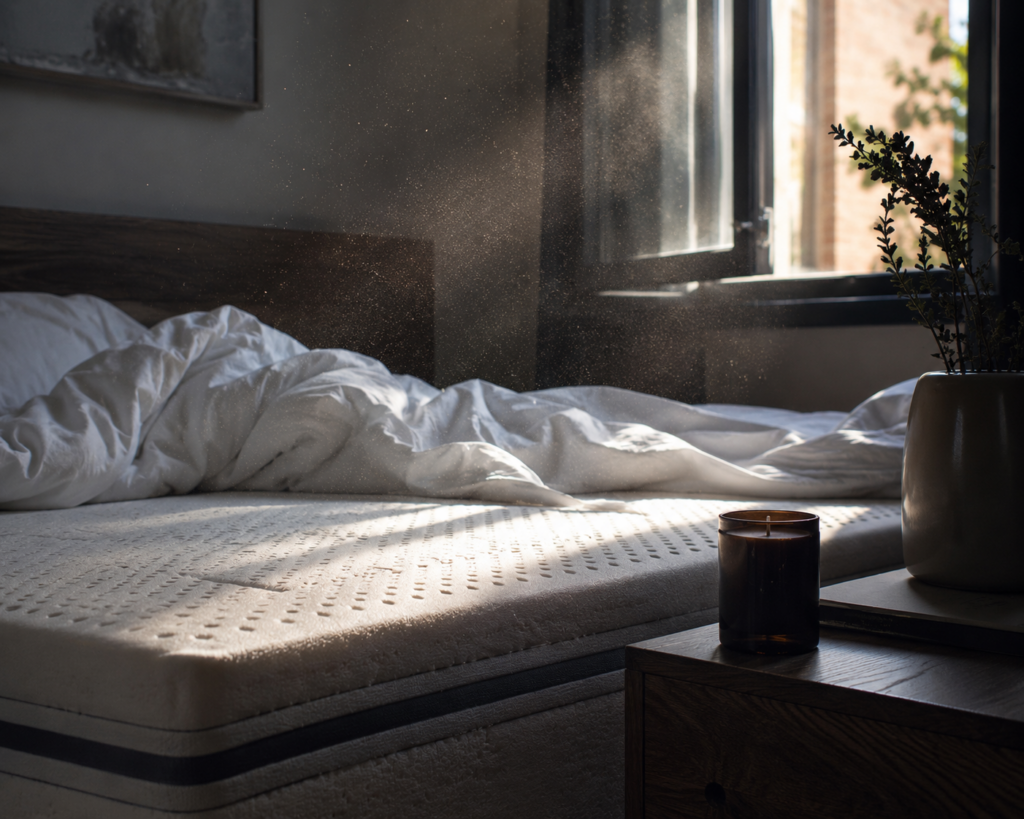
Of all the rooms in your home, the bedroom is often the one with the worst air quality — and the one where you spend the most time. Eight hours of unconscious breathing in a sealed, carpeted room with a foam mattress, synthetic bedding, and no open window is not a passive experience. Your body is working to process whatever’s in that air, all night long.
What’s Off-Gassing While You Sleep
New mattresses are notorious for VOC emissions. Polyurethane foam, in particular, off-gases compounds including formaldehyde, benzene, and toluene — though levels vary significantly by manufacturer and decline over time. Synthetic pillows and duvets can harbor dust mite colonies. Pressed-wood bed frames, bedside tables, and closets continuously release low levels of formaldehyde.
Add to this the fact that many people use synthetic air fresheners, scented candles, or plug-in fragrance diffusers in their bedrooms — products that introduce additional VOC loads including phthalates, limonene, and artificial musks — and you have a sleep environment that’s actively working against recovery.
Home Air Quality and Sleep Architecture
Poor air quality doesn’t just make breathing uncomfortable. It can subtly fragment sleep architecture itself.
Research published in the Indoor Air journal has linked elevated particulate matter and VOC exposure to reductions in slow-wave (deep) sleep and increases in nighttime awakenings. Mold exposure has been associated with elevated cortisol at night. Dust mite allergens trigger low-grade immune activation that can suppress sleep quality even without obvious allergy symptoms.
You might be getting seven hours, technically. But the quality of those hours can be significantly undermined by what you’re breathing through them.
The Role of Dust and Why It’s More Than Just Annoying
🔬 What Household Dust Actually Contains
Household dust is not simple dirt. A typical dust sample contains:
- Shed human skin cells (a primary food source for dust mites)
- Dust mite bodies and fecal matter (the actual allergen)
- Pet dander (even in homes without pets — carried in on clothing)
- Mold spores
- Pollen tracked indoors
- Synthetic fibers from textiles and carpets
- Flame retardant particles from furniture foam
- Lead particles in older homes
- Microplastics from synthetic fabrics and packaging
Dust is not passive. It circulates. Every time someone walks across a carpeted floor, sits on an upholstered sofa, or pulls open a drawer in a dusty room, particles become airborne and stay suspended for minutes to hours depending on particle size.
Dust mites specifically are one of the most common triggers of both allergic rhinitis and asthma. They thrive in bedding, carpets, and upholstered furniture at temperatures between 20–25°C and humidity above 50%. Their fecal pellets contain digestive enzymes that, when inhaled, provoke immune responses in sensitized individuals — causing classic allergy symptoms and, in the process, chronically activating the immune system in a way that drains energy and disrupts sleep.
Reducing dust accumulation isn’t just about aesthetics. It’s a legitimate health intervention.
VOCs at Home: The Invisible Chemical Load
Volatile organic compounds are chemicals that evaporate at room temperature and accumulate in indoor air. They come from an enormous range of ordinary household products and materials.
The health effects of chronic low-level VOC exposure vary by compound, but common outcomes include: eye, nose, and throat irritation; headaches; nausea; dizziness; and impaired concentration. Some VOCs — formaldehyde and benzene among them — are classified as known or probable human carcinogens by the International Agency for Research on Cancer (IARC), though household levels are generally well below those associated with disease risk.
What they do at everyday concentrations is contribute to what researchers call the «sick building syndrome» spectrum — a pattern of non-specific symptoms that improve when you leave the building and worsen when you return.
The Scented Candle Problem
This is where many people’s instincts backfire. To make a room smell «fresh,» they light candles, spray air fresheners, or plug in fragrance diffusers. These products add to the VOC load rather than improving air quality. Paraffin candles produce particulate matter, benzene, and toluene as combustion byproducts. Even soy or beeswax candles release particles.
«Natural» doesn’t mean non-reactive. Limonene — found in citrus-scented products, many of them marketed as natural or eco-friendly — reacts with ozone in indoor air to form formaldehyde and ultrafine particles. The more you try to mask stale air with fragrance, the worse the actual air quality often becomes.
Mold: The Hidden Threat Behind Your Walls
🚨 Mold Exposure Symptoms to Watch For
- Persistent cough or wheezing, especially in certain rooms
- Sinus congestion that doesn’t respond to antihistamines
- Chronic fatigue or feeling of systemic malaise
- Eye irritation and runny nose indoors only
- Musty odor that intensifies in damp areas (bathrooms, basements, behind furniture on exterior walls)
- Visible discoloration on walls, ceilings, or around window frames
- Worsening asthma or respiratory symptoms despite treatment
Mold grows wherever moisture accumulates — behind furniture placed against cold exterior walls, under bathroom tiles with failing grout, in HVAC ducts, inside wall cavities after leaks, under kitchen sinks. It doesn’t need to be visually spectacular to cause health effects. Small colonies produce spores continuously, and some species produce mycotoxins — chemical compounds with demonstrated inflammatory effects at sufficient exposure levels.
The CDC acknowledges that mold exposure can cause nasal stuffiness, throat irritation, coughing, wheezing, eye irritation, and skin irritation. For people with mold allergies or underlying respiratory conditions, effects can be considerably more pronounced. And for a subset of people — particularly those with genetic variants affecting immune clearance — mold exposure is associated with a range of systemic inflammatory symptoms that can be disabling.
The key word in identifying mold isn’t always visual. It’s olfactory. A persistent musty or earthy smell in a specific room or area is a strong indicator of active mold growth nearby, even if you can’t see it.
Air Quality and Brain Fog: A Mechanism That Makes Sense

Brain fog is a loosely defined but very real experience — that sensation of mental slowness, difficulty retrieving words, reduced ability to focus, and general cognitive grittiness that makes simple tasks feel effortful.
Poor ventilation symptoms — elevated CO2, accumulated VOCs, particulate matter — can contribute to brain fog through several mechanisms:
- CO2 accumulation reduces intracellular pH in neurons, impairing synaptic transmission efficiency
- PM2.5 exposure triggers neuroinflammatory responses; ultrafine particles can cross the blood-brain barrier
- VOCs at chronic low doses impair mitochondrial function in cells, reducing cellular energy output
- Sleep disruption from poor air quality compounds all of the above — cognitive performance declines progressively with each night of fragmented or non-restorative sleep
This is why working from home in a poorly ventilated space can feel so cognitively taxing. You’re not imagining it. The environmental inputs are real, the physiological mechanisms are real, and the solution is more straightforward than most people assume.
[https://bodyfixhub.com/small-changes-to-your-desk/]
Signs of Poor Air Quality in Your House: A Room-by-Room Audit
🏠 Room-by-Room Air Quality Checklist
Bedroom
- Is the window ever open during sleep? (Even briefly before bed?)
- Is the mattress more than 10 years old and unencased?
- Are there VOC-emitting products (air fresheners, new furniture) in the room?
- Is there carpet (primary dust reservoir)?
- Is there visible dust accumulation on surfaces?
Kitchen
- Do you use the extractor fan every time you cook?
- Is there any sign of moisture under the sink or around the dishwasher?
- Do you store cleaning products in an enclosed unventilated space?
Bathroom
- Is there an extractor fan, and do you run it after every shower?
- Is there any visible grout darkening or ceiling discoloration?
- Do products air dry properly, or does damp accumulate?
Living Room
- Is furniture placed against exterior walls without a gap?
- Are there scented candles, plug-ins, or synthetic fragrance products in use?
- When did you last vacuum upholstered furniture?
Home Office
- Is the room ventilated during long working sessions?
- Has CO2 accumulation ever been measured or considered?
- Are there multiple electronic devices generating heat and off-gassing?
How to Improve Air Quality at Home: What Actually Works

This is where most articles lose nuance. They recommend houseplants and leave it at that. Let’s be more rigorous.
1. Ventilation First — It’s Non-Negotiable
No technology replaces the effect of fresh air exchange. Opening windows for ten to fifteen minutes in the morning creates more meaningful air quality improvement than most air purifiers operating for hours in a sealed room.
Cross-ventilation — opening windows on opposite sides of the home simultaneously — creates a passive pressure differential that flushes stale air efficiently. Even in winter, briefly ventilating with cold air lowers CO2, reduces VOC concentrations, and reduces humidity, all simultaneously.
The EPA recommends that homes achieve at least 0.35 air changes per hour, meaning the total volume of indoor air is replaced with outdoor air at least every three hours. Most sealed modern homes achieve far less than this without deliberate ventilation.
2. Address Humidity — The Mold Threshold Is 60%
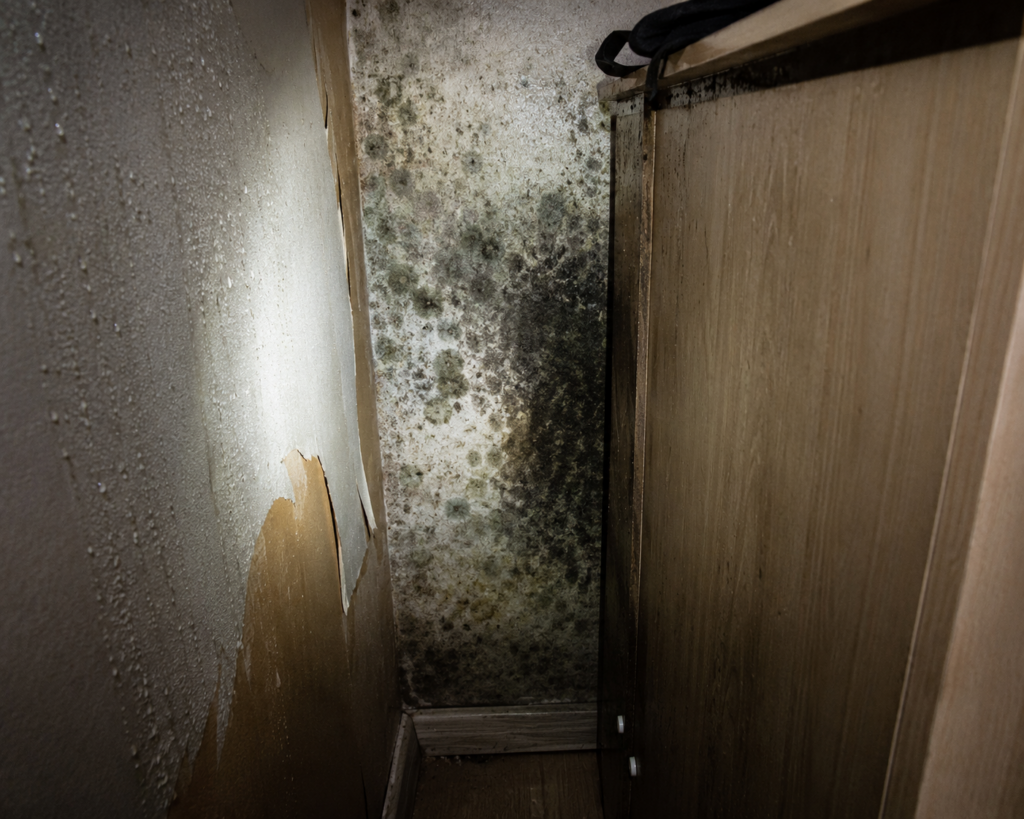
Dust mites and mold both struggle to reproduce below 50% relative humidity. Keeping indoor humidity between 40–60% is the single most effective passive control for both. In humid climates, a dehumidifier is a legitimate health investment. In dry climates (or during winter heating), a humidifier prevents the opposite problem — dry air that irritates mucous membranes and increases respiratory vulnerability.
A basic hygrometer costs very little and gives you actionable data. Put one in your bedroom.
3. Reduce Dust Systematically
Carpet is the single largest dust reservoir in most homes. If replacing it isn’t feasible, high-efficiency vacuuming (with a HEPA-filter vacuum) twice weekly significantly reduces particulate load. Washable rugs on hard floors are a much more manageable compromise.
Mattress and pillow protectors — specifically ones rated as allergen-impermeable — dramatically reduce dust mite allergen exposure during sleep. This is one of the highest-ROI interventions for anyone experiencing morning congestion, respiratory symptoms, or poor sleep quality.
Flat surfaces accumulate dust fast. Reducing clutter reduces the surface area available for dust to settle on. A minimalist bedroom is, in part, a health decision.
4. Switch to Low-VOC or No-VOC Products
The consumer market has improved considerably. Most major paint brands now offer zero-VOC or low-VOC formulations. Cleaning products made with diluted vinegar, sodium bicarbonate, castile soap, or certified low-VOC formulations perform comparably to conventional products for most household tasks.
When buying new furniture, look for GREENGUARD certification or equivalent — a third-party certification indicating the product has been tested for chemical emissions. Solid wood off-gases far less than MDF or particleboard. If buying new pressed-wood furniture is unavoidable, ventilate the room aggressively for the first few weeks while off-gassing is highest.
Replace synthetic air fresheners with genuinely improved air quality. The scent issue disappears when you fix the underlying problem.
5. Air Purifiers Benefits: What They Can and Can’t Do
A HEPA-filter air purifier genuinely reduces airborne particulate matter — dust, pollen, mold spores, pet dander, some bacteria. The evidence base for this is solid.
For VOC removal, you need an activated carbon filter in addition to HEPA. Not all «air purifiers» include activated carbon; check the specifications. And activated carbon filters have a finite capacity — they need to be replaced regularly or they can re-release what they’ve absorbed.
Air purifiers do not fix ventilation problems, but help with them. They don’t lower CO2. They don’t eliminate the source of mold or dust mites. Think of them as supplementary rather than primary interventions. Also, a good air purifier can make those problems easier to deal with.
6. Plants: Useful, But Not What You’ve Been Told
The NASA Clean Air Study is perhaps the most over-cited piece of data in wellness content. The study was conducted in sealed chambers with conditions far more extreme than any home environment. Real-world effect sizes for plant-based VOC removal are small — to replicate the chamber conditions in an average room would require hundreds of plants.
That doesn’t mean plants are useless. They improve humidity regulation modestly, support psychological wellbeing, and in aggregate contribute something — just not the atmospheric transformation often implied. Choose them for quality of life, not as a primary air quality strategy.
The Small Habits That Accumulate Into Real Change
✅ Daily Habits That Meaningfully Improve Indoor Air Quality
- Open bedroom windows for 10 minutes every morning — flushes CO2 and resets air quality before you seal the room for the day
- Run the kitchen extractor fan every time you cook — especially for gas stove cooking, which produces NO2 and particulate matter
- Use the bathroom extractor fan for 20 minutes after showering — prevents moisture accumulation that feeds mold
- Leave new furniture and carpets to off-gas in a ventilated space before use — the first 2–4 weeks have the highest VOC output
- Vacuum with a HEPA filter twice weekly — standard vacuum bags re-release fine particles
- Wash bedding at 60°C every 1–2 weeks — kills dust mites; lower temperatures don’t achieve this
- Never use scented candles or plug-ins in the bedroom — the air there is already the most compromised
- Check under sinks and behind bathroom furniture seasonally — early-stage mold is easy to address; late-stage is not
- Remove shoes at the door — dramatically reduces tracked-in particulates, pollen, and pesticides
None of these require specialist knowledge or significant expense. They require habit adjustment. The compounding effect of several small improvements is more meaningful than any single intervention.
Most People Never Notice This
Here’s the pattern that comes up again and again: people who work from home and struggle with chronic low energy, afternoon brain fog, and unrefreshing sleep spend years attributing their symptoms to work stress, screen fatigue, or some personal inadequacy — not to the environment they’re sealed inside for twelve or more hours a day.
The clue, when it emerges, is usually comparative. Someone takes a holiday and feels startlingly better within two days. Someone moves house and finds that a chronic symptom they’d accepted as normal simply disappears. Someone starts working from a co-working space three days a week and notices their afternoon energy improves significantly.
Poor air quality at home doesn’t announce itself. It normalizes itself. And once normalized, it becomes invisible. You stop noticing the stale smell. You stop noticing the morning congestion. You just feel, vaguely and persistently, worse than you should.
The intervention doesn’t have to be dramatic. It has to be consistent.
The Stress and Recovery Dimension
There’s a physiological layer to this that rarely gets discussed in air quality content. Chronic low-level pollutant exposure — dust allergens, mold spores, elevated CO2, VOCs — triggers persistent low-grade immune activation. The immune response to allergens involves the release of histamine and inflammatory cytokines. These compounds don’t stay in your nasal passages. They circulate systemically, cross the blood-brain barrier, and have documented effects on mood, energy, and resilience to psychological stress.
In short: a home with genuinely poor air quality isn’t just making you physically uncomfortable. It’s keeping your nervous system in a subtly activated, hypervigilant state that undermines recovery from the day’s demands. Sleep feels less restful. Stress feels harder to shake. Emotional regulation takes more effort.
This is not speculative. The bidirectional relationship between inflammatory load and psychological wellbeing is one of the most replicated findings in psychoneuroimmunology. Reducing environmental triggers for immune activation — including indoor air pollutants — is a legitimate and underutilized strategy for improving stress resilience and emotional baseline.
Quick-Start Improvement Plan: What to Do First
If you want to start improving indoor air quality without being overwhelmed by the full scope of the problem, prioritize in this order:
Morning and evening for 10–15 minutes.
Stop using synthetic air fresheners and scented candles.
Run kitchen and bathroom fans consistently.
Leave a small gap from exterior walls to reduce moisture buildup.
Track humidity levels in your bedroom.
Protect pillows and mattresses from dust mites.
Use low-VOC or fragrance-free detergents and cleaners.
Reduce dust and allergens more effectively.
Useful if humidity stays above 60%.
HEPA + activated carbon helps with allergies and VOCs.
Inspect behind furniture and under sinks regularly.
Use 60°C every 1–2 weeks.
Change them more often if you have pets.
Especially after painting or installing new furniture.
This isn’t about perfection. It’s about systematically reducing your body’s daily inflammatory and chemical burden so that your energy, sleep, concentration, and resilience have the conditions they need to work properly.
Poor air quality at home is a real, measurable, and largely correctable problem — and it’s contributing to the way millions of people feel on a daily basis without them ever identifying the cause.
You don’t need an expensive renovation or an elaborate wellness setup. You need to understand what’s actually in your indoor air, how it affects your physiology, and which interventions have the strongest evidence behind them.
Fresh air, reduced moisture, lower VOC load, systematic dust management, and — where needed — targeted filtration. That’s the framework. The science backs it. The changes are practical. And the effect on how you feel, sleep, and think can be considerably larger than most people expect.
Your home should be where you recover. Not where you slowly deplete.
References: U.S. Environmental Protection Agency (EPA) — Indoor Air Quality; World Health Organization — Household Air Pollution; Harvard T.H. Chan School of Public Health — Cognitive Effects of CO2; Centers for Disease Control and Prevention (CDC) — Mold; Sleep Foundation — Environmental Factors Affecting Sleep Quality; International Agency for Research on Cancer (IARC) — VOC Classifications
*Disclosure: Some of the links on this site are affiliate links. This means that if you choose to make a purchase through them, we may earn a small commission at no additional cost to you. We only recommend products or tools that are relevant to the content and that we believe can provide value. This helps support the site and allows us to continue creating useful, free content.